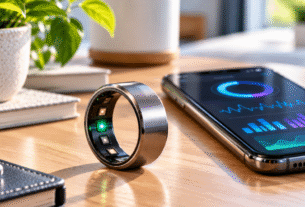
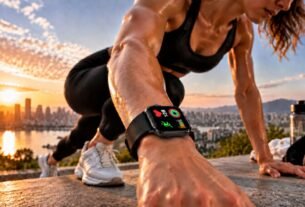
Health monitoring wearables are electronic devices that use sensors to collect information about your body, physical activity and daily routines. They can track measurements such as heart rate, sleep patterns, blood oxygen estimates and skin temperature.
By combining sensor data with software, these devices help users understand personal health trends without replacing medical testing or diagnosis.
A smartwatch can display your heart rate during a morning walk, estimate how long you slept overnight or show changes in your resting heart rate over several weeks. A fitness band can record daily movement, while a smart ring can collect sleep and temperature-related information.
However, the technology behind these measurements is more complicated than it appears. Some readings come directly from detected physical signals, while others are calculated using algorithms that combine several measurements.
This distinction matters. A device may provide a useful estimate without delivering the same accuracy as a clinical instrument. Understanding how the sensors work, what they actually measure and where their limitations begin helps consumers make better use of wearable health data.
What Are Health Monitoring Wearables?
Health monitoring wearables are electronic devices designed to collect, process and display information related to physical activity and selected physiological measurements.
Most consumer devices are worn on the wrist or finger. Some specialized systems use chest straps, adhesive patches or other body-mounted sensors.
They typically combine three elements:
- Hardware sensors: Collect physical signals such as movement, light absorption, electrical activity and temperature.
- Processing algorithms: Convert raw sensor signals into understandable measurements or estimates.
- Software applications: Display readings, store historical records and identify changes over time.
For example, a smartwatch may detect changes in blood volume near the skin using an optical sensor. Its software processes these signals to estimate heart rate and display the result in beats per minute.
The device does not simply count visible heartbeats. It analyzes changes in an optical signal and applies algorithms to interpret the pattern.
Consumer Wellness Wearables vs. Medical Monitoring Devices
One of the most important distinctions is the difference between a consumer wellness wearable and a medical monitoring device.
Consumer wearables generally focus on personal activity, fitness and wellness awareness. Medical monitoring devices may be designed for specific clinical measurements, patient monitoring or use under healthcare supervision.
| Area | Consumer Wellness Wearables | Medical Monitoring Devices |
|---|---|---|
| Main purpose | General wellness and activity awareness | Specific medical monitoring purposes |
| Typical examples | Smartwatches, fitness bands, smart rings | Medical ECG monitors, prescribed glucose monitors |
| Data interpretation | Consumer-facing estimates and trends | Device-specific clinical measurements |
| Intended use | Daily personal tracking | Defined medical applications |
| Clinical requirements | Depend on product claims and regulatory status | Depend on intended medical use and applicable regulation |
The distinction is not determined by appearance. A wrist-worn device can have a medical purpose, while another device with similar hardware may only provide general wellness information.
The FDA’s General Wellness: Policy for Low Risk Devices explains how the agency approaches certain low-risk products intended to encourage healthy lifestyles. Its guidance is particularly relevant when distinguishing general wellness functions from medical device functions.
Why Wearable Health Monitoring Is Different From Basic Fitness Tracking
Basic fitness tracking focuses primarily on physical activity.
It may count steps, estimate distance and record exercise duration. Health monitoring expands this functionality by collecting additional information about the body’s physiological responses.
For example, a fitness tracker may record how long someone walks. A more advanced wearable may also estimate heart rate during the walk, monitor resting heart rate overnight and compare activity patterns over time.
These features can work together, but they do not all measure the same thing.
To understand the broader technology behind these devices, explore our complete wearable technology guide, which covers the different types of wearables and how they are changing everyday technology.
How Health Monitoring Wearables Work
Health monitoring wearables follow a measurement process that begins with physical signals and ends with information displayed on a screen.
Understanding this process helps explain why two devices can report different values even when worn by the same person.
Step 1: Sensors Collect Physical Signals
The device first collects information using its built-in sensors.
Depending on the hardware, these signals may include:
- Changes in reflected light.
- Electrical signals associated with heart activity.
- Acceleration and movement.
- Rotational movement.
- Skin temperature.
- Geographic location.
Each sensor has a specific purpose. An accelerometer cannot directly measure heart rate, for example, and a temperature sensor cannot independently determine blood oxygen saturation.
Step 2: Software Processes the Signals
Raw sensor information is not always clean or easy to interpret.
Movement, loose contact, environmental interference and other factors can introduce unwanted signals.
The wearable’s software processes the information, identifies usable signal patterns and applies algorithms to estimate the relevant measurement.
For optical heart rate tracking, this may involve identifying repeating changes in the light signal that correspond to pulse activity.
For sleep tracking, software may combine movement and heart rate patterns to estimate when the user is asleep or awake.
Step 3: Algorithms Calculate Measurements
The processed signals are converted into numbers or classifications.
Examples include:
- Heart rate in beats per minute.
- Estimated blood oxygen saturation as a percentage.
- Step counts.
- Sleep duration.
- Heart rate variability.
- Skin temperature changes.
Some measurements are relatively direct interpretations of sensor signals. Others involve multiple inputs and more complex calculations.
Calories burned, sleep stages and readiness scores are examples where software estimates play a substantial role.
Step 4: The Device Displays and Stores Results
After processing, the device displays information through its screen or a connected smartphone application.
Some wearables also store historical measurements to create charts and trends.
Depending on the manufacturer’s system, data may be stored on the device, synchronized with a phone or transferred to cloud services.
This final stage makes it possible to compare readings across days and weeks rather than relying only on individual measurements.
Sensors Used in Health Monitoring Wearables
The sensors inside a wearable determine which measurements it can collect.
Several technologies are particularly important in modern health monitoring devices.
Photoplethysmography (PPG) Sensors
Photoplethysmography, commonly called PPG, is an optical sensing technique used in many smartwatches and fitness bands.
It works by shining light into the skin and detecting changes in the amount of light reflected or absorbed as blood volume changes.
During each heartbeat, blood volume in small blood vessels changes. These variations influence the optical signal detected by the sensor.
The device processes this repeating signal to estimate pulse rate.
Many wrist-based wearables use green LEDs for heart rate tracking because this wavelength can provide useful signals from superficial blood vessels.
PPG technology is also used in selected blood oxygen monitoring systems, although the optical configuration and algorithms differ.
Why does movement affect PPG?
The sensor needs a reasonably stable relationship with the skin to interpret changes in reflected light.
During running, cycling or strength training, wrist movement can introduce additional optical signals. These disturbances are known as motion artifacts.
If the software cannot reliably separate the pulse signal from movement interference, the displayed heart rate may become less accurate.
This explains why a wearable may perform differently while someone is sitting quietly compared with performing high-intensity exercise.
Electrocardiogram (ECG) Sensors
An electrocardiogram records electrical activity associated with the heart.
Some consumer smartwatches include electrodes that allow users to capture a single-lead ECG recording.
Unlike PPG, which detects optical changes associated with blood volume, ECG measures electrical signals.
The two technologies therefore provide different types of information.
| Characteristic | PPG | ECG |
|---|---|---|
| Measurement method | Optical light sensing | Electrical signal recording |
| Main signal | Changes associated with blood volume | Electrical activity of the heart |
| Common use | Heart rate tracking | ECG recording |
| Typical operation | Passive tracking on supported devices | Often requires a deliberate recording |
| Main limitation | Movement and optical interference | Limited recording duration and lead configuration |
A single-lead smartwatch ECG is not equivalent to a standard 12-lead clinical ECG.
It captures information from a different electrical perspective and may not identify every cardiac abnormality.
For example, Apple’s ECG app documentation explains how compatible Apple Watch models use electrical heart sensors to record an ECG. The availability and interpretation of these features depend on the device and applicable regional requirements.

Accelerometers and Gyroscopes
Movement sensors are essential to wearable activity and sleep tracking.
An accelerometer detects acceleration along different axes. It can identify movement patterns associated with walking, running and other activities.
A gyroscope measures rotational movement and helps determine changes in orientation.
Together, these sensors can help a device distinguish between different types of movement.
For example, an accelerometer may detect repeated movement patterns associated with walking, while a gyroscope provides additional information about how the wrist or device is rotating.
These sensors also contribute to activity recognition and sleep estimation.
Optical Sensors for Blood Oxygen Monitoring
Some wearables estimate peripheral blood oxygen saturation, commonly displayed as SpO2.
This measurement represents the estimated proportion of oxygen-carrying hemoglobin in arterial blood.
Optical oxygen sensors commonly use red and infrared light. Oxygenated and deoxygenated hemoglobin absorb these wavelengths differently.
By analyzing the relative optical signals, the device estimates oxygen saturation.
However, wrist-based measurements have limitations. Movement, poor skin contact, circulation and individual physiological characteristics can affect signal quality.
A wearable SpO2 estimate should not automatically be treated as equivalent to a medical pulse oximeter measurement.
Skin Temperature Sensors
Temperature sensors in wearables can detect changes in skin temperature.
Some devices collect measurements during sleep because reduced movement can provide more consistent conditions for monitoring overnight trends.
A wearable may compare the latest measurement with a personal baseline rather than presenting it as a direct internal body temperature reading.
This distinction is essential.
Skin temperature is not the same as core body temperature. The temperature at the skin surface can change with room temperature, circulation, clothing, physical activity and other environmental factors.
GPS and Environmental Sensors
GPS is not a direct health sensor, but it can provide useful context for activity monitoring.
A wearable with GPS can record movement routes, speed and estimated distance during outdoor exercise.
Some devices also use environmental sensors, such as barometers, to estimate elevation changes.
These measurements help explain the context of physical activity, although they do not independently measure physiological health.
What Can Health Monitoring Wearables Track?
The available measurements depend on the device’s hardware, software and intended functionality.
Some devices provide basic activity tracking, while others offer several physiological estimates.
Heart Rate
Heart rate is the number of heartbeats per minute.
Many wearables use PPG sensors to estimate heart rate throughout the day, during exercise and sometimes during sleep.
Common heart rate measurements include:
- Resting heart rate.
- Current or real-time heart rate.
- Exercise heart rate.
- Average heart rate during selected periods.
- Overnight heart rate.
Resting heart rate can be useful when comparing personal trends over time.
For example, someone following a regular exercise routine may notice changes in their resting heart rate across several weeks.
However, a single reading should not be used to determine whether a person is healthy or unhealthy.
Heart Rate Variability (HRV)
Heart rate variability describes variations in the time intervals between consecutive heartbeats.
It is different from average heart rate.
Two people can have the same average heart rate but different intervals between individual beats.
Some wearables estimate HRV using pulse signals collected through optical sensors. Others use electrical recordings or different measurement approaches.
This introduces an important technical distinction: pulse rate variability derived from PPG is not always interchangeable with ECG-derived HRV.
HRV can vary with sleep, stress, physical activity, illness, alcohol consumption and measurement conditions.
Many consumer applications use HRV trends to provide recovery or readiness information. These scores are algorithmic interpretations, not direct measurements of fitness or medical health.
Blood Oxygen Saturation (SpO2)
SpO2 estimates the percentage of hemoglobin carrying oxygen in the blood.
Some smartwatches and other wearables provide spot measurements or selected background monitoring functions.
The results may help users observe personal trends, but wrist-based optical measurements have limitations.
Users should also understand that feature availability can change by region.
For example, Apple’s August 2025 US Blood Oxygen update describes changes affecting certain Apple Watch models and US users.
Sleep Duration and Sleep Stages
Wearables estimate sleep using combinations of movement, heart rate and other available signals.
Their reports may include:
- Total estimated sleep time.
- Sleep onset and wake time.
- Periods of wakefulness.
- Estimated REM sleep.
- Estimated light sleep.
- Estimated deep sleep.
The distinction between sleep duration and sleep-stage classification is important.
A device may provide a reasonably useful estimate of how long someone slept while still having difficulty identifying the exact stage of sleep at a particular moment.
Consumer wearables generally do not measure brain activity in the same way as polysomnography, the standard method used in clinical sleep studies.
Skin Temperature Trends
Some wearables collect overnight skin temperature measurements and compare them with a personal baseline.
These trends can be influenced by:
- Room temperature.
- Bedding and clothing.
- Menstrual cycle-related changes.
- Physical activity.
- Illness and other physiological factors.
The measurement should be understood as a skin temperature trend rather than a direct diagnosis or fever measurement.
Activity, Steps and Energy Expenditure
Wearables use movement sensors and algorithms to estimate daily activity.
Common measurements include:
- Steps.
- Walking and running distance.
- Active minutes.
- Exercise duration.
- Estimated calories burned.
- Activity intensity.
Step counts are generally easier to understand than calorie estimates.
Calorie calculations may combine movement, heart rate, body measurements and personal profile information. However, the result remains an estimate because the device cannot directly measure total energy expenditure through ordinary wrist movement tracking.

How Accurate Are Health Monitoring Wearables?
Accuracy is not a single property shared by every feature of a wearable.
A device may estimate heart rate reasonably well under certain conditions while producing less reliable sleep-stage or calorie estimates.
The accuracy of health monitoring wearables depends on several factors:
- Sensor hardware.
- Software algorithms.
- Measurement conditions.
- Device positioning.
- User physiology.
- The specific metric being measured.
What Scientific Research Says About Wearable Accuracy
A 2024 living umbrella review published in Sports Medicine examined 24 systematic reviews covering consumer wearable accuracy.
The research included 249 non-duplicate validation studies involving 430,465 participants.
Its findings highlighted important differences across measurements:
- Heart rate measurements showed a mean bias of approximately ±3% in the reviewed evidence.
- Step-count errors varied, with reported mean percentage errors ranging from approximately -9% to +12%.
- Sleep tracking frequently overestimated total sleep time.
- Energy expenditure estimates showed substantial variation.
The authors also highlighted limited validation coverage across commercially available wearable devices.
This means that a device having a particular sensor does not automatically establish that every measurement it provides has been independently validated.
See the full systematic review of consumer wearable accuracy for the methodology and results.
What a 2026 Apple Watch Accuracy Review Found
A living systematic review and meta-analysis published in npj Digital Medicine on January 10, 2026, evaluated 82 studies examining 14 Apple Watch health metrics.
The analysis included approximately 430,052 participants.
Its findings illustrate why average measurement bias and measurement agreement should not be confused.
For heart rate, the pooled mean bias was only -0.27 beats per minute. However, the limits of agreement ranged from approximately -7.19 to +6.64 beats per minute.
For blood oxygen saturation, the average bias was also small, but the limits of agreement were wider, approximately -4.00 to +3.94 percentage points.
The review also found moderate accuracy for sleep and step counting, while energy expenditure estimates were inconsistent and frequently showed large errors.
These findings relate specifically to the Apple Watch evidence included in the review. They should not automatically be applied to every smartwatch or wearable manufacturer.
The full research is available in npj Digital Medicine’s 2026 Apple Watch accuracy review.
Why Wearable Measurements Can Be Inaccurate
Motion artifacts
Movement can interfere with optical signals, particularly during intense exercise.
Poor device positioning
A loose band or inconsistent sensor contact can reduce signal quality.
Skin and tissue characteristics
Optical measurements can be influenced by skin characteristics, tattoos, hair and other factors that affect light transmission.
Rapid physiological changes
Some algorithms may take time to follow sudden changes in heart rate or other physiological measurements.
Algorithm differences
Different manufacturers use different processing methods, filtering systems and estimation models.
Individual variation
The same device may perform differently across users because of differences in physiology and measurement conditions.
The practical lesson is to evaluate each metric independently instead of assuming that every number displayed by a smartwatch has the same level of reliability.
Types of Health Monitoring Wearables
Health monitoring technology is available in several physical formats.
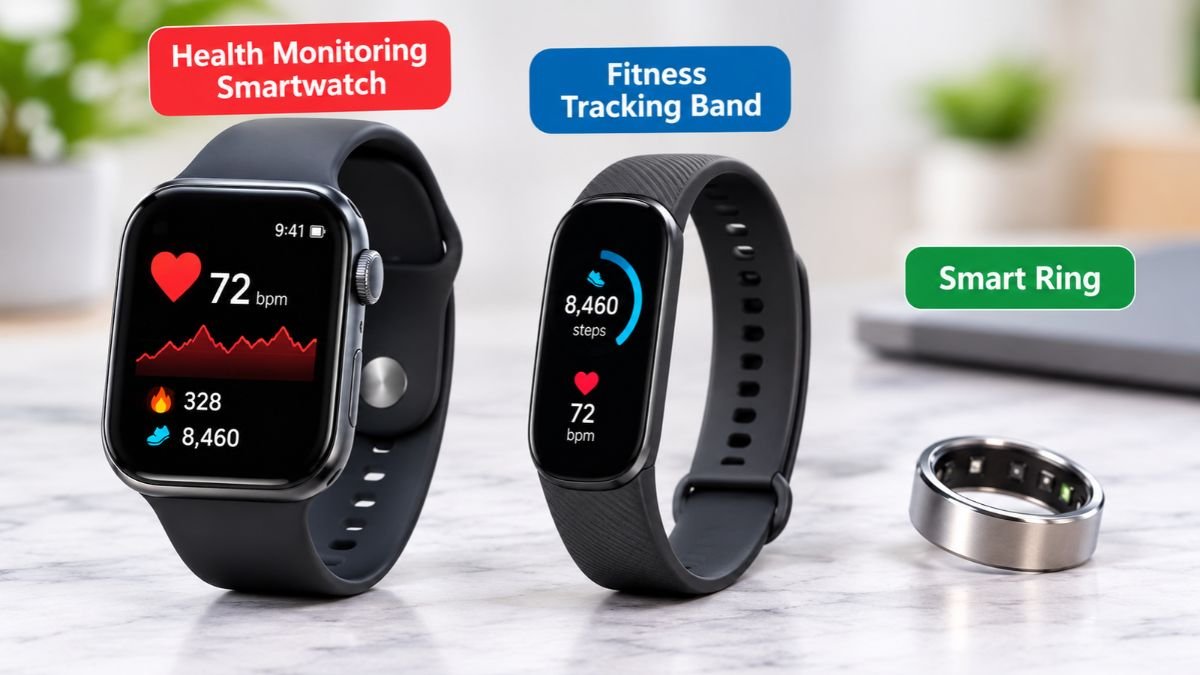
Health Monitoring Smartwatches
Smartwatches combine a touchscreen, wireless connectivity and multiple sensors.
Depending on the model, they may provide heart rate monitoring, sleep tracking, selected ECG functions, skin temperature trends and other features.
Their larger screens also make it easier to review charts and notifications.
Explore our guide to smartwatch technology for more information about their hardware and software.
To learn more about their hardware, sensors, connectivity, and software, read our detailed guide to smartwatch technology.
Health Monitoring Bands
Fitness bands generally have smaller displays and simpler designs.
They commonly focus on movement, exercise, sleep and selected biometric measurements.
Their lightweight construction can make them suitable for people who want continuous activity tracking without wearing a larger smartwatch.
See our guide to fitness trackers for more information about their tracking technology.
For a deeper explanation of activity tracking, built-in sensors, and fitness monitoring features, explore our guide to fitness trackers.
Smart Rings
Smart rings place sensors inside a compact ring-shaped device.
Depending on the model, they can collect heart rate, HRV, movement and skin temperature information.
Their small design is particularly useful for overnight tracking, although proper sizing and sensor contact remain important.
Read our explanation of smart rings and how they work.
Learn more about smart rings and how they work, including their compact sensors, tracking methods, and everyday applications.
Medical Wearable Sensors
Medical wearable sensors are designed for specific measurement or monitoring applications.
Examples include:
- Continuous glucose monitoring systems.
- Ambulatory ECG monitors.
- Medical adhesive monitoring patches.
- Specialized wearable temperature sensors.
Some systems are prescribed or used under clinical supervision.
Their intended medical purpose and regulatory requirements distinguish them from ordinary consumer wellness devices.
How to Interpret Wearable Health Data Correctly
Collecting health information is only useful when the measurements are interpreted appropriately.
A smartwatch can generate dozens of numbers every day, but not all of them deserve equal attention.
Establish a Personal Baseline
A personal baseline provides a reference for comparing measurements over time.
For example, recording resting heart rate consistently under similar conditions can help users understand their usual pattern.
A single reading may be influenced by temporary conditions, whereas repeated measurements provide more context.
Compare Similar Measurement Conditions
Measurements should ideally be compared under similar conditions.
For example, comparing resting heart rate after waking up with heart rate immediately after exercise may produce misleading conclusions.
Likewise, sleep data can be affected by differences in bedtime, device fit and overnight conditions.
Understand Estimates and Direct Measurements
Not every metric represents a direct measurement.
| Metric | What the Device Does |
|---|---|
| Heart rate | Estimates pulse rate from optical or electrical signals |
| HRV | Calculates variation between detected beat-related intervals |
| SpO2 | Estimates oxygen saturation using optical signals |
| Sleep stages | Estimates stages using available sensor data and algorithms |
| Calories burned | Calculates estimated energy expenditure |
| Step count | Identifies movement patterns associated with steps |
| Skin temperature | Records temperature at or near the skin |
Knowing this difference helps prevent users from interpreting an algorithm-generated estimate as a laboratory measurement.
Avoid Overreacting to Individual Readings
An unexpected number does not automatically indicate a health problem.
First consider whether the device was positioned correctly, whether movement interfered with the sensor or whether the measurement was taken under unusual conditions.
Persistent or concerning symptoms should not be dismissed because a wearable displays normal readings. Similarly, an unexpected wearable alert should not be treated as a confirmed diagnosis.
Review the Device’s Measurement Documentation
Manufacturers generally provide information about supported features, measurement conditions and limitations.
Read this documentation before relying on advanced measurements.
Pay particular attention to regional restrictions, supported smartphone operating systems, software requirements and the intended purpose of each health feature.
Privacy and Security in Health Monitoring Wearables
Wearables can collect highly personal information.
Depending on the product, this may include heart rate history, sleep patterns, activity records, location information and other biometric data.
The information may be stored on the device, transferred to a smartphone or synchronized with cloud services.
Before enabling these functions, users should understand how their information is handled.
Understand Where Your Data Is Stored
Some applications store information locally, while others synchronize it with manufacturer accounts or cloud platforms.
Review the application’s privacy documentation to understand the available storage and synchronization options.
Review Data-Sharing Permissions
Check whether the application shares information with connected services or third-party applications.
Only enable integrations that provide a clear benefit.
Protect Your Account
Use strong authentication where available and keep device software updated.
If a wearable application contains sensitive personal information, account security is an important part of protecting that information.
Understand Data Deletion Options
Check whether you can delete historical records, revoke permissions or disconnect third-party services.
Also understand whether deleting data from the device automatically deletes synchronized copies.
The Future of Health Monitoring Wearables
Wearable health technology is developing beyond conventional activity tracking.
New sensor designs, better signal processing and advances in artificial intelligence are creating opportunities for more detailed personal monitoring.
AI-Powered Health Monitoring
Artificial intelligence can analyze multiple measurements together rather than treating each reading independently.
For example, an algorithm may compare sleep, heart rate and activity records to identify changes relative to a person’s usual patterns.
This may make wearable information easier to interpret.
However, an AI-generated insight is only as reliable as the underlying data and the algorithm’s validation. A predicted pattern is not automatically a medical diagnosis.
Advanced Biochemical Sensors
Traditional consumer wearables primarily collect physical signals such as movement, temperature and optical changes.
Research is also exploring sensors that analyze biological substances in sweat, tears, saliva and other bodily fluids.
A 2026 review published in Biosensors and Bioelectronics: X examines advances in wearable biochemical and physical sensors, including challenges involving calibration, signal drift, sample collection and clinical validation.
Research published in ACS Omega in 2025 examines advances in flexible wearable sensors for monitoring physiological, biochemical and environmental signals. The review also discusses sensor design, measurement technologies, performance challenges and future applications.
These developments may expand the range of health-related information that wearable devices can collect, although further research and validation remain necessary. Read the research on wearable sensors for human health monitoring.
More Personalized Health Insights
Wearables may increasingly compare measurements with an individual’s historical patterns.
This could help distinguish normal daily fluctuations from more persistent changes.
However, personalization must be supported by reliable data and transparent algorithms. A device should not present uncertain predictions as established medical findings.
Greater Integration With Healthcare Systems
Wearable data may become more useful when integrated into appropriate healthcare systems.
For example, selected measurements could help healthcare professionals understand patterns between appointments.
This requires suitable data quality, interoperability, privacy protections and clinical oversight.
Conclusion
Health monitoring wearables combine optical sensors, electrical sensors, motion detection, temperature measurements and software algorithms to provide information about daily activity and selected physiological patterns.
Their value comes from making these measurements easier to collect, review and compare over time.
However, not every metric has the same accuracy. Heart rate, sleep stages, blood oxygen estimates and calorie calculations have different measurement limitations. Understanding those differences is essential before relying on the information displayed by a smartwatch, fitness band or smart ring.
As wearable technology advances, better sensors and more sophisticated algorithms may improve personal health monitoring.
For now, the most responsible approach is to use these devices to understand personal trends while recognizing that consumer health monitoring wearables do not replace medical testing or professional evaluation.
Important Notice
The information in this article is provided for educational and informational purposes only. It is not intended to replace professional medical advice, diagnosis, or treatment. Always consult a qualified healthcare professional before making decisions about your health, medical conditions, or treatment.
Consumer health monitoring wearables are not substitutes for medical-grade monitoring devices or professional medical evaluation.
Frequently Asked Questions About Health Monitoring Wearables
1. What are health monitoring wearables used for?
Health monitoring wearables collect information about physical activity and selected physiological measurements. Depending on the device, they can track heart rate, sleep patterns, blood oxygen estimates, skin temperature and movement. They help users understand personal health trends and daily habits but are not automatically substitutes for medical monitoring equipment.
2. How do health monitoring wearables measure heart rate?
Most consumer health monitoring wearables use photoplethysmography (PPG). This technology shines light into the skin and detects changes in reflected light associated with blood volume variations. Software processes the repeating signals to estimate beats per minute. Some advanced devices also use electrical sensors to record ECG signals.
3. Are health monitoring wearables accurate enough for everyday use?
Health monitoring wearables can provide useful information for personal wellness tracking, but accuracy depends on the metric, device and measurement conditions. Heart rate tracking may perform differently from sleep-stage classification or calorie estimation. Users should understand each feature’s limitations rather than treating all displayed measurements as equally reliable.
4. What is the difference between PPG and ECG in health monitoring wearables?
PPG uses optical signals to detect changes associated with blood volume, commonly estimating pulse rate. ECG records electrical activity associated with the heart. PPG is commonly used for passive heart rate tracking, while ECG functionality on selected wearables allows users to capture electrical recordings for specific heart rhythm assessments.
5. Can health monitoring wearables measure blood oxygen levels?
Some health monitoring wearables estimate blood oxygen saturation using red and infrared optical sensors. Their readings are commonly displayed as SpO2 percentages. However, wrist-based measurements can be affected by movement, sensor contact and individual characteristics. They should not automatically be considered equivalent to medical pulse oximeter measurements.
6. Can health monitoring wearables detect sleep problems?
Health monitoring wearables can estimate sleep duration, movement and selected sleep stages. These measurements may help users understand sleep habits and identify patterns. However, consumer devices generally do not measure brain activity like clinical polysomnography. They cannot independently diagnose sleep disorders.
7. Are smart rings better than health monitoring watches?
Smart rings and health monitoring watches offer different wearing experiences and sensor configurations. Smart rings are compact and can provide sleep and biometric tracking, while watches offer larger displays and broader smartwatch functionality. Neither format is automatically more accurate for every measurement. Performance depends on the specific device and feature.
8. Do health monitoring wearables store personal health information?
Many health monitoring wearables store information such as heart rate, sleep, activity and other biometric measurements. Depending on the manufacturer, data may remain on the device, synchronize with a smartphone or transfer to cloud services. Users should review privacy policies, application permissions, data-sharing settings and deletion options.
9. What is the difference between consumer and medical health monitoring wearables?
Consumer health monitoring wearables are generally designed for personal wellness and activity awareness. Medical wearables have specific intended medical purposes, such as continuous glucose monitoring or cardiac monitoring. Their regulatory status, validation requirements and clinical applications can differ. The product’s intended use matters more than its physical appearance.

I’m a Technology Editor at SmartGadgetWave with a passion for innovation, AI, and consumer technology. I enjoy exploring the latest gadgets, smart home devices, and wearable tech. My goal is to make technology easy to understand by sharing practical insights, honest perspectives, and helpful product comparisons so readers can make smarter tech decisions.