Last updated on November 2nd, 2026 at 08:05 pm
Smartwatch technology combines sensors, processors, software, displays, and wireless connectivity to deliver features beyond traditional timekeeping.
Depending on the model, a smartwatch can track physical activity, estimate heart rate, record GPS routes, display notifications, run applications, and support selected health-monitoring functions.
These capabilities depend on how the device’s hardware and software work together. Sensors collect information, processors handle calculations, and applications turn the resulting data into useful information.
Wireless connections allow the watch to communicate with smartphones, accessories, and online services.
However, not every smartwatch offers the same capabilities. Some models operate independently for selected tasks, while others rely heavily on a paired smartphone.
Measurement accuracy, battery life, compatibility, and privacy controls also vary. Understanding the technology behind these devices helps consumers distinguish useful features from marketing claims.
What Is Smartwatch Technology?
Smartwatch technology refers to the combination of electronic hardware and software that allows a wrist-worn device to perform computing, communication, and monitoring tasks.
Unlike a traditional watch, which primarily displays time, a smartwatch can process sensor readings, synchronize information, run applications, and respond to user interactions.
Depending on the model, it may support navigation, contactless payments, exercise tracking, and selected health features.
How a Smartwatch Works
Most smartwatches rely on four interconnected components. Sensors collect information: motion sensors detect movement, optical sensors estimate heart rate, and supported GPS receivers determine location.
The processor handles calculations, processes sensor readings, runs applications, and coordinates hardware. The operating system manages the interface, notifications, applications, and settings.
Connectivity exchanges data, commonly through Bluetooth, with Wi-Fi and cellular options on supported models.
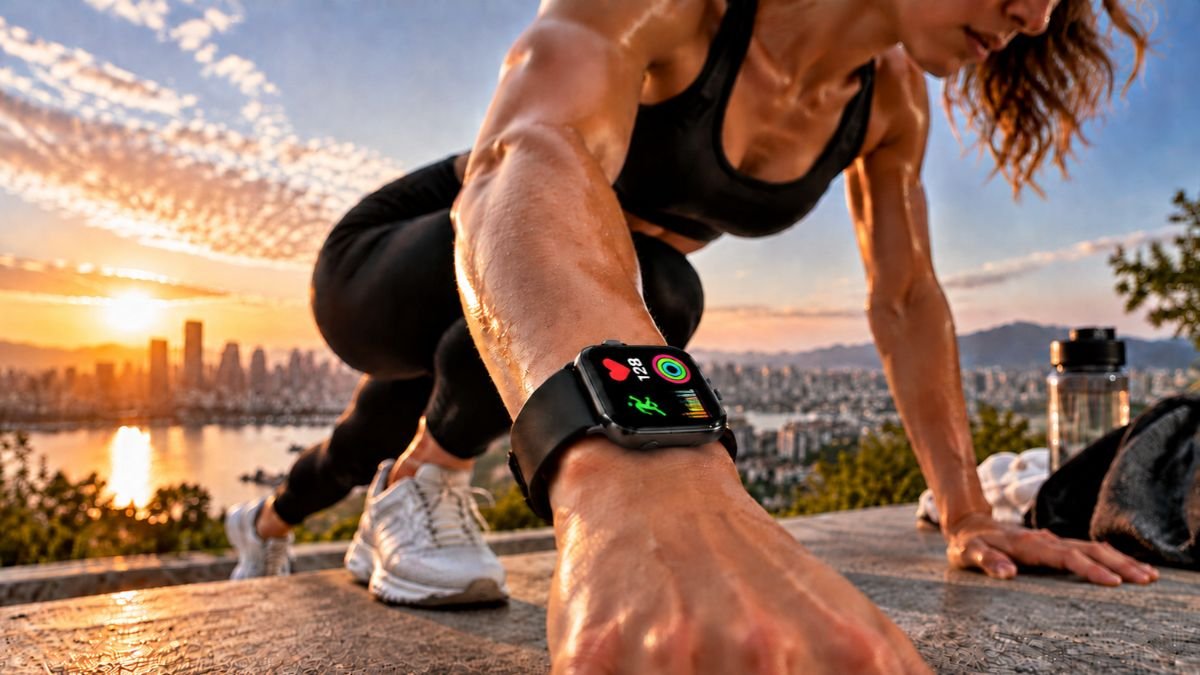
Consider someone going for a run. The watch may use GPS to record the route, motion sensors to identify movement, and an optical sensor to estimate heart rate. Software combines these inputs to calculate distance, pace, and workout duration.
These results are useful, but not all are direct measurements. Distance and pace are calculated from location data and can be affected by positioning errors.

Smartwatches vs. Fitness Trackers and Traditional Watches
Traditional watches focus on timekeeping, often with alarms, timers, or stopwatch functions. Fitness trackers emphasize activity monitoring, including steps, exercise, and selected wellness measurements.
For a closer look at how these devices work, including their sensors, features, and measurement capabilities, read our guide to fitness trackers.
Smartwatches combine connected computing with features such as notifications, applications, activity tracking, and supported payment services. Hybrid smartwatches combine traditional styling with selected connected functions.
These categories overlap. Some fitness trackers offer advanced health features, while certain smartwatches prioritize sports tracking over general-purpose applications. Smart rings offer another approach, emphasizing discreet sleep and wellness tracking without a traditional watch display.
Compare actual capabilities: which sensors are included, which functions work without a phone, and whether the software supports the services you intend to use. For a broader overview, read our complete wearable technology guide.
How Smartwatch Sensors Work
Sensors are essential because they detect movement, estimate physiological measurements, and determine location. Software processes their signals and converts them into information the wearer can understand.
A sensor does not automatically produce a perfectly accurate result: device fit, movement, environmental conditions, and algorithms can all affect measurements.
Understanding Sensor Specifications
Sensor specifications describe hardware capabilities, but they do not guarantee identical results across watches. Two devices may use similar optical sensors yet differ in sampling frequency, sensor placement, signal processing, and the algorithms used to interpret readings.
Manufacturers do not always publish enough technical detail to make direct comparisons possible. For consumers, the most useful questions are whether a feature is available on the exact model, what its intended purpose is, and which limitations the manufacturer documents.
Optical Heart Rate Sensors
Many smartwatches use photoplethysmography (PPG) to estimate heart rate. Small light-emitting diodes illuminate the wrist, while optical detectors measure changes in reflected or absorbed light.
As blood volume changes with each heartbeat, the detected signal varies. Software analyzes this pattern to estimate beats per minute.
Readings can be affected by loose straps, repetitive wrist movements, sweat, circulation, and sensor design. Wearing the watch according to the manufacturer’s fitting instructions can help maintain consistent skin contact.
Apple’s heart-rate monitoring guidance explains how fit and measurement conditions can affect readings.
Electrical Sensors and ECG
Some smartwatches include electrical sensors that can record an electrocardiogram, commonly called an ECG or EKG. Unlike optical sensors, which estimate pulse-related changes in blood flow, ECG technology records electrical signals associated with the heart’s activity.
On compatible devices, the wearer touches an electrode while the watch maintains another point of contact with the skin, recording a signal during a defined measurement period.
ECG differs from continuous optical heart-rate monitoring, and its availability varies by model, software, country, and regulatory requirements. An ECG-capable smartwatch should not be assumed to provide every function of a clinical electrocardiogram system.
Accelerometers and Gyroscopes
An accelerometer measures acceleration along one or more axes and helps identify movement patterns associated with walking, running, and other activities. A gyroscope measures rotational movement and helps the device interpret changes in orientation.
Together, these sensors support step counting, workout recognition, wrist-raise gestures, and movement analysis; some watches also use motion data for fall detection.
These functions rely on algorithms rather than direct observation of every physical action. Pushing a shopping cart may reduce natural arm movement and affect step estimates, while repetitive arm movements when seated may confuse activity-recognition systems.

GPS and Other Sensors
The Global Positioning System (GPS) allows compatible smartwatches to estimate location using signals from navigation satellites. Built-in GPS can record an outdoor route without relying on a smartphone’s GPS receiver.
Software uses successive position estimates to calculate distance and pace, but tall buildings, dense trees, tunnels, and other obstructions can affect accuracy. Some watches use connected GPS, relying on a paired phone for location information.
Other models may include temperature sensors, blood oxygen sensors, barometers, compasses, and ambient-light sensors. Wrist temperature is not equivalent to core body temperature, and blood oxygen (SpO2) readings can be affected by movement, fit, circulation, and other conditions.
Barometers can help estimate elevation changes, while ambient-light sensors can adjust screen brightness. Not every watch includes these components, and feature availability may depend on software and regional requirements.
Smartwatch Health Tracking Explained
Health tracking combines sensor readings with software analysis to help users observe activity levels, heart-rate patterns, sleep estimates, and selected physiological measurements. These features can support personal awareness, but they do not automatically provide the accuracy or clinical significance of a medical test.
Heart Rate, HRV, and Sleep
Heart rate is the number of heartbeats per minute. It can help users compare exercise intensity and notice changes in their usual patterns, but movement, temperature, stress, medication, and other factors may influence readings.
Heart rate variability (HRV) describes variations in the time intervals between successive heartbeats. Some watches estimate HRV during rest or sleep and use it in wellness or recovery summaries.
HRV is influenced by sleep, physical activity, stress, illness, and individual differences. A change should not automatically be interpreted as proof of illness or improved fitness. Measurement methods vary between manufacturers, making direct comparisons difficult.
Sleep tracking combines movement, heart rate, and other signals to estimate sleep duration and stages. These estimates can help users recognize broad patterns, but a smartwatch does not directly measure brain activity like a clinical sleep study.
Recovery scores are software-generated summaries, not direct measurements of physical readiness. Longer-term patterns are generally more useful than a single night’s score.
Smartwatches are just one category of devices used for personal health monitoring. Other wearables, including fitness trackers and smart rings, use different sensors to collect physiological information.
Explore our guide to health monitoring wearables to understand how these devices track health measurements, how their sensors work, and what their limitations are.
What Health Measurements Can and Cannot Tell You
Smartwatch health features range from general wellness tracking to functions designed for specific medical purposes.
Heart-rate readings can be affected by fit and movement; HRV depends on measurement methods and personal context; sleep stages are inferred; blood oxygen is estimated; ECG functions are limited to their intended use; and activity tracking depends on algorithms and activity type.
Some wearable features have received regulatory authorization or clearance for defined medical purposes, but that status does not automatically apply to every health-related function.
The FDA’s evaluation of smartwatch cardiovascular notifications discusses the importance of evaluating these features in real-world use. A notification may prompt further assessment, but it is not itself a diagnosis.
The FDA also warns that it has not authorized, cleared, or approved smartwatches or smart rings that measure or estimate blood glucose on their own without piercing the skin. Read the agency’s blood glucose smartwatch safety communication for details.
A watch displaying information from a separate compatible glucose-monitoring device is different from a watch claiming to measure glucose independently.
Smartwatch Connectivity and Compatibility
Connectivity determines how a smartwatch communicates with smartphones, accessories, and online services. It also influences which functions remain available when the wearer leaves the phone at home.
Bluetooth, Wi-Fi, and Cellular Connectivity
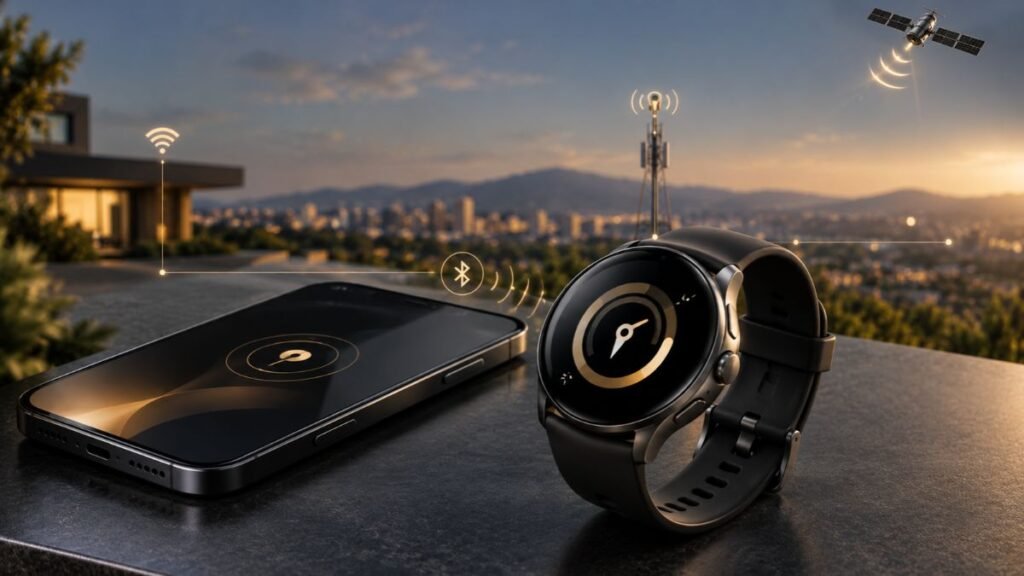
Bluetooth commonly connects a smartwatch to a nearby smartphone and compatible accessories, supporting notifications and data synchronization. Wi-Fi can provide access to supported network services when the phone is not nearby, although not every application works independently.
Cellular connectivity lets supported watches make calls, send messages, and access selected services without the phone nearby, provided the carrier, plan, and coverage support it.
Cellular use can increase power consumption. GPS is different from internet connectivity: a watch can estimate its location using satellite signals without cellular internet, while an internet-connected watch may still rely on a phone for location data.
GPS Without a Smartphone
Built-in GPS allows a compatible smartwatch to record an outdoor route without relying on a smartphone’s GPS receiver. However, satellite signal quality can be affected by tall buildings, dense trees, tunnels, and other obstructions.
Offline maps are a separate feature. A watch may record a route without a phone but still require a network connection or previously downloaded maps for navigation. Check the capabilities of your specific model before relying on it for an outdoor activity.
Built-In GPS vs. Connected GPS in Everyday Use
Built-in GPS uses a receiver inside the smartwatch to determine location, making it useful for runners, cyclists, and hikers who prefer to leave their phones behind.
Connected GPS relies on a paired smartphone for location data. It can be sufficient for people who normally carry their phones and want to avoid paying for a watch with built-in GPS.
When comparing the two, consider whether you exercise without a phone, how accurately you need to record routes, and whether you require navigation or only distance and pace tracking. Remember that GPS availability does not automatically provide cellular connectivity, messaging, or online maps.
Smartphone Compatibility and Offline Functions
Compatibility depends on the watch’s operating system, phone model, software versions, companion applications, and sometimes the manufacturer’s ecosystem. Apple Watch models are designed for compatible iPhones, while many Wear OS watches support compatible Android phones.
Some features may still be restricted by phone brand, region, or service. Google’s Wear OS support center provides information about supported devices, pairing, and troubleshooting.
Timekeeping, selected workouts, built-in GPS recording, and some health measurements may work offline. Downloaded music can play without streaming, while notifications, messaging, synchronization, and online services may require a phone or network.
Evaluate each function separately rather than assuming that any one connection type makes a watch fully independent.
Smartwatch Displays, Processors and Software
Display Technology and Always-On Screens
Many smartwatches use OLED or AMOLED displays, which can provide deep blacks, strong contrast, and vivid colors. LCD displays use a separate backlight and have different characteristics.
Brightness affects outdoor readability, resolution influences text sharpness, and screen size determines how much information can be displayed comfortably.
An always-on display keeps selected information visible when the wearer is not actively interacting with the watch. The device may dim the screen or simplify displayed information to conserve energy.
This feature makes it easier to check the time or workout metrics, but generally uses more power than turning the display off.
Processors, Operating Systems, Apps, and Payments
The processor performs calculations and coordinates hardware operations. Memory supports active tasks, while storage retains applications, settings, and supported offline content. The operating system manages these resources and determines how users interact with the watch.
Software updates may improve stability and address security vulnerabilities, although support varies by manufacturer and model.
Applications can provide navigation, calendars, reminders, music controls, exercise tools, and communication features. Because a watch has a smaller screen and fewer input options than a smartphone, it is best suited to short interactions.
Some watches support voice assistants, while compatible models use near-field communication (NFC) for contactless payments. Payment availability depends on the device, service, card issuer, region, and merchant terminal.
Smartwatch Battery Technology
Battery performance affects how conveniently a smartwatch can be used. GPS, bright displays, health sensors, and cellular connectivity provide useful functions but consume energy.
Battery life depends on capacity, processor efficiency, display settings, sensor activity, wireless connections, and software optimization.
Why Battery Life Varies and How to Improve It
Keeping a bright screen or always-on display active, recording GPS routes, using cellular data, running frequent health measurements, and receiving many notifications can increase energy use.
The impact varies by model, so advertised battery life should be considered alongside the functions you expect to use.
To conserve energy, lower screen brightness, disable the always-on display if unnecessary, limit nonessential notifications, and review battery-usage information.
Use GPS and cellular features when needed, and follow the manufacturer’s guidance. Google’s Wear OS battery guidance offers additional advice. Battery-saving modes may restrict some features.
Charging and Battery Aging
Smartwatches commonly use magnetic charging cables, dedicated docks, or manufacturer-specific accessories. Similar-looking chargers are not necessarily interchangeable, so check compatibility before using a replacement. Most smartwatches use rechargeable lithium-ion batteries, which gradually lose capacity through aging and repeated use. Avoid excessive heat, use compatible charging equipment, and follow the manufacturer’s instructions.
Wireless charging technology varies across devices, and smartwatch charging methods are not universally interchangeable. For a broader explanation, read our guide to wireless charging technology.
Smartwatch Durability and Everyday Use
A smartwatch is designed to be worn throughout the day, including during exercise, commuting, and sleep. Its durability depends on the construction of the case, display, seals, buttons, and strap. Choosing a device involves balancing protection, comfort, and the functions needed for everyday use.
Water Resistance, Materials, and Fit
Water resistance describes a device’s ability to withstand exposure under specified conditions. A watch designed for splashes may not be suitable for swimming, and a swimming-compatible model may not be suitable for diving or high-pressure water.
Water resistance can deteriorate through wear, impacts, and aging; follow the manufacturer’s instructions for the exact model.
Cases may use aluminum, stainless steel, titanium, or reinforced polymers. Display materials, including strengthened glass and sapphire crystal, differ in scratch resistance, impact behavior, and weight, but none is completely immune to damage.
Fit matters too: optical sensors generally work best with stable skin contact, while an excessively tight band can cause discomfort.
Can a Smartwatch Replace a Smartphone?
A smartwatch can handle selected tasks such as calls, messages, GPS workouts, music controls, navigation prompts, and contactless payments. Cellular connectivity can provide greater independence, but watches have smaller displays, limited input methods, and battery constraints.
Some apps require a paired phone or internet access. Smartwatches are especially useful for quick interactions, while complex tasks are generally easier on a phone or computer.
A Practical Checklist Before Choosing a Smartwatch
Start with your routine rather than the longest feature list. If you mainly want notifications and basic activity records, reliable phone compatibility, comfort, and battery life may matter more than cellular service.
Runners may prioritize built-in GPS and workout controls; frequent travelers may value offline content and broad network support. People interested in health features should verify the exact measurements available in their region and understand their intended use.
Finally, consider charging frequency, replacement straps, software support, and privacy settings. This checklist helps connect technical specifications to everyday needs.
Smartwatch Privacy and Data Security
Smartwatches can collect information about activity, location, sleep patterns, and selected health measurements. Depending on the device and application, data may be stored on the watch, transferred to a phone, synchronized with a cloud service, or shared with connected applications.
Review the manufacturer’s privacy policy and the permissions requested by individual apps.
Practical Ways to Protect Personal Data
Review app permissions and allow access to location, contacts, and health information only when appropriate.
Secure associated accounts with strong passwords and multifactor authentication where supported. Install software updates, check data-sharing settings, and learn how to locate, lock, unpair, or erase a lost watch.
Before selling or giving away a device, follow the manufacturer’s instructions for removing personal information and disconnecting accounts.
The Future of Smartwatch Technology
Smartwatch technology may continue to advance through improvements in sensors, processing efficiency, connectivity, and software analysis.
More context-aware summaries could combine activity, sleep estimates, and heart-rate patterns, but combining measurements does not automatically produce medically reliable conclusions. Data quality and validation remain important.
Low-power processors, displays, sensors, and improved software may help devices perform more tasks without proportionally increasing energy consumption. Better offline functions and connectivity may also make some activities more convenient.
As watches collect detailed information about everyday behavior, clear permissions, secure updates, understandable data policies, and meaningful user control will remain essential.
Conclusion: Understanding Smartwatch Technology
Smartwatch technology combines sensors, processors, software, displays, and wireless connectivity to deliver functions beyond traditional timekeeping.
These components enable compatible devices to track activity, estimate selected health measurements, record GPS routes, run applications, and communicate with other devices.
Their usefulness depends on more than advertised features. Sensor limitations, smartphone compatibility, battery performance, durability, software support, and privacy controls all influence the everyday experience.
Consumers can make better decisions by understanding what each feature does, identifying which capabilities suit their routine, and recognizing the difference between a direct measurement and a software-generated estimate.
For a broader overview of connected wearable devices, read our complete wearable technology guide.
Health notice: This article is for general educational purposes and does not replace professional medical advice, diagnosis, or treatment.
Smartwatch measurements can be inaccurate or limited by device design and usage conditions.
Frequently Asked Questions
What is smartwatch technology?
Smartwatch technology combines sensors, processing hardware, software, displays, and connectivity to provide functions beyond traditional timekeeping. Depending on the model, these may include activity tracking, notifications, GPS, applications, and selected health measurements.
How does smartwatch technology measure heart rate?
Many smartwatches use optical sensors to detect changes associated with blood flow beneath the skin. Software analyzes these signals to estimate heart rate. Movement, fit, and measurement conditions can affect accuracy.
Does a smartwatch require a smartphone?
Not always. Compatible watches can display the time, record selected activities, and use built-in GPS without a phone nearby. Notifications, application synchronization, and some online services may require a paired phone or an active network connection.
Can smartwatches track sleep accurately?
Smartwatches estimate sleep duration and patterns using movement, heart rate, and other available signals. These estimates can help users recognize general trends, but sleep-stage classifications are not equivalent to clinical sleep studies.
How can I extend smartwatch battery life?
Reducing screen brightness, disabling the always-on display, limiting unnecessary notifications, and reviewing background applications can help conserve energy. Actual battery life depends on the device and how its features are used.
Can a smartwatch diagnose medical conditions?
Some smartwatches offer features designed for specific medical purposes, but many measurements are intended for general wellness. A notification or reading does not automatically establish a diagnosis. Follow the device’s intended-use guidance and seek appropriate medical evaluation when necessary.

I’m a Technology Editor at SmartGadgetWave with a passion for innovation, AI, and consumer technology. I enjoy exploring the latest gadgets, smart home devices, and wearable tech. My goal is to make technology easy to understand by sharing practical insights, honest perspectives, and helpful product comparisons so readers can make smarter tech decisions.