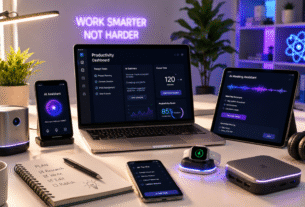
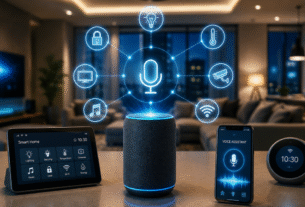
AI gadgets are consumer electronic devices that use artificial intelligence to interpret information, recognize patterns, make predictions, or generate responses.
They include smart speakers, AI wearables, connected cameras, home robots, and intelligent assistants. Their capabilities depend on specialized software, sensors, processors, and AI models working together.
Artificial intelligence is changing what people expect from everyday electronics. Smartphones can process complex requests, smartwatches can identify patterns in activity data, and connected cameras can distinguish between different types of movement.
These capabilities represent a shift from devices that simply execute predefined commands to systems that can interpret information and respond according to context.
However, the growing use of AI in consumer technology also creates confusion. Manufacturers frequently describe products as intelligent, automated, or AI-powered, even though these terms do not always refer to the same capabilities.
Readers interested in exploring specific devices can also discover some of the best AI gadgets available for different everyday applications.
Understanding the technology behind AI gadgets helps consumers distinguish genuine artificial intelligence from conventional automation. It also makes it easier to evaluate practical functionality, hardware requirements, privacy implications, and long-term usefulness.
The adoption of AI is no longer limited to technology enthusiasts. According to a Pew Research Center survey published in June 2026, 49% of US adults reported having used AI chatbots.
The same survey found that 35% of US adults had a smart speaker with AI features. These findings illustrate how artificial intelligence is becoming increasingly familiar to American consumers.
What Are AI Gadgets?
AI gadgets are electronic devices that incorporate artificial intelligence into their functionality to perform tasks involving perception, interpretation, prediction, classification, or content generation.
Unlike conventional electronics that depend entirely on fixed instructions, AI-enabled devices can process information using trained computational models.
The exact implementation varies considerably. Some gadgets use relatively simple machine learning models to recognize movement or classify objects, while others rely on advanced language models to understand questions and generate conversational responses.
For example, an ordinary digital clock displays the time and follows programmed alarms. An AI-enabled assistant may interpret a natural-language request, identify the intended reminder, and organize it according to the user’s instructions.
The important distinction is not whether a device has an internet connection, touchscreen, or mobile application. It is whether artificial intelligence performs a meaningful part of the device’s operation.
How AI Gadgets Differ From Traditional Electronic Devices
The difference becomes easier to understand when comparing how traditional and AI-powered devices handle information. While conventional electronics typically follow predefined rules, AI-enabled devices can analyze incoming data, recognize patterns, and produce outputs based on their trained models.
Consider the difference between a conventional security camera and an AI-enabled camera.
A basic camera records video and stores the footage. It may also detect movement using a simple sensor.
An AI-enabled camera can use computer vision to analyze captured images, recognize selected objects, distinguish certain types of activity, and generate more specific notifications.
| Characteristic | Traditional Electronic Device | AI-Powered Gadget |
|---|---|---|
| Main operation | Programmed instructions | AI model processing and programmed logic |
| Input processing | Basic signals or commands | May interpret complex data |
| Pattern recognition | Usually limited | Can identify patterns using trained models |
| Personalization | Often manually configured | May adapt to user preferences |
| Predictions | Generally predefined | Can estimate outcomes from available data |
| Content generation | Usually fixed outputs | May generate text, images, audio, or responses |
| Examples | Basic digital clock, conventional timer | AI assistant, object-recognition camera |
This comparison does not mean every AI gadget operates independently or continuously learns from its owner.
Some AI systems use fixed, previously trained models. They perform inference, meaning they apply what the model has learned to new information without necessarily changing the model itself.
This distinction is important because consumers sometimes assume that an AI-powered product automatically becomes smarter every time it is used.
That is not necessarily how the technology works.
AI Gadgets vs. Smart Gadgets: Are They the Same?
The terms smart gadget and AI gadget are related, but they are not interchangeable.
A smart gadget generally refers to an electronic device with connected features, automation, remote controls, or communication capabilities.
An AI gadget uses artificial intelligence to perform one or more functions.
A device can therefore be smart without being AI-powered.
For example, a Wi-Fi-enabled light bulb that follows a scheduled routine is a smart device. It can connect to an application and respond to commands, but its operation may depend entirely on predefined rules.
An intelligent lighting system that analyzes occupancy patterns and uses predictive models to adjust its behavior introduces an AI component.
The same distinction applies to other consumer electronics:
- A conventional thermostat follows a temperature setting.
- An automated thermostat may follow a schedule.
- An AI-enabled climate system may analyze usage patterns and make predictions to optimize supported settings.
Key takeaway: Connectivity allows devices to communicate, automation allows them to execute predefined actions, and artificial intelligence allows them to interpret information using computational models.
Why the Difference Matters to Consumers
Understanding this distinction helps consumers evaluate technology more realistically.
A product advertised as AI-powered may offer useful capabilities, but the label alone does not explain how the system works.
Consumers should look at the actual features:
- Does the device recognize objects or simply detect movement?
- Can it understand natural language or only respond to specific commands?
- Does it make predictions based on data?
- Does it process information locally or through cloud services?
- Does it adapt its behavior, or does it follow fixed automation rules?
These questions reveal more about a device’s capabilities than broad marketing descriptions.
Core AI Technologies Behind Consumer Gadgets
AI gadgets do not rely on a single technology.
Most combine several computational methods to collect information, analyze it, interpret user input, and produce useful outputs.
Understanding these underlying technologies is essential because different AI applications require different capabilities.
Machine Learning: How Devices Recognize Patterns
Machine learning is a branch of artificial intelligence that enables computer systems to identify patterns in data and use those patterns to make predictions or classifications.
Instead of requiring programmers to define every possible situation manually, developers train machine learning models using relevant examples.
After training, the model can process new information and produce an output based on the patterns it has learned.
For example, a wearable device may use movement data to classify physical activities.
The model analyzes signals collected through sensors and estimates whether the user is walking, running, or performing another recognized activity.
Similarly, an AI-enabled camera may analyze image data to identify objects within its field of view.
Machine learning is useful in consumer gadgets because it allows devices to handle situations that would be difficult to manage using simple fixed instructions.
Its accuracy depends on factors such as training data, model design, sensor quality, and operating conditions.
Deep Learning: Processing More Complex Information
Deep learning is a specialized area of machine learning that uses artificial neural networks with multiple computational layers.
These networks can identify increasingly complex patterns in large datasets.
Deep learning is particularly important for applications involving images, audio, speech, and natural language.
For example, a smart camera may use a deep learning model to recognize objects in an image. A voice assistant may use neural networks to interpret spoken language and identify the user’s request.
Deep learning models can contain millions or billions of parameters, depending on their architecture and purpose. Their computational requirements vary considerably.
This explains why some AI functions run efficiently on smartphones and other compact devices, while more demanding tasks require cloud-based processing.
Generative AI and Large Language Models
Generative artificial intelligence refers to systems capable of producing new content based on patterns learned during training.
Unlike traditional classification models that identify or categorize information, generative models can create outputs such as:
- Written responses.
- Summaries.
- Images.
- Audio.
- Computer-generated speech.
- Other forms of digital content.
Large language models, commonly known as LLMs, are an important category of generative AI.
They process language and generate responses based on the input they receive.
In consumer gadgets, generative AI can support conversational assistants, writing tools, intelligent search features, and voice-based interactions.
However, generative AI can produce inaccurate information. Its outputs should not automatically be treated as verified facts.
Computer Vision: Helping Devices Interpret Images
Computer vision is an AI field focused on enabling machines to extract useful information from images and video.
It allows systems to detect, classify, track, and sometimes interpret visual objects.
Common applications include:
- Object recognition in smart cameras.
- Obstacle detection in robot vacuums.
- Visual assistance in smart glasses.
- Image analysis on smartphones.
- Facial recognition in supported devices.
- Visual search applications.
Consider a robot vacuum operating in a home.
Its camera and sensors collect information about nearby objects. Computer vision models can analyze visual data to identify certain obstacles and help the robot navigate its surroundings.
Lighting conditions, camera positioning, object appearance, and environmental complexity can affect recognition accuracy.
Natural Language Processing: Understanding Human Communication
Natural Language Processing (NLP) is an area of artificial intelligence concerned with how computers process and interpret human language.
It supports many technologies that allow people to communicate with electronic devices using spoken or written words.
Examples include:
- Voice assistants.
- Speech-to-text applications.
- Automatic translation.
- Conversational interfaces.
- Text classification.
- Language-based search.
A voice-enabled gadget may combine speech recognition, language processing, and text-to-speech technology.
First, the device captures spoken input. A speech recognition system converts the audio into text. Language processing helps interpret the request, and the system generates an appropriate response.
Some modern conversational systems use large language models to handle more flexible requests.
Hardware Behind AI Gadgets: The Technology That Makes AI Possible
Artificial intelligence requires more than software. Consumer gadgets need physical components capable of collecting information, processing data, running AI models, and communicating with users.
The hardware architecture determines which AI functions a device can support, how quickly it responds, how much energy it consumes, and whether it can operate independently of an internet connection.
Central Processing Units (CPUs)
The CPU is the general-purpose processor responsible for executing instructions and coordinating many operations within an electronic device.
It manages operating system processes, applications, background services, and interactions between hardware components.
In AI gadgets, CPUs can execute certain machine learning operations, manage data before it reaches specialized processors, and coordinate application workflows.
Graphics Processing Units (GPUs)
GPUs were originally developed to handle graphics calculations, but their parallel processing architecture also makes them useful for artificial intelligence.
Many AI models require large numbers of mathematical operations to process information. GPUs can perform many of these operations simultaneously.
In consumer technology, GPUs may support image recognition, generative AI applications, image enhancement, and other parallel computing workloads.
Neural Processing Units (NPUs)
An NPU is a specialized processor designed to accelerate artificial intelligence workloads, particularly operations commonly used by neural networks.
NPUs are becoming increasingly important in smartphones, laptops, tablets, and other consumer electronics because they can execute supported AI workloads efficiently.
For example, an AI-enabled laptop may use an NPU to handle background effects during video calls, supported speech processing, or other local AI features.
Microsoft’s Copilot+ PC documentation explains how compatible Windows computers use dedicated NPUs to accelerate supported on-device AI workloads. The 40 TOPS requirement applies specifically to the Copilot+ PC category and is not a universal requirement for every AI gadget.
An NPU does not automatically make a device intelligent. It provides hardware acceleration for compatible AI operations.

How CPUs, GPUs, and NPUs Work Together
Modern AI gadgets may distribute workloads across different processors instead of relying on a single component.
| Component | Main Function | AI-Related Role |
|---|---|---|
| CPU | General-purpose computing | Coordinates applications and processes |
| GPU | Parallel processing and graphics | Supports image processing and AI calculations |
| NPU | Specialized AI acceleration | Runs supported neural network operations |
| RAM | Temporary data storage | Holds model data and active computations |
| Storage | Long-term data storage | Stores applications and model files |
| Sensors | Collect environmental or user input | Provide information for AI processing |
The exact division of work varies by device and software implementation.
Sensors: How AI Gadgets Understand Their Environment
Processors perform calculations, but they need information to analyze.
This information often comes from sensors built into consumer electronics.
| Sensor Type | Information Collected | Consumer Applications |
|---|---|---|
| Camera sensor | Images and video | Smart cameras, smartphones |
| Microphone | Sound and speech | Voice assistants, earbuds |
| Accelerometer | Acceleration and movement | Smartwatches, fitness trackers |
| Gyroscope | Rotational movement | Wearables, smartphones |
| GPS receiver | Location information | Smartphones, wearables |
| Temperature sensor | Temperature readings | Smart thermostats |
| Proximity sensor | Nearby object presence | Smartphones |
| Optical heart-rate sensor | Changes in blood volume detected through light | Smartwatches |
The quality of sensor information can significantly affect AI performance.
An image recognition model may be capable of identifying objects, but poor camera resolution, insufficient lighting, or obstructed lenses can reduce accuracy.
Memory and Storage Requirements
AI models need memory and storage to operate.
RAM temporarily holds information that the processor needs while applications are running. Storage preserves operating system files, applications, user data, and sometimes AI model files.
Larger AI models generally require more memory, although the exact requirements depend on model architecture, quantization, and implementation.
Quantization reduces the numerical precision used to represent model parameters. It can lower memory requirements and improve processing efficiency, although it may also affect model accuracy.
AI Model Training vs. AI Inference
One of the most important concepts in artificial intelligence is the difference between model training and model inference.
Model training is the process of developing an AI model by exposing it to data and adjusting its internal parameters.
Model inference happens when the trained model processes new information and generates an output.
Most consumer AI gadgets primarily perform inference rather than training large AI models from scratch.
What Is AI Model Training?
AI model training involves using datasets and computational algorithms to develop a model capable of performing a particular task.
During training, the system processes examples and adjusts its parameters to improve performance according to a defined objective.
For example, developers creating an image recognition model may train it using large collections of labeled images.
Training can require substantial computing resources, especially for large deep learning models. It may involve specialized GPUs, large memory systems, and distributed computing infrastructure.
What Is AI Inference?
AI inference is the process of applying a trained model to new information.
When a consumer asks a voice assistant a question, an AI model processes the input and generates an output.
Other examples include:
- A smartwatch classifying physical activity.
- A camera recognizing a selected object.
- A smartphone generating an image description.
- A smart speaker interpreting a voice command.
- A translation device converting spoken language.
Training vs. Inference: Key Differences
| Characteristic | Model Training | Model Inference |
|---|---|---|
| Main purpose | Develop or improve a model | Use an existing model |
| Data | Training datasets | New input information |
| Computing requirements | Often substantial | Vary from low to very high |
| Typical location | Data centers or development systems | Devices or cloud servers |
| Consumer example | Developing a speech recognition model | A speaker recognizing a command |
| Frequency | During model development and updates | Whenever the feature is used |
The distinction affects how consumer devices are designed. A compact wearable may run a relatively small model locally while relying on cloud infrastructure for more demanding tasks.
Edge AI: Processing Intelligence Closer to the User
Edge AI refers to artificial intelligence processing performed on or near the device where data is collected, rather than sending every operation to a centralized cloud server.
For example, an AI security camera may analyze video footage directly on its internal processor to identify movement or recognize selected objects.
Edge AI can operate directly on a consumer device or through nearby computing infrastructure, such as a local smart home hub or network gateway. The defining characteristic is that AI processing takes place close to where the data is generated rather than depending entirely on centralized cloud servers.
This distinction is important because Edge AI and on-device AI are related but not identical. On-device AI specifically refers to processing performed on the device itself, while Edge AI can also include nearby computing systems that handle data from multiple connected devices.
Edge Computing vs. Edge AI
Edge computing is a broader architecture in which data is processed closer to where it is generated.
Edge AI specifically involves running artificial intelligence workloads within that edge environment.
A smart home hub may process information from connected sensors locally. If it uses machine learning to identify activity patterns, it combines edge computing with edge AI.
Hardware Limitations and TOPS
AI gadgets face physical and technical limitations involving memory, processing capacity, battery power, and thermal management.
TOPS stands for trillions of operations per second. It is a performance measurement commonly used to describe the theoretical processing capability of AI accelerators.
However, TOPS alone does not determine how well a device performs in real-world AI applications.
Memory bandwidth, model size, software optimization, processor architecture, and thermal limits also matter.
Major Categories of AI Gadgets and How They Work
Artificial intelligence is being integrated into wearable electronics, home automation systems, audio equipment, cameras, translation devices, and personal robots.
Each category uses AI differently.
AI Smartphones and Computers
Smartphones and computers are among the most versatile platforms for consumer artificial intelligence.
Modern AI-enabled smartphones can support:
- Intelligent photo editing.
- Voice recognition and transcription.
- Language translation.
- Conversational AI assistants.
- Text summarization.
- Image recognition and visual search.
- Personalized software features.
For example, a smartphone camera may use machine learning to recognize a scene and adjust image processing accordingly.
Google’s Gemini Nano documentation explains how lightweight generative AI models can run directly on supported Android devices, enabling selected AI features through on-device processing without relying entirely on cloud-based services.
Apple Intelligence demonstrates how generative AI and personal intelligence features are being integrated into supported consumer devices.
AI Smart Home Devices
AI smart home devices use artificial intelligence to interpret information from connected household equipment and respond to selected conditions.
Common examples include:
- AI-enabled smart speakers.
- Intelligent thermostats.
- Smart security cameras.
- Robot vacuums.
- Connected lighting systems.
- Smart home hubs.
An AI-enabled climate system may use occupancy patterns and historical usage to adjust supported settings.
Not every automated smart home system uses AI. Some rely entirely on predefined rules, timers, and sensor triggers.

For a more focused discussion, see our guide to AI gadgets for smart homes.
AI Wearables and Smart Rings
Wearable devices place sensors and computing capabilities directly on the user’s body.
Smartwatches, fitness trackers, and smart rings can collect movement, activity, and selected physiological information.
AI models may analyze this information to identify patterns, classify activities, and generate personalized insights.
Smart rings have particularly strict hardware limitations because they must fit into a small physical form. They may collect information locally but rely on a paired smartphone or cloud service for more demanding analysis.
Sensor measurements should not be confused with medical diagnoses. A wearable’s AI-generated interpretation does not automatically make it a diagnostic medical system.
Explore our complete wearable technology guide for additional information about smartwatches, fitness trackers, and other connected devices.
AI Smart Glasses
AI smart glasses combine wearable computing with cameras, microphones, speakers, and intelligent software.
Depending on the model, features can include:
- Voice-controlled AI assistants.
- Image recognition.
- Object identification.
- Language translation.
- Audio playback.
- Hands-free communication.
- Contextual information.
A user may look at an object and ask a supported AI assistant to identify it or provide additional information.
The device may capture an image, process it using a computer vision model, and return a spoken response.
Smart glasses also introduce privacy considerations because cameras and microphones may capture information involving people nearby.
Our guide to AI smart glasses explores their technology, features, and everyday applications in more detail.
AI Earbuds and Intelligent Headphones
Wireless earbuds and headphones can incorporate AI-powered features that improve communication, process speech, adapt sound settings, and support hands-free interaction.
Some capabilities include:
- Adaptive noise cancellation.
- AI-assisted microphone processing.
- Background noise reduction.
- Voice recognition.
- Speech translation.
- Personalized audio adjustments.
Not every noise cancellation system uses AI. Some rely on conventional signal processing, while others combine both approaches.
For example, Apple’s Live Translation with AirPods combines compatible AirPods, an Apple Intelligence-enabled iPhone, and the Translate application to support translated conversations. Availability depends on supported hardware, software, and languages.
AI translation earbuds are communication aids, not guaranteed replacements for qualified human interpreters.
AI Security Cameras and Intelligent Monitoring Devices
Security cameras are increasingly incorporating computer vision and machine learning to analyze video footage.
AI-enabled cameras may identify people, recognize selected objects, detect vehicles, or classify certain activities.
A conventional motion detection system may trigger an alert whenever movement occurs. An AI-enabled camera may distinguish between selected types of objects and generate more specific notifications.
However, recognition is not infallible. Poor lighting, unusual camera angles, visual obstructions, and environmental conditions can affect detection accuracy.
Consumers should also consider whether video is stored locally or uploaded to remote servers.
AI Translation Devices and Language Assistants
AI translation devices combine microphones, speech recognition, natural language processing, translation models, and audio output to convert spoken communication into another language.
A typical translation workflow involves:
- Capturing spoken language.
- Converting audio into text.
- Interpreting the input.
- Generating translated content.
- Producing text or spoken audio.
Some systems use integrated speech-to-speech models.
Translation quality depends on language coverage, accent recognition, background noise, model quality, and connectivity.
Our guide to AI translator devices provides a more detailed explanation of translation technology, supported features, and practical applications.
AI Note-Taking and Productivity Devices
AI productivity gadgets help users capture, organize, and process information.
Examples include AI voice recorders, transcription systems, smart note-taking devices, and intelligent document assistants.
Dedicated AI productivity gadgets can also help users organize information, manage tasks, and simplify everyday workflows.
An AI recorder may capture audio, convert speech into text, and use a language model to organize the transcript into summaries or action items.
These systems can reduce the time spent reviewing long recordings.
However, generated summaries may omit important context or misinterpret statements. Users should verify critical information against the original recording.
Explore our guide to AI note-taking devices to learn more about intelligent recording, transcription, and automated note organization.
AI Home Robots and Autonomous Consumer Devices
AI home robots combine mechanical components, sensors, navigation systems, and intelligent software to perform tasks within physical environments.
Consumer applications include robot vacuums, robotic lawn mowers, educational robots, and selected home assistant robots.
Explore our guide to AI home robots to understand how intelligent robotic devices support household tasks.
A robot vacuum may combine LiDAR, computer vision, motion sensors, and navigation algorithms to map rooms, identify obstacles, and determine cleaning routes.
For example, Xiaomi’s robot vacuum product documentation describes AI vision and 3D obstacle recognition.
AI recognition and autonomous navigation are related but different capabilities. A robot can navigate using mapping and distance sensors without necessarily using advanced AI object recognition.
Personal AI Assistants and Companion Devices
Personal AI assistants can interpret flexible requests and generate responses using language models.
They may appear as smartphone applications, smart speakers, desktop software, wearable interfaces, or dedicated physical devices.
For a closer look at conversational technologies and their everyday applications, explore our guide to AI voice assistants.
Capabilities can include conversational interaction, information retrieval, task organization, language assistance, and contextual recommendations.
Some assistants support multimodal inputs, allowing them to process text, images, and audio.
However, conversational responses should not be confused with human understanding, emotions, or genuine relationships. These systems generate outputs through computational models and can produce inaccurate statements.
How AI Gadgets Are Used in Everyday Life
Artificial intelligence becomes most useful when it solves practical problems rather than simply adding more technology to a device.
In everyday consumer environments, AI gadgets can help people manage household activities, communicate across languages, organize information, access digital content, and interact with electronic devices more naturally.
AI in Home Automation and Energy Management
In everyday home environments, AI-powered automation can help coordinate household activities, improve energy management, and reduce repetitive manual adjustments.
Instead of focusing only on individual devices, these applications show how connected systems can use information from multiple sources to support everyday routines.
Common applications include:
- Temperature adjustment based on occupancy patterns.
- Intelligent lighting controls.
- Energy consumption analysis.
- Smart appliance scheduling.
- Predictive maintenance alerts.
- Voice-controlled home automation.
A connected energy monitoring system may analyze electricity usage across different periods and identify patterns associated with higher consumption.
However, identifying consumption patterns does not automatically guarantee lower energy bills. Actual savings depend on household behavior, equipment efficiency, electricity rates, and other conditions.
AI for Communication and Accessibility
AI is making consumer technology more accessible through speech recognition, computer vision, text-to-speech systems, and real-time transcription.
Applications include:
- Real-time captions.
- Speech-to-text communication.
- Text-to-speech functionality.
- AI-generated image descriptions.
- Voice-controlled navigation.
- Language translation.
Apple’s accessibility features include tools such as VoiceOver, image recognition, spoken content, and visual descriptions that help users interact with supported devices. Feature availability depends on the device, software, language, and region.
AI for Entertainment and Digital Content
Entertainment platforms use artificial intelligence to understand user preferences, organize content, and improve digital experiences.
Common applications include personalized recommendations, automatic image enhancement, AI-assisted photo editing, intelligent audio processing, and content discovery.
Recommendation systems analyze viewing history, search activity, ratings, and interaction patterns to estimate which content may be relevant to a user.
These systems can make large content libraries easier to navigate, but they reflect platform algorithms and optimization goals rather than objective rankings.
AI in Gaming Technology
Artificial intelligence has several applications in gaming, including non-player character behavior, adaptive difficulty, graphics enhancement, and procedural content generation.
One established example is NVIDIA’s DLSS technology, which uses AI to support graphics reconstruction and performance optimization in compatible games.
The availability and performance of these features depend on GPU hardware, game implementation, drivers, and settings.
AI for Personal Productivity
AI gadgets can help consumers organize tasks, manage information, and reduce repetitive work.
Examples include meeting transcription, research organization, document summarization, language translation, and voice-controlled assistants.
These features can save time, but accuracy and privacy remain important considerations.
Users should review generated summaries and understand recording permissions before capturing conversations.
On-Device AI vs. Cloud-Based AI
One of the most important decisions in AI gadget design is where artificial intelligence processing takes place.
Some devices execute AI models directly on their internal hardware. Others send information to remote servers where more powerful computing infrastructure processes the request.
How On-Device AI Works
On-device AI processes information directly on the consumer device.
A smartphone, laptop, smartwatch, or smart home camera may contain a processor capable of running selected machine learning models without sending every input to an external server.
Potential advantages include reduced dependence on internet connectivity, faster responses for supported tasks, and reduced external data transmission.
However, local AI is limited by available memory, processing capacity, battery power, and thermal management.
How Cloud-Based AI Works
Cloud-based AI uses remote computing infrastructure to process information.
The device sends the relevant input to a remote service. The cloud infrastructure processes the request and returns the result.
This approach allows consumer gadgets to access computational resources that would be difficult to include in compact hardware.
However, cloud-based features generally depend on connectivity and introduce additional data-handling considerations.

On-Device AI vs. Cloud AI: Comparison
| Evaluation Factor | On-Device AI | Cloud-Based AI |
|---|---|---|
| Processing location | Local hardware | Remote servers |
| Internet requirement | Not always required | Generally required |
| Response time | Often faster for supported tasks | Depends on network and server |
| Model size | Limited by device resources | Can support larger models |
| Data transmission | Can reduce external transfers | Requires transmitting relevant inputs |
| Offline functionality | Possible | Usually unavailable |
| Updates | May require software or model updates | Models can be updated centrally |
| Typical applications | Local transcription and image recognition | Advanced chatbots and complex generation |
Actual performance varies by implementation.
Hybrid AI: Combining Local and Cloud Processing
Many modern consumer AI systems use a hybrid architecture.
A smartphone may handle basic voice recognition locally but send a complex conversational request to a remote model.
A connected camera may identify basic movement on the device while using a cloud service for additional analysis.
Google’s Gemini Nano documentation explains how supported Android devices can run AI models locally through on-device processing.
This architecture provides flexibility because manufacturers do not have to depend entirely on one processing environment.
Why Processing Architecture Matters When Choosing AI Gadgets
Consumers should understand where a device processes information before relying on its AI capabilities.
Before using an AI gadget, check:
- Which features work without internet access.
- Whether the device uploads audio, images, or other information.
- Whether local processing is available.
- Whether cloud AI requires a subscription.
- Whether software updates are provided.
- What happens if the cloud service becomes unavailable.
AI Gadget Compatibility, Connectivity and Ecosystem Integration
AI gadgets rarely operate in isolation.
Many depend on smartphones, wireless networks, cloud platforms, operating systems, and third-party applications to deliver their full functionality.
Smartphone and Operating System Compatibility
Some AI gadgets require a compatible smartphone to configure settings, install updates, or access advanced features.
Consumers should verify supported operating system versions, application availability, hardware requirements, regional availability, and account registration requirements.
A device may physically connect to a smartphone while still lacking access to certain AI functions because of software restrictions.
Wi-Fi, Bluetooth and Internet Connectivity
Different wireless technologies serve different purposes within consumer AI ecosystems.
Wi-Fi provides network connectivity and is commonly used by smart speakers, connected cameras, and home hubs.
Bluetooth supports short-range communication between devices, including smartphones, earbuds, smartwatches, and accessories.
Cellular connectivity allows selected gadgets to access mobile networks without relying on nearby Wi-Fi.
The required connection depends on the gadget’s design and supported features.
Smart Home Ecosystem Compatibility
Smart home devices often depend on platforms that allow products from different manufacturers to communicate.
Matter is an industry standard designed to improve interoperability between compatible smart home devices.
The Connectivity Standards Alliance explains how Matter provides a common connectivity standard designed to improve interoperability between compatible smart home products.
However, Matter compatibility does not guarantee that every AI feature will work across all platforms.
Software Updates and Long-Term Compatibility
AI gadgets depend heavily on software.
Manufacturers may release updates to improve performance, fix bugs, strengthen security, or introduce additional AI capabilities.
Before relying on an AI gadget, consumers should understand update availability, security support, subscription requirements, and whether essential features continue working if a manufacturer’s cloud service is discontinued.
Privacy, Security and Consumer Risks of AI Gadgets
AI gadgets can collect, process, and exchange significant amounts of information. Depending on their functionality, they may have access to voice recordings, images, location information, activity patterns, personal preferences, and other sensitive data.
A smart speaker may process voice commands, a wearable may collect movement information, and an AI security camera may analyze video footage from inside or outside a home.
Although these capabilities can improve convenience, they also increase the importance of understanding how personal information is handled.
Privacy and security should therefore be considered part of the overall functionality of an AI gadget.
What Personal Information Can AI Gadgets Collect?
The information collected depends on the device category and its intended functionality.
Common data categories include:
- Voice information: Audio captured by microphones and voice assistants.
- Visual information: Photographs and video captured by cameras.
- Location information: GPS coordinates and location-related data.
- Activity information: Movement patterns and selected wearable measurements.
- Usage information: Application interactions, preferences, and device activity.
- Environmental information: Temperature, occupancy, and other sensor readings.
- Communication information: Messages, transcriptions, and selected conversational data.
Not every AI gadget collects all these categories.
Consumers should distinguish between information collected by the physical device, information processed by its applications, and information transmitted to external cloud services.
How AI Gadgets Process and Store Personal Data
Some information is processed directly on the device. Other information may be transmitted to a smartphone application, home hub, or remote server.
Storage locations also vary.
A security camera may store recordings on a local memory card, a home network device, or a cloud platform.
A voice assistant may process certain commands locally while using remote services for more advanced requests.
Consumers should investigate:
- Whether audio and video are stored locally or remotely.
- How long collected information is retained.
- Whether recordings can be deleted.
- Whether data is shared with third parties.
- Whether information is used to improve AI models.
- Whether users can disable selected data collection features.
On-Device AI and Data Privacy
On-device processing can reduce the amount of personal information transmitted to external servers.
When an AI model runs locally, the device may process selected information without sending the original input to a cloud service.
This can reduce exposure associated with external data transmission.
However, local processing does not automatically guarantee complete privacy.
Applications may still transmit other information, synchronize data with online accounts, or use connected services.
Privacy also depends on operating system permissions, encryption, account security, application behavior, and manufacturer policies.
Security Risks in Connected AI Devices
AI gadgets are often connected to wireless networks, smartphones, online accounts, and cloud platforms.
These connections can introduce potential security weaknesses.
Common risks include:
- Weak or reused passwords.
- Outdated device firmware.
- Unnecessary application permissions.
- Insecure wireless configurations.
- Unauthorized account access.
- Vulnerabilities in connected applications.
- Poorly managed third-party integrations.
The NIST Cybersecurity Framework provides guidance for managing cybersecurity risks through activities such as identifying, protecting, detecting, responding, and recovering.
Practical Ways to Improve AI Gadget Security
Consumers can take several steps to reduce common security risks.
- Use strong and unique passwords: Avoid reusing the same password across connected devices and online accounts.
- Enable multifactor authentication: Use additional verification when the manufacturer supports it.
- Install software updates: Keep device firmware, applications, and operating systems current.
- Review application permissions: Restrict unnecessary access to microphones, cameras, location, and contacts.
- Check privacy settings: Understand how recordings, images, and other information are stored and shared.
- Secure home networks: Use modern wireless security settings and change default router credentials.
- Remove unused integrations: Disconnect applications and services that are no longer necessary.
These practices cannot eliminate every security risk, but they help establish a more secure environment for connected consumer electronics.
Limitations of AI Gadgets: What Consumers Should Understand
Artificial intelligence can make electronic devices more capable, but it does not remove the limitations of hardware, software, data, or computational models.
Consumers sometimes expect AI gadgets to understand every request, recognize every object, or operate independently under all conditions.
In reality, these systems work within defined technical boundaries.
AI Can Produce Incorrect Information
Generative AI systems can produce responses that sound convincing but contain incorrect information.
This happens because language models generate outputs based on learned statistical patterns rather than guaranteeing that every statement is factually verified.
For example, an AI assistant may provide an inaccurate explanation of a technical problem or generate an incorrect summary of a recorded conversation.
Users should verify important information using reliable sources rather than assuming that an AI response is automatically correct.
AI Recognition Is Not Always Accurate
Computer vision and speech recognition systems can also make mistakes.
An AI camera may misclassify an object, while a voice assistant may misunderstand a command.
Factors affecting accuracy include:
- Poor lighting conditions.
- Background noise.
- Unusual camera angles.
- Incomplete or unclear input.
- Accent and language variations.
- Environmental interference.
- Limitations in model training data.
A device that performs well under controlled conditions may produce different results in a complex real-world environment.
AI Gadgets May Depend on Cloud Services
Dependence on external services can affect how reliably an AI gadget works over time. Internet outages, server interruptions, subscription changes, or discontinued platforms may limit features that consumers regularly use.
This creates an important ownership consideration: a device may continue functioning as basic hardware even when some of its advertised AI capabilities become unavailable.
Consumers should therefore consider service availability, subscription conditions, and offline functionality before choosing a cloud-dependent product.
AI Features Can Increase Battery Consumption
Running AI models requires computing resources.
Features such as continuous voice recognition, image analysis, and background processing can increase energy consumption.
This is particularly relevant to smartphones, smart glasses, wireless earbuds, and wearable devices.
Specialized processors can improve energy efficiency, but hardware limitations remain.
AI Marketing Does Not Always Reflect Technical Capabilities
Manufacturers may use terms such as intelligent, adaptive, AI-powered, and next-generation to promote consumer electronics. However, these descriptions do not always explain which artificial intelligence technologies are actually included or how they contribute to the product’s functionality.
Some advertised features may rely on conventional automation, while others use machine learning or generative AI. Consumers should therefore distinguish between promotional claims and documented technical capabilities before deciding whether a product offers meaningful AI functionality.
How to Evaluate AI Gadgets Without Falling for Marketing Claims
Understanding AI technology allows consumers to evaluate products using practical criteria instead of relying exclusively on promotional descriptions.
An AI gadget should provide a clear benefit, perform its intended functions reliably, and fit into the user’s existing technology environment.
Identify the Actual AI Function
Start by identifying exactly what artificial intelligence does within the product.
A device may include several AI features, but not every feature necessarily uses machine learning.
For example, a smart speaker may use voice recognition and natural language processing for conversational interactions while using conventional programming for timers and alarms.
Examine Hardware and Processing Requirements
The device’s processor, memory, sensors, and battery capacity influence its AI capabilities.
A gadget that relies on local processing may require a more capable processor and sufficient memory.
A cloud-dependent product may have lower local hardware requirements but introduce additional connectivity and service dependencies.
Check Whether Important Features Require Subscriptions
Some AI gadgets provide basic functionality without additional payments but restrict advanced features to paid plans.
Consumers should understand:
- Which features are included.
- Which features require subscriptions.
- Whether cloud services are optional.
- What happens when a subscription expires.
- Whether essential functions continue working.
Evaluate Privacy and Data Handling
Consumers should review privacy documentation and determine whether data is stored locally, transmitted to external servers, or shared with third parties.
Products involving microphones, cameras, location services, and biometric sensors deserve particular attention.
Consider Long-Term Software Support
Manufacturers may introduce new features, improve existing models, or change cloud services.
Consumers should consider expected update availability, security support, application compatibility, and the manufacturer’s approach to discontinued services.
Evaluate Practical Usefulness
The most important question is whether the AI feature solves a real problem.
For example:
- Does AI transcription reduce the time needed to organize meeting notes?
- Does intelligent object recognition make a camera’s notifications more useful?
- Does a wearable provide understandable activity insights?
- Does a voice assistant make everyday device control easier?
- Does a smart home system reduce repetitive manual tasks?
A useful AI gadget is not necessarily the device with the largest model or the most advanced processor. It is the device that performs a relevant task reliably, efficiently, and with acceptable privacy and compatibility requirements.
The Future of AI Gadgets and Consumer Technology
Artificial intelligence is likely to become increasingly integrated into consumer electronics as processors become more efficient, AI models become more capable, and connected ecosystems continue to develop.
The next stage of consumer AI will not necessarily involve creating entirely new categories of gadgets. Much of the development will happen inside devices people already use, including smartphones, computers, wearables, home appliances, and entertainment systems.
Smaller and More Efficient AI Models
One important direction is the development of smaller AI models that can perform useful tasks with fewer computing resources.
Large AI models can provide advanced capabilities, but their computational requirements may make them unsuitable for small consumer devices.
Smaller models can be optimized for specific applications, such as speech recognition, object detection, text processing, and activity classification.
Techniques such as quantization, pruning, and knowledge distillation can reduce model size and processing requirements.
This may allow more AI functionality to run directly on smartphones, wearables, and home electronics.
More Powerful On-Device AI
As mobile processors and NPUs improve, consumer devices may become capable of executing increasingly complex AI operations locally.
This could reduce dependence on cloud services for supported tasks.
However, on-device AI will still be limited by memory, processing capacity, energy consumption, and model size.
Cloud computing will remain relevant for tasks requiring substantial computational resources.
Multimodal AI in Everyday Devices
Multimodal AI refers to systems capable of processing multiple types of information, such as text, images, audio, and video.
For example, a smart glasses system may combine visual information from a camera with spoken questions from a user.
A smartphone assistant could interpret a photograph, understand a written instruction, and generate a response using both inputs.
The potential benefit is more natural interaction between people and electronic devices.
However, multimodal systems also introduce additional privacy considerations because they may process several types of personal information simultaneously.
More Advanced AI Wearables
Wearable devices are likely to incorporate additional AI capabilities as sensors, processors, and battery technology improve.
Potential developments include:
- More accurate activity recognition.
- Improved speech processing.
- Context-aware notifications.
- More advanced language translation.
- Personalized digital assistance.
- Better integration with smartphones and computers.
The challenge will be balancing functionality with comfort, battery life, processing efficiency, and data protection.
AI Agents and More Autonomous Consumer Devices
AI agents are designed to perform sequences of tasks toward a defined objective.
Depending on their capabilities and permissions, they may retrieve information, organize data, interact with supported applications, and complete selected workflows.
In consumer electronics, this could lead to more capable digital assistants that coordinate multiple connected devices and applications.
However, agentic AI introduces additional risks. Systems that can take actions on behalf of users require appropriate permissions, clear confirmation mechanisms, and safeguards against unintended operations.
Greater Interoperability Between AI Gadgets
As consumers use more connected electronics, compatibility between different manufacturers and platforms will become increasingly important.
Standards such as Matter are intended to improve interoperability in smart home environments.
Future developments may also make it easier for AI services to coordinate supported functions across different devices.
However, interoperability does not automatically mean that every manufacturer will expose its proprietary AI capabilities to competing platforms.
Greater Attention to Privacy and Responsible AI
As AI becomes part of more personal devices, privacy and responsible data handling will become increasingly important.
Consumers will expect clearer information about how gadgets collect information, process requests, store data, and share it with external services.
The NIST AI Risk Management Framework provides guidance for managing risks associated with the design, development, deployment, and use of artificial intelligence systems.
The future of AI gadgets will depend not only on more powerful models but also on whether consumers can use these devices confidently and understand their limitations.
Conclusion: Understanding the Real Value of AI Gadgets
The real value of an AI gadget depends on how effectively it combines artificial intelligence with useful hardware and software. A device may offer advanced processing capabilities, but those features only matter when they deliver reliable results and address practical user needs.
Choosing the right technology requires looking beyond the presence of an AI label. Consumers should understand how a device processes information, what resources it requires, how it handles personal data, and whether its essential features will remain available over time.
Understanding these devices requires looking beyond marketing terminology. Their actual capabilities depend on machine learning models, processors, sensors, software, connectivity, and the way information is processed.
On-device AI and cloud computing also play different roles, each offering advantages and limitations related to performance, privacy, connectivity, and hardware requirements.
For consumers, the most useful approach is to evaluate AI gadgets according to their practical functionality, reliability, compatibility, privacy controls, and long-term software support.
Artificial intelligence will continue to influence how people interact with electronic devices. However, the most valuable developments will be those that solve genuine problems rather than simply adding AI features for promotional purposes.
As consumer AI technology evolves, understanding how it works will help people make better decisions and recognize which innovations genuinely improve everyday life.
Frequently Asked Questions About AI Gadgets
What are AI gadgets?
AI gadgets are electronic devices that use artificial intelligence to recognize patterns, interpret information, make predictions, or generate responses. Examples include AI-powered smartphones, smart speakers, wearable devices, security cameras, translation gadgets, and home robots.
How do AI gadgets work?
AI gadgets collect information through sensors, microphones, cameras, and other input components. Artificial intelligence models process this information to identify patterns, recognize objects, understand speech, or generate responses. Processing can happen directly on the device or through cloud-based computing services.
What is the difference between AI gadgets and smart gadgets?
Smart gadgets generally offer connectivity, remote controls, and automated functions. AI gadgets use artificial intelligence to perform tasks such as pattern recognition, prediction, language processing, and intelligent classification. A connected light bulb that follows a schedule is a smart gadget, while a system that uses predictive models to adjust lighting based on occupancy patterns incorporates AI.
Can AI gadgets work without an internet connection?
Yes. Some AI gadgets can operate without an internet connection, depending on their hardware and software. Basic functions and selected AI features may remain available offline, while cloud-based services, remote processing, and online integrations generally require connectivity. Offline capabilities vary by device and manufacturer.
What are the most common types of AI gadgets?
Common categories include AI smartphones, computers, smart speakers, wearable devices, smart glasses, intelligent earbuds, security cameras, translation devices, productivity gadgets, and home robots. Each category uses different AI technologies to support functions such as voice recognition, object detection, activity analysis, language translation, and automated navigation.
Are AI gadgets safe for personal use?
AI gadgets can be used responsibly, but consumers should understand their data collection and security practices. Devices with cameras, microphones, location services, and biometric sensors may process personal information. Reviewing privacy policies, limiting application permissions, installing software updates, and securing connected accounts can help reduce common risks.
What should I consider before buying an AI gadget?
Consider the device’s actual AI capabilities, processing requirements, compatibility, battery life, privacy settings, and software support. Check whether important features require an internet connection or subscription. It is also useful to understand which functions operate locally and which depend on external cloud services.
What is on-device AI?
On-device AI is an approach in which artificial intelligence models execute directly on a device’s internal hardware instead of depending entirely on remote cloud servers. Smartphones, laptops, and compatible wearable devices can use this architecture to process selected tasks locally. Its performance depends on available processing power, memory, and software optimization.
What is the difference between AI training and AI inference?
AI training is the process of developing a model by exposing it to data and adjusting its internal parameters. AI inference occurs when the trained model processes new information and generates an output. Most consumer AI gadgets primarily perform inference rather than training large AI models from scratch.
Will AI gadgets replace traditional consumer electronics?
AI gadgets are more likely to expand the capabilities of traditional electronics than completely replace them. Smartphones, computers, cameras, and home appliances will continue to serve their existing purposes while incorporating additional AI features. The extent of this integration will depend on consumer demand, hardware development, software compatibility, and practical usefulness.

I’m a Technology Editor at SmartGadgetWave with a passion for innovation, AI, and consumer technology. I enjoy exploring the latest gadgets, smart home devices, and wearable tech. My goal is to make technology easy to understand by sharing practical insights, honest perspectives, and helpful product comparisons so readers can make smarter tech decisions.