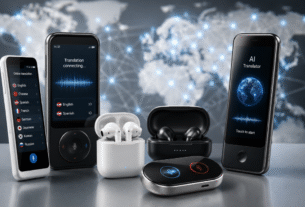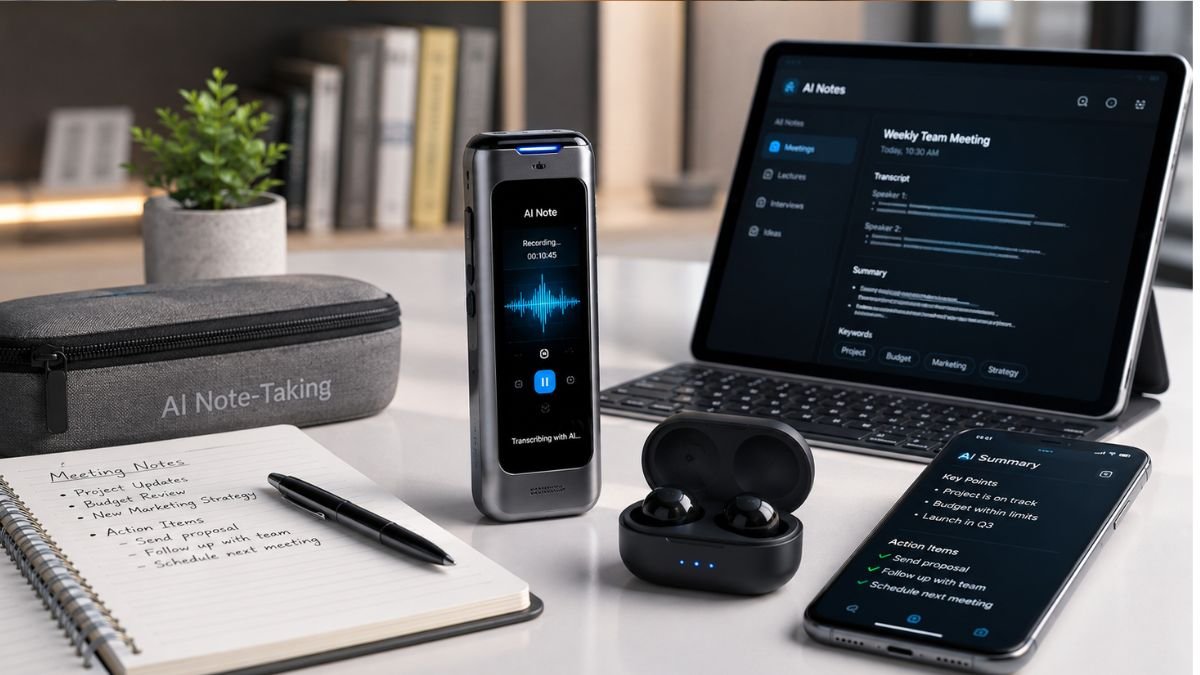
AI note taking devices are smart tools that use artificial intelligence to capture, transcribe, organize, summarize, and retrieve information automatically.
For students, professionals, and researchers, these devices can significantly reduce manual note-taking while improving productivity and information retention. Whether they are worth the investment depends on how often you attend meetings, lectures, or information-heavy events.
Taking notes has always been one of the most important parts of learning and productivity. Whether you’re sitting in a university lecture, participating in a business meeting, or conducting research, capturing information accurately can make a major difference in how effectively you learn and work.
The challenge is that traditional note-taking often forces people to split their attention between listening and writing.
According to research published by MIT Technology Review, advancements in artificial intelligence are transforming how people interact with information, making automation increasingly valuable in educational and professional environments.
This shift has led to the rise of AI note-taking devices, which can record conversations, transcribe speech, generate summaries, organize notes, and even identify action items automatically.
For many users, these capabilities offer significant time savings and improved productivity. But are these devices genuinely useful, or are they simply another tech trend?
The answer depends on how you work, study, and manage information. Understanding both the advantages and limitations of AI note-taking technology is essential before deciding whether it deserves a place in your workflow.
What Are AI Note-Taking Devices?
AI note-taking devices are smart hardware tools designed to capture spoken information and convert it into organized, searchable digital notes using artificial intelligence.
Unlike traditional digital recorders, modern devices can:
- Transcribe conversations automatically
- Identify speakers
- Generate summaries
- Highlight key points
- Create searchable archives
- Suggest action items
Many devices also integrate with cloud platforms, productivity software, and collaboration tools.
AI note-taking devices combine recording technology and artificial intelligence to transform spoken conversations into structured, searchable notes with minimal manual effort.
Why AI Note-Taking Devices Are Becoming Popular
The popularity of AI note-taking devices is growing because modern work and education generate enormous amounts of information.
Information Overload
Students and professionals are constantly processing:
- Meetings
- Lectures
- Training sessions
- Interviews
- Brainstorming discussions
Manually documenting everything can be difficult and inefficient.
Hybrid Work Environments
According to data from Gallup Workplace Research, hybrid work continues to be widely adopted across many industries. As remote collaboration increases, demand for accurate meeting documentation has grown significantly.
Productivity Demands
Organizations increasingly prioritize efficiency. AI-powered note-taking tools help users focus on conversations instead of worrying about recording every detail.
How AI Note-Taking Devices Work
Most devices follow a similar process.
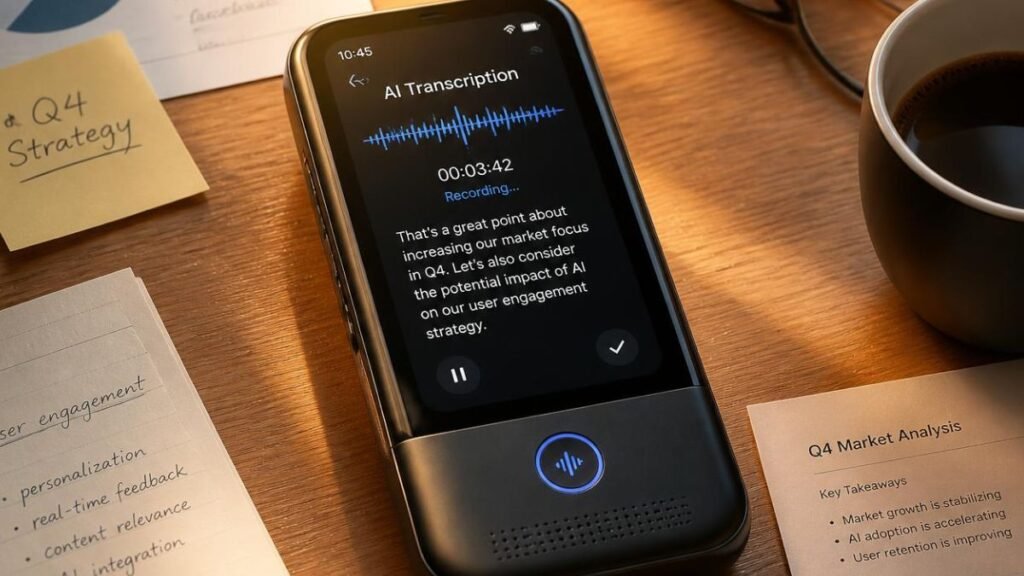
Step 1: Audio Capture
The device records spoken conversations using built-in microphones.
Modern hardware often includes:
- Noise reduction
- Directional microphones
- Voice enhancement
Step 2: Speech Recognition
Artificial intelligence converts spoken words into text.
Advances in speech recognition have dramatically improved transcription accuracy over the past few years.
Step 3: Content Analysis
AI algorithms analyze the conversation and identify:
- Key topics
- Important decisions
- Action items
- Frequently mentioned terms
Step 4: Organization
The system organizes notes automatically into searchable formats.
Users can later retrieve information quickly without reviewing entire recordings.
Key Benefits of AI Note-Taking Devices
Improved Focus
One of the biggest advantages is the ability to remain engaged during conversations.
Instead of dividing attention between listening and writing, users can focus entirely on understanding the discussion.
Faster Information Retrieval
Finding information becomes significantly easier when notes are searchable.
Users can search for:
- Keywords
- Topics
- Names
- Dates
- Projects
within seconds.
Better Meeting Documentation
Many professionals struggle to document meetings accurately.
AI note-taking tools help ensure that important details are not missed.
Increased Productivity
Automated transcription and summarization reduce administrative work.
These productivity improvements are part of a broader category of intelligent devices. Discover more examples in our guide to AI productivity gadgets.
This allows more time for analysis, learning, and decision-making.
The primary value of AI note-taking devices is not transcription itself—it’s the ability to transform raw conversations into organized, actionable information.
AI Note-Taking Devices vs Traditional Note-Taking
| Feature | AI Note-Taking Devices | Traditional Notes |
|---|---|---|
| Speed | Automatic | Manual |
| Searchability | Excellent | Limited |
| Accuracy | High (depending on audio quality) | Variable |
| Organization | Automated | Manual |
| Review Process | Fast | Time-consuming |
| Learning Engagement | Higher listening focus | Divided attention |
While traditional note-taking still offers cognitive benefits, AI-powered systems provide substantial advantages for managing large volumes of information.
Who Benefits Most from AI Note-Taking Devices?
Not everyone needs an AI note-taking gadget.
However, several groups can benefit significantly.
Students
Students attending multiple lectures each week often find value in:
- Automatic lecture transcription
- Searchable study notes
- Summary generation
- Exam preparation support
Students who rely on digital learning tools can benefit even more from combining AI note-taking devices with other smart educational technologies. Explore more solutions in our guide to AI gadgets for students.
Professionals
Business users frequently rely on meeting notes.
AI devices can simplify:
- Team meetings
- Client calls
- Project discussions
- Training sessions
Researchers
Researchers often conduct interviews and gather extensive information.
AI transcription tools can reduce hours of manual work.
Content Creators
Podcast hosts, journalists, and creators frequently use transcription technology to organize content more efficiently.
Potential Drawbacks to Consider
Despite their advantages, AI note-taking devices are not perfect.
Accuracy Limitations
Speech recognition can struggle with:
- Strong accents
- Background noise
- Technical terminology
- Multiple speakers talking simultaneously
Accuracy continues to improve but is not flawless.
Privacy Concerns
Recording conversations raises legitimate privacy considerations.
Users should always understand:
- Data storage policies
- Security measures
- Consent requirements
before recording discussions.
Subscription Costs
Many devices require software subscriptions for advanced AI features.
This ongoing expense should be considered alongside the hardware purchase.
According to research from IEEE Spectrum, AI-powered productivity tools increasingly rely on cloud-based processing, which often drives recurring subscription models.
Features That Matter Most When Choosing a Device
Not all AI note-taking devices offer the same value.
Consider these factors:
Transcription Accuracy
Accuracy remains the most important feature.
A highly accurate device reduces editing time significantly.
Battery Life
Long battery life is essential for:
- Lectures
- Conferences
- Full workdays
Cloud Integration
Integration with existing tools improves productivity.
Voice-based technology is becoming increasingly connected with productivity workflows. Learn more about this evolution in our guide to AI voice assistants.
Popular integrations include:
- Google Workspace
- Microsoft 365
- Notion
- Dropbox
Search Capabilities
Advanced search functionality can dramatically improve usability.
Speaker Identification
Some premium devices can distinguish between multiple speakers, making transcripts easier to review.
Are AI Note-Taking Devices Worth It?
The answer depends on how often you process spoken information.
Worth It For:
- College students
- Graduate students
- Researchers
- Executives
- Consultants
- Journalists
- Content creators
Less Necessary For:
- Users who rarely attend meetings
- Individuals with simple note-taking needs
- People who prefer handwritten notes
For information-heavy workflows, the time savings can quickly justify the investment.
AI note-taking devices are worth considering for users who regularly attend lectures, meetings, interviews, or collaborative sessions.
The productivity gains often outweigh the costs when information capture is a daily requirement.

The Future of AI Note-Taking Technology
Future devices are expected to become even more intelligent.
AI note-taking devices are part of a wider movement toward smarter consumer technology. Explore more innovations in our guide to future technology gadgets.
Emerging trends include:
- Real-time translation
- Context-aware summaries
- Personalized learning insights
- Automatic task management
- Cross-platform productivity integration
According to developments highlighted by Google Research, future AI systems will increasingly understand context rather than simply converting speech into text.
This could make note-taking devices far more valuable than traditional transcription tools.
Conclusion
AI note-taking devices represent one of the most practical applications of artificial intelligence in everyday productivity.
By automating transcription, organizing information, and generating useful summaries, these devices help users spend less time documenting conversations and more time focusing on meaningful work.
While they are not perfect and still face challenges related to accuracy, privacy, and subscription costs, the benefits can be substantial for students, professionals, researchers, and content creators.
As AI technology continues to evolve, note-taking devices are likely to become even smarter, more accurate, and more deeply integrated into daily workflows.
For users who regularly manage large amounts of spoken information, AI note-taking devices are increasingly proving to be a worthwhile investment.
AI Note-Taking Devices FAQ
What are AI note-taking devices?
AI note-taking devices are smart tools that record conversations, transcribe speech into text, organize notes automatically, and generate summaries using artificial intelligence.
Are AI note-taking devices accurate?
Most modern devices offer high accuracy under good recording conditions. However, accuracy can decrease when there is background noise, overlapping speech, or complex technical vocabulary.
Can students benefit from AI note-taking devices?
Yes. Students often use these devices to transcribe lectures, organize study materials, and review class content more efficiently.
Do AI note-taking devices require internet access?
Many devices can record audio offline, but advanced AI features such as cloud transcription and automatic summarization often require internet connectivity.
Are AI note-taking devices secure?
Security depends on the manufacturer and platform. Users should review privacy policies, storage practices, and encryption features before using any device.
What is the biggest advantage of AI note-taking devices?
The biggest advantage is the ability to transform conversations into organized, searchable information without requiring extensive manual note-taking.
Will AI note-taking devices replace traditional notes?
Not completely. Many users combine AI-generated notes with traditional note-taking methods to maximize both productivity and learning retention.