


Last updated on November 1st, 2026 at 05:14 am
Wireless charging allows smartphones and other electronic devices to receive power without using a physical cable connection.
A wireless charger guide explains how electromagnetic fields transfer energy between a charger and a compatible device, how charging standards work, and what factors influence charging speed, efficiency, and reliability.
Wireless charging has changed the way people interact with everyday technology. Instead of searching for cables or connecting a charger port every time a device needs power, users can simply place compatible devices on a charging surface and allow energy transfer to happen automatically.
This simple experience hides a surprisingly advanced system involving electromagnetic fields, charging standards, battery management, and communication between devices.
For many smartphone users, wireless charging feels like a futuristic feature that has become part of normal daily life. It is now available across smartphones, wireless earbuds, smartwatches, and other connected accessories.
However, many people still have questions:
- How does a wireless charger actually transfer power?
- Why do some wireless chargers work faster than others?
- Does every smartphone support wireless charging?
- Why does charging slow down when a device gets warm?
Understanding the technology behind wireless charging helps users make better decisions about compatibility, performance, and everyday usage.
According to the Wireless Power Consortium (WPC), the organization responsible for developing the Qi wireless charging standard, wireless power technology enables compatible devices to safely transfer energy without traditional cable connections.
Readers exploring modern device ecosystems can also learn how different connected products work together in our guide to smart home devices.
How Wireless Charging Technology Works
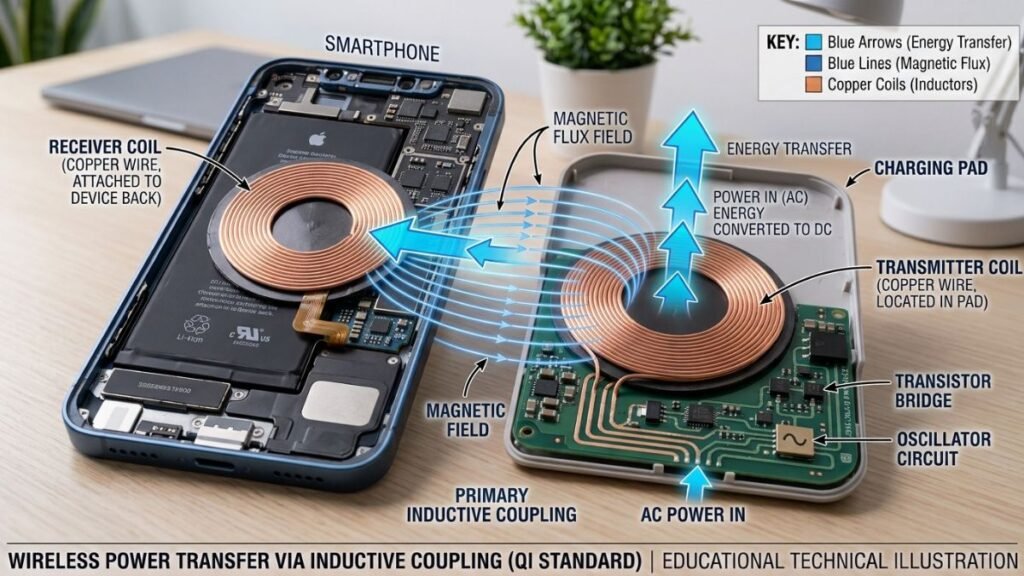
Wireless charging works through electromagnetic induction, a process that transfers electrical energy between two coils without requiring a direct physical connection.
Inside every wireless charging system are two important components:
- A transmitter coil inside the charging pad
- A receiver coil inside the device
When electricity flows through the transmitter coil, it creates a changing magnetic field. The receiver coil inside the smartphone captures this energy and converts it back into electrical power that charges the battery.
The process happens through three main steps:
- The charging pad receives electricity from a power source.
- The transmitter coil creates an electromagnetic field.
- The receiver coil inside the device converts the transferred energy into usable electricity.
Unlike traditional wired charging, where electricity travels directly through a cable, wireless charging uses a controlled electromagnetic connection between two components.
The technology is designed to be convenient, but efficient power transfer requires accurate engineering.
Small differences in positioning can affect:
- Charging speed
- Energy efficiency
- Heat generation
- Charging stability
This is why many modern wireless chargers include alignment systems, magnets, or multiple charging coils to improve the connection between the charger and device.
The Science Behind Wireless Power Transfer
Wireless charging is based on the same fundamental principle used in electromagnetic induction systems.
When alternating electrical current passes through a transmitter coil, it creates a changing magnetic field. When another coil is placed within that field, the magnetic energy creates an electrical current inside the second coil.
In simple terms:
The charger creates energy movement → the device captures that energy → the battery stores it.
A wireless charger does not send electricity freely through the air. Instead, it creates a short-range electromagnetic field designed specifically for energy transfer between compatible components.
The efficiency of this process depends on several factors:
- Distance between charging coils
- Coil alignment
- Charger design
- Device compatibility
- Temperature conditions
For example, placing a smartphone slightly away from the ideal charging position may reduce efficiency because the transmitter and receiver coils are not perfectly aligned.
Modern charging systems solve this problem through improved hardware design.
Apple’s MagSafe system is one example of magnetic alignment technology. The official MagSafe documentation from Apple explains how magnetic alignment helps compatible accessories connect more accurately with supported devices.
How Electromagnetic Induction Transfers Energy
A wireless charging system can be understood as a communication process between the charger and the device.
The charger does not simply provide unlimited power. Instead, the two components communicate to determine how much energy should be transferred.
The main parts involved include:
Transmitter Coil
The transmitter coil is located inside the charging pad.
Its job is to create the electromagnetic field required for energy transfer.
Receiver Coil
The receiver coil is located inside the smartphone or compatible device.
It captures energy from the magnetic field and converts it into electrical power.
Power Management System
The device controls how much energy reaches the battery.
This system helps prevent problems such as:
- Excessive heat
- Overcharging
- Unstable power delivery
Modern smartphones continuously monitor charging conditions and adjust performance automatically.
This intelligent power management is one reason wireless charging has become safer and more reliable compared with earlier generations of wireless power technology.
Understanding Wireless Charging Standards
Wireless charging would be far more complicated without industry standards. Different manufacturers could create completely separate systems, forcing users to purchase specific chargers for every device brand.
Charging standards solve this problem by creating common communication rules between chargers and devices.
These standards define:
- How devices communicate with chargers
- How much power can be transferred
- How safety features operate
- How compatibility is maintained
The most widely recognized wireless charging standard today is Qi, developed by the Wireless Power Consortium.

Qi Wireless Charging Explained
Qi wireless charging is the most common wireless charging technology used in consumer electronics.
The Qi standard allows compatible devices and chargers from different manufacturers to communicate with each other and transfer power safely.
According to the Wireless Power Consortium, Qi technology was created to provide a universal wireless charging system that supports interoperability between different brands.
This means a Qi-compatible smartphone can generally work with a Qi-compatible charging pad, even if the phone and charger are produced by different companies.
Common Qi-supported devices include:
- Smartphones
- Wireless earbuds
- Smartwatches
- Portable electronics
The importance of Qi becomes clearer as more devices become part of the connected technology ecosystem.
Without a shared standard, users would need different charging solutions for every device manufacturer.
Qi2 and The Evolution of Wireless Charging
Wireless charging technology continues to evolve beyond the original Qi standard.
Qi2 is a newer generation of wireless charging designed to improve alignment, efficiency, and overall user experience.
One of the important improvements introduced with Qi2 is magnetic alignment technology, which helps devices position themselves more accurately with charging coils.
Better alignment can help improve:
- Energy efficiency
- Charging consistency
- User convenience
As more manufacturers adopt newer wireless charging standards, consumers can expect improved compatibility and more reliable charging experiences across different devices.
How Device Compatibility Works
A common misunderstanding is that every modern smartphone can charge wirelessly.
In reality, wireless charging requires specific internal hardware.
A compatible device needs:
- A built-in receiver coil
- Supported charging technology
- Proper power management components
- Software integration for charging control
A smartphone may physically sit on a charging pad but still fail to charge if it does not contain the necessary wireless charging components.
Compatibility depends on several factors:
| Factor | Why It Matters |
|---|---|
| Receiver coil | Allows the device to capture wireless energy |
| Charging standard | Determines communication between charger and device |
| Power support | Controls maximum charging speed |
| Device software | Manages charging behavior and safety |
| Accessories | Some cases or attachments can affect performance |
For example, a phone that supports fast wireless charging may still charge slowly when placed on a basic wireless charger with lower power output.
Wireless Charging Compatibility With Cases and Accessories
Phone cases are one of the most common reasons users experience wireless charging problems.
Many standard protective cases work normally with wireless charging, but certain materials and accessories can interfere with energy transfer.
Potential issues may occur with:
- Very thick protective cases
- Metal plates used for magnetic mounts
- Unsupported magnetic accessories
- Built-in battery cases
A case does not necessarily need to be removed every time, but users should understand that additional layers between the charger and device can affect efficiency.
For devices using magnetic alignment systems, accessory compatibility becomes even more important.
Apple’s magnetic alignment system is designed to help compatible devices and accessories maintain accurate positioning during wireless charging.
Wireless Charging Terms Explained
Understanding common wireless charging terms makes it easier to follow technical discussions and compare different charging technologies.
| Term | Meaning |
|---|---|
| Qi | A wireless charging standard that allows compatible devices and chargers to transfer power safely |
| Transmitter Coil | The coil inside the charging pad that creates the electromagnetic field |
| Receiver Coil | The coil inside the device that receives transferred energy |
| Electromagnetic Induction | The process of creating electrical energy through a changing magnetic field |
| Charging Efficiency | How effectively electrical energy is transferred from charger to device |
| Magnetic Alignment | A system that helps position charging coils correctly |
These concepts explain why wireless charging performance depends on more than simply placing a phone on a charging pad.
The hardware inside both the charger and the device plays an important role.
What Affects Wireless Charging Speed
Wireless charging speed depends on multiple factors working together.
Many users assume that buying a higher-power charger automatically results in faster charging. However, charging speed is limited by the capabilities of both the charger and the device.
A powerful charging pad cannot force a smartphone to accept more power than it is designed to handle.
The main factors affecting wireless charging speed include:
- Charger power output
- Device charging limit
- Coil alignment
- Temperature
- Charging standard
- Background device activity
Understanding these factors helps explain why the same wireless charger may perform differently with different devices.
Power Output and Charging Efficiency
Wireless chargers are often rated by wattage, which represents their maximum power capability.
However, the actual charging speed depends on the complete charging system.
For example:
| Charger Capability | Device Capability | Expected Performance |
|---|---|---|
| High-power wireless charger | Device supports high-power charging | Faster wireless charging |
| High-power wireless charger | Device supports standard charging | Standard charging speed |
| Basic wireless charger | Device supports high-power charging | Limited charging performance |
Wireless charging also experiences some energy loss because power must transfer through an electromagnetic field rather than a direct cable connection.
Efficiency can be affected by:
- Distance between coils
- Poor alignment
- Excessive heat
- Low-quality charging accessories
This is why proper positioning is one of the most important parts of wireless charging performance.
Heat Management and Battery Protection
Heat management is one of the most important aspects of modern wireless charging technology.
During wireless power transfer, a small amount of energy naturally converts into heat. This happens because electromagnetic energy transfer is not perfectly efficient.
Modern smartphones use built-in temperature monitoring systems to maintain safe charging conditions. When a device detects excessive heat, it can automatically adjust charging behavior.
The device may:
- Reduce charging speed
- Pause charging temporarily
- Resume charging after temperatures decrease
This protection helps maintain battery performance and prevents unnecessary stress on internal components.
According to Google’s Pixel charging guidance, temperature control plays an important role in maintaining safe charging behavior and protecting device performance.
Why Wireless Chargers Generate Heat
Some users notice that their phone feels warmer while using wireless charging compared with wired charging.
This happens because wireless charging requires energy to travel through an electromagnetic field rather than a direct cable connection.
Common causes of additional heat include:
- Lower charging efficiency
- Poor coil alignment
- Thick phone cases
- High ambient temperatures
- Intensive smartphone usage during charging
For better wireless charging performance, users can:
- Keep the charging surface clean
- Avoid charging in direct sunlight
- Remove incompatible accessories
- Place the phone correctly on the charging pad
Heat does not automatically indicate a problem. Moderate warmth during charging is normal, but excessive heat can reduce charging efficiency.
Wireless Charging vs Wired Charging
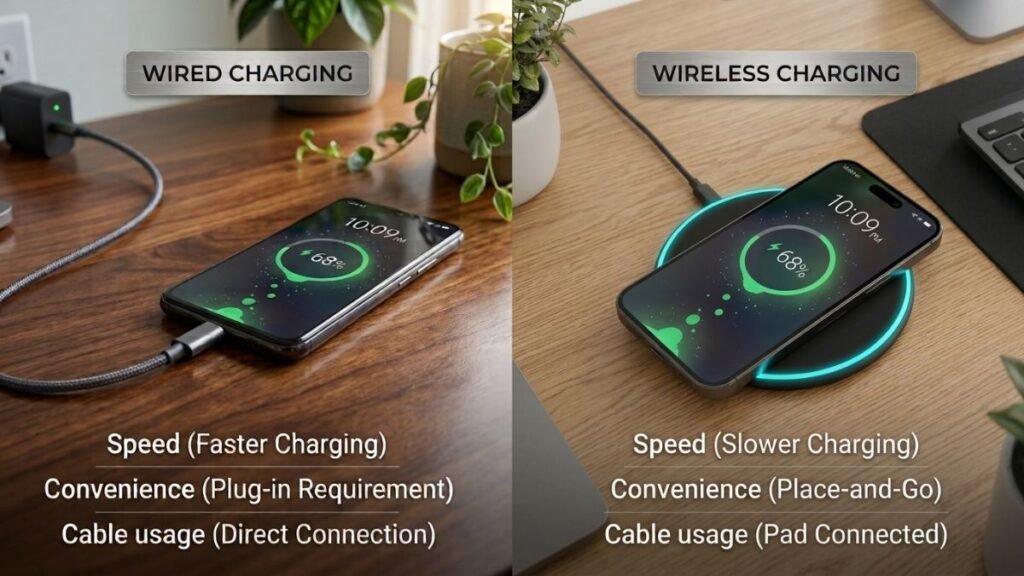
Wireless charging and wired charging both provide power to electronic devices, but they are designed around different priorities.
Wired charging focuses mainly on maximum charging speed, while wireless charging focuses on convenience and reducing cable dependency.
For users who need power away from charging surfaces, power bank technology provides a different approach by storing energy for portable charging whenever it is needed.
For situations where a power outlet is unavailable, portable chargers offer another practical way to keep compatible devices powered. Their capacity, charging speed, and device compatibility help determine which option best suits everyday use or travel.
The better option depends on the user’s daily habits and expectations.
| Feature | Wireless Charging | Wired Charging |
|---|---|---|
| Power transfer | Electromagnetic energy transfer | Direct cable connection |
| Convenience | Very high | Requires plugging in |
| Charging speed | Usually slower | Usually faster |
| Cable management | Cleaner setup | Requires cables |
| Charging port usage | Does not use port | Uses charging port |
| Best use cases | Desks, nightstands, vehicles | Fast charging situations |
Advantages of Wireless Charging
Wireless charging has become popular because it improves everyday convenience.
Easier Daily Charging
One of the biggest advantages is simplicity.
Instead of searching for a cable and connecting it manually, users can place their device on a charging surface whenever they are not actively using it.
This works especially well in locations such as:
- Office desks
- Bedside tables
- Living rooms
- Cars with built-in charging areas
Wireless charging turns charging into a passive habit rather than a separate task.
Reduces Charging Port Usage
A smartphone charging port experiences physical stress every time a cable is connected and removed.
Wireless charging reduces the need for frequent cable connections, which can help minimize mechanical wear over time.
This does not mean charging ports will automatically fail, but reducing repeated physical connections can be beneficial.
Creates Cleaner Technology Setups
Wireless charging can help create more organized spaces by reducing cable clutter.
This fits naturally into modern technology environments where users have multiple connected devices.
For example, a single charging area can support:
- Smartphones
- Wireless earbuds
- Smartwatches
- Other compatible accessories
For readers interested in how multiple connected devices work together, the Smart Gadget Wave article on smartphone accessories explores how modern mobile gadgets improve everyday technology experiences.
Limitations of Wireless Charging
Although wireless charging offers convenience, it also has some limitations.
Understanding these limitations helps users choose the right charging method for different situations.
Slower Charging Speeds
Wireless charging is often slower than wired charging because energy transfer is less direct.
Users who need maximum charging speed before leaving home may still prefer cable-based charging.
For example:
- Emergency charging situations
- Low battery before travel
- Fast power boosts during the day
Wired charging usually remains the preferred option for these scenarios.
Less Freedom While Charging
A wired charger allows users to continue holding and using their phone while it remains connected.
Wireless charging usually requires the device to stay positioned on the charging surface.
This can be inconvenient when:
- Watching long videos
- Playing games
- Using navigation applications
- Making extended phone calls
Wireless charging works best when the device can remain stationary.
Compatibility Requirements
Wireless charging requires compatible hardware.
Older smartphones and some entry-level devices may not include wireless charging capabilities.
Users should check device specifications before purchasing wireless charging accessories.
Important compatibility factors include:
- Supported charging standard
- Device model
- Maximum charging speed
- Case compatibility
How To Use a Wireless Charger Correctly
Using a wireless charger is simple, but correct setup can improve reliability and charging performance.
Small adjustments can make a noticeable difference in everyday use.
Proper Phone Placement
The position of the smartphone on the charging pad directly affects energy transfer.
The transmitter coil inside the charger and receiver coil inside the phone need to align correctly.
For better results:
- Place the phone near the center of the charging surface
- Confirm the charging indicator appears
- Avoid placing objects between the phone and charger
- Keep the charging surface clean
Some modern chargers use magnets or multiple coils to improve positioning accuracy.
Cases and Accessories Compatibility
Phone cases are a common reason users experience wireless charging problems.
Many thin protective cases work normally, but thicker materials may reduce charging efficiency.
Potential issues can occur with:
- Heavy-duty protective cases
- Metal inserts
- Magnetic accessories
- Unsupported mounts
Before assuming the charger is defective, users should test charging without additional accessories.
For devices that use magnetic alignment technology, accessory compatibility becomes especially important. Apple’s magnetic alignment system is designed to help compatible devices and accessories maintain accurate positioning during wireless charging.
Common Wireless Charging Problems Explained
Wireless charging is designed to be simple, but users may occasionally experience problems such as slow charging, inconsistent connections, or devices not charging at all.
In most cases, these issues are caused by compatibility, positioning, temperature, or power limitations rather than a failure of the wireless charging technology itself.
Understanding common problems helps users troubleshoot more effectively and improve their charging experience.
Why Wireless Charging Stops Suddenly
A wireless charger may stop charging because the device detects conditions that could affect safety or charging efficiency.
Modern smartphones continuously monitor charging conditions and can automatically reduce or stop power delivery when necessary.
Common reasons include:
Excessive Heat
Temperature is one of the most common reasons wireless charging may slow down or stop.
When a device becomes too warm, the charging system can reduce power output to protect internal components.
Heat can increase because of:
- Hot environments
- Direct sunlight
- Thick phone cases
- Background applications running during charging
- Poor airflow around the device
Keeping the phone and charger in a cool environment can help maintain better charging performance.
Incorrect Phone Position
Wireless charging requires accurate alignment between the transmitter coil and receiver coil.
If the smartphone is not positioned correctly, the connection between the charger and device may become inefficient.
Common signs of alignment problems include:
- Charging starts and stops repeatedly
- Slow charging speed
- Device does not recognize the charger
The solution is usually simple: reposition the smartphone until the charging indicator appears consistently.
Unsupported Accessories
Not all wireless charging accessories provide the same level of compatibility.
Problems may occur when:
- The charger does not support the device’s charging standard
- The power adapter does not provide enough output
- The accessory is not designed for the device
Using certified accessories from reliable manufacturers can improve charging consistency.
Why Wireless Charging May Be Slow
Slow wireless charging does not always mean something is wrong.
Wireless charging speed depends on several connected factors:
- Charger power output
- Smartphone charging limit
- Coil alignment
- Temperature
- Device activity
For example, a phone may charge slower when:
- The screen remains active
- Multiple applications are running
- The device is warm
- The charger has lower power output
Wireless charging is often designed around convenience rather than maximum speed.
For users who charge their devices throughout the day at a desk or bedside, slower but consistent charging can still be highly practical.
Future of Wireless Charging Technology
Wireless charging continues to evolve as manufacturers explore better efficiency, faster charging, and more flexible ways to deliver power.
Today’s wireless charging systems usually require the device to be placed directly on a charging surface. However, future technologies may improve how devices receive power.
Potential improvements include:
- Greater charging efficiency
- Better alignment systems
- Faster wireless charging speeds
- More integration into vehicles and furniture
- Expanded support for more device categories
The development of wireless power technology is connected to the broader growth of connected devices and smart environments.
The IEEE publishes research and technical information related to electrical engineering, wireless technologies, and emerging electronics systems that influence future charging innovations.
Wireless Charging and the Future of Smart Devices
Wireless charging is becoming an important part of a larger technology ecosystem.
Modern devices are increasingly designed to work together without requiring complicated setups.
Examples include:
- Smartphones charging on desks
- Wireless earbuds using charging cases
- Smartwatches using compact wireless charging systems
- Vehicles offering built-in wireless charging areas
This movement supports a future where technology becomes more seamless and less dependent on visible cables.
Wireless power is not just about charging a phone. It represents a broader shift toward more convenient and connected consumer technology.
For readers interested in how connected devices are changing everyday life, the Smart Gadget Wave guide on wearable technology explores how smart devices are becoming more integrated into daily routines.
To understand the technology behind these wearable devices in more detail, read our guide to smartwatch technology, covering sensors, GPS, connectivity, and battery systems.
Key Takeaways About Wireless Charging
A wireless charger guide helps explain that wireless charging is more than simply removing cables.
The technology combines electromagnetic principles, hardware design, communication standards, and intelligent power management.
The most important points are:
- Wireless chargers transfer energy through electromagnetic induction.
- Qi is the most widely used wireless charging standard.
- Device compatibility determines charging performance.
- Heat management affects charging speed and reliability.
- Correct phone placement improves energy transfer.
- Wireless charging prioritizes convenience, while wired charging often provides faster speeds.
Understanding these basics helps users use wireless charging more effectively and avoid common mistakes.
Conclusion
Wireless charging has become an important part of modern consumer technology by making everyday charging simpler and more convenient.
A complete wireless charger guide should explain not only how charging pads work but also the practical factors that influence real-world performance.
From electromagnetic energy transfer and Qi standards to heat management and compatibility, every part of the system contributes to the final charging experience.
While wired charging continues to offer advantages in speed, wireless charging provides a cleaner and more convenient solution for many daily situations.
As smartphones, wearables, and smart devices become increasingly connected, wireless power technology will continue playing an important role in the future of consumer electronics.
Frequently Asked Questions About Wireless Charging
What is a wireless charger and how does it work?
A wireless charger transfers power to compatible devices through electromagnetic induction. The charging pad creates a magnetic field using a transmitter coil, and the device receives that energy through an internal receiver coil to charge the battery.
Is wireless charging safe for smartphones?
Yes, wireless charging is generally safe when using compatible chargers and devices. Modern smartphones include systems that monitor temperature, power delivery, and charging conditions to maintain safe operation.
Does wireless charging damage battery health?
Wireless charging does not automatically damage smartphone batteries. Battery health depends on multiple factors, including heat exposure, charging habits, and battery chemistry. Proper temperature management helps maintain safer charging conditions.
Why is my wireless charger charging slowly?
Wireless charging may be slow because of device limitations, charger power output, poor alignment, heat, or background activity. Checking compatibility and improving phone placement can often improve charging performance.
Can I use a phone case with a wireless charger?
Many thin phone cases work with wireless charging. However, thick cases, metal components, and unsupported accessories may reduce charging efficiency or prevent charging completely.
What is Qi wireless charging?
Qi wireless charging is a standard created by the Wireless Power Consortium that allows compatible devices and chargers from different manufacturers to transfer power safely and efficiently.
Is wired charging better than wireless charging?
Wired charging is usually faster, while wireless charging provides greater convenience and reduces cable usage. The better choice depends on whether speed or simplicity is the user’s priority.

I’m a Technology Editor at SmartGadgetWave with a passion for innovation, AI, and consumer technology. I enjoy exploring the latest gadgets, smart home devices, and wearable tech. My goal is to make technology easy to understand by sharing practical insights, honest perspectives, and helpful product comparisons so readers can make smarter tech decisions.


