Last updated on November 1st, 2026 at 05:15 am
Portable chargers, also called power banks, are rechargeable batteries that store energy for smartphones, tablets, and other electronics when a wall outlet is unavailable.
Their performance depends on stored energy (Wh), battery capacity (mAh), output power (W), charging protocols, and device compatibility. Understanding these specifications helps you estimate real charging performance and use power banks safely.
A portable charger can keep navigation, messaging, mobile payments, and work tools running during a commute or trip. Yet its advertised capacity rarely translates into a simple number of full phone recharges. A 10,000mAh power bank, for example, does not necessarily refill a 5,000mAh smartphone battery twice.
The reason is that energy must pass through voltage-conversion circuitry and the phone’s charging system. Some energy is lost as heat, and a device may continue consuming power while connected.
Charging speed adds another variable: two power banks with the same capacity can deliver very different wattages.
This guide explains the essential electrical concepts, the differences between wired, magnetic, and solar chargers, and the practical limits that matter for laptops, everyday safety, and air travel. The goal is to understand the technology—not to rank individual products.
What Are Portable Chargers and How Do They Work?
A portable charger stores electricity in rechargeable cells and supplies it later through USB or, in supported models, wireless charging.
Unlike a wall adapter, it does not need an outlet while powering a device. Portable chargers are one category of smartphone accessories that help extend device use away from home.
The Main Components Inside a Portable Charger
- Battery cells: Usually lithium-ion cells that store electrical energy.
- Battery management circuitry: Helps control cell voltage, current, and temperature and provides protective shutoffs.
- Power conversion circuitry: Adjusts the battery’s voltage to an output suitable for connected electronics.
- Charging controller: Regulates the power bank’s own recharge process.
- Ports or wireless coils: Transfer power to a connected device.
Protection systems differ between models and cannot eliminate all risks. Battery construction and circuit design also affect efficiency, size, weight, and maximum output power.

How Stored Energy Reaches Your Device
First, the power bank receives electricity from a compatible source and stores it in its cells. When a device connects, the power bank converts the stored energy into a supported output. The receiving device then manages the energy entering its own battery.
Many lithium-ion cells have a nominal voltage around 3.6V or 3.7V, while conventional USB output is commonly 5V. Conversion between these voltages consumes energy.
Fast-charging systems may negotiate higher voltage or current, but a power bank capable of 30W does not force 30W into every phone. The device, cable, and charging protocol must support the requested mode.
Portable Charger Capacity Explained: mAh vs Wh
Battery capacity is commonly advertised in milliampere-hours (mAh), but this figure measures electrical charge rather than stored energy. Watt-hours (Wh) provide a more useful measure of energy because they account for both capacity and voltage.
To estimate nominal energy, use this formula:
Wh = (mAh × nominal voltage) ÷ 1,000
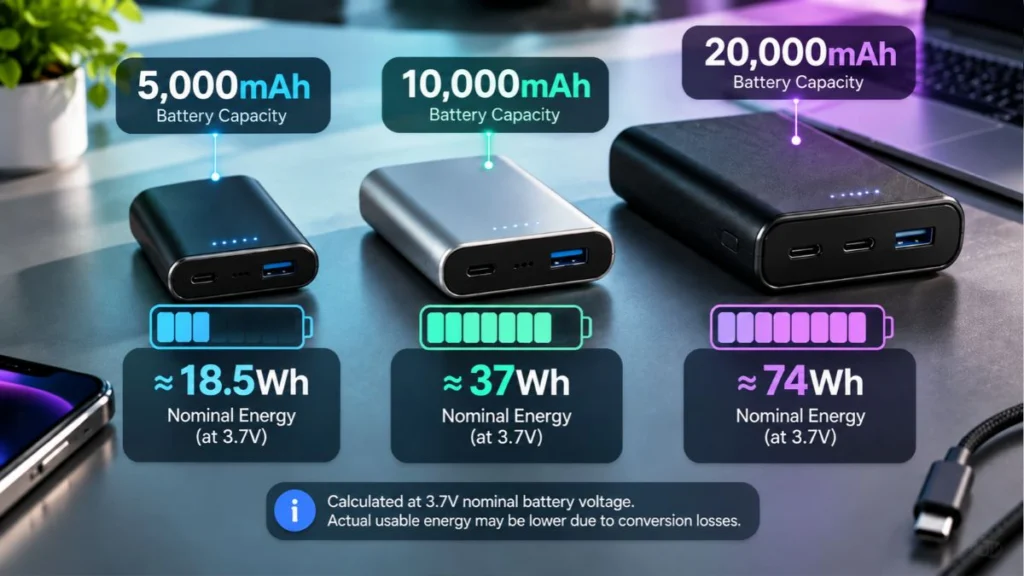
For example, a 10,000mAh portable charger rated at 3.7V stores approximately 37Wh of nominal energy. A 20,000mAh model at the same voltage stores approximately 74Wh. These figures describe stored energy, not the amount ultimately delivered to a connected device.
The comparison image below illustrates how common portable charger capacities translate into watt-hours at a nominal voltage of 3.7V. Actual usable energy varies by model and depends on conversion efficiency, operating conditions, and the connected device.
What 5,000mAh, 10,000mAh, and 20,000mAh Mean
For a battery with a nominal voltage of 3.7V, the relationship is Wh = (mAh × V) ÷ 1,000. The following examples assume that voltage; the rating printed on a real product takes precedence.
| Advertised capacity | Nominal energy at 3.7V | Common application |
|---|---|---|
| 5,000mAh | 18.5Wh | Compact backup for a phone |
| 10,000mAh | 37Wh | Commuting and day trips |
| 20,000mAh | 74Wh | Several devices or extended travel |
| 26,800mAh | 99.16Wh | Higher-capacity portable use |
Illustrative calculations, not measured results or guarantees of usable output.
A larger battery generally stores more energy at the same nominal voltage, but it does not necessarily charge devices faster. For further technical context, see our explanation of power bank technology, including how capacity and efficiency affect charging performance.
Why Actual Charging Capacity Is Lower Than Advertised
A portable charger cannot transfer all its stored energy to a phone’s battery. Voltage conversion, electrical resistance, heat, and the phone’s own charging circuitry reduce the energy ultimately stored in the device.
For this reason, dividing a power bank’s advertised mAh rating by a phone’s battery capacity does not provide a reliable estimate of full recharges. Comparing watt-hours and accounting for conversion losses gives a more realistic picture of charging performance.
Actual results vary with the charger, cable, phone, temperature, and device activity. Treat recharge estimates as approximations rather than guaranteed results.
Portable Charger Charging Speed and USB-C Technology
Portable charger capacity tells you how much energy a power bank stores, while output power indicates how quickly it can deliver that energy. To choose a suitable model, check its wattage, supported charging protocols, port specifications, and compatibility with your devices. A high-capacity power bank is not necessarily a fast charger.
Understanding Watts, Volts, and Amps
Watts (W) indicate power output, volts (V) measure electrical potential, and amps (A) measure current. For standard DC charging, power is calculated by multiplying voltage by current: watts = volts × amps.
For example, a 5V/2A output provides up to 10W, while a compatible 9V/3A mode can provide up to 27W. These figures describe the maximum power available under the specified conditions, not a constant charging speed.
When comparing portable chargers, check the output rating of the specific port you plan to use. A model with multiple ports may distribute its available power differently when several devices are connected.
USB-C Power Delivery and Fast Charging
USB-C describes the connector, not the charging speed. A USB-C port does not automatically support USB Power Delivery (USB PD), and two USB-C power banks may offer different output levels.
USB PD allows compatible chargers and devices to negotiate supported power levels. Some equipment also supports Programmable Power Supply (PPS), which enables compatible devices to request adjustable voltage within supported limits.
For fast charging, the power bank, connected device, and cable must support the required charging mode.
Check the manufacturer’s specifications rather than assuming that a USB-C connection guarantees maximum speed. For further technical details, consult the official USB Implementers Forum.
For a broader explanation of compatible cables, chargers, hubs, and adapters, see our guide to USB-C accessories.
Charging Phones, Tablets, and Laptops
Phones: Check the phone’s supported charging protocol and maximum input power. A power bank may charge a phone safely but more slowly if their fast-charging systems are not compatible.
Tablets: Tablets often have larger batteries and may need more power, particularly during gaming, video streaming, or other demanding tasks. Compare the tablet’s charging requirements with the power bank’s output.
Laptops: Confirm that the laptop supports charging through the relevant port and that the power bank provides sufficient USB-C PD output. A 20W power bank, for example, may be inadequate for a laptop designed for a 65W input.
Also consider stored energy, not just output wattage. A power bank may supply enough power to operate a laptop but still lack enough usable energy to recharge its battery fully.
When charging multiple devices, check the combined output rating. The power available to one port may decrease when other ports are in use. Charging speed can also drop as a device’s battery fills or when temperature limits apply.
Different Types of Portable Chargers
Portable chargers vary in how they deliver power and how their stored energy is replenished. Some categories overlap: a high-capacity power bank can support both wired and wireless charging, for example.

Standard Wired Power Banks
Wired power banks transfer energy through USB-A or USB-C cables. They offer a direct connection, can support substantial USB PD output, and do not depend on aligning wireless coils.
Their main trade-off is the need to carry a compatible cable. USB-C input/output capability and simultaneous charging behavior should be checked rather than assumed.
Wireless and Magnetic Portable Chargers
Wireless chargers transfer energy through electromagnetic induction between coils in the charger and receiving device. Alignment affects efficiency, and losses can create heat. Magnetic portable chargers use magnets to position compatible phones; the magnets themselves do not transfer charging energy.
The Wireless Power Consortium’s Qi guidance explains Qi2 magnetic alignment and charging certification. Original Qi2 introduced 15W charging for compatible certified devices; Qi2 25W is a newer supported level. Magnetic attachment alone does not prove that a charger or phone supports either charging mode.
High-Capacity Portable Chargers
High-capacity power banks, often 20,000mAh or more, are useful when several devices need charging or outlets are scarce. The extra energy generally adds weight and can lengthen recharge time. Capacity does not imply laptop-compatible wattage, and large batteries may cross airline watt-hour limits.
Solar Portable Chargers
Solar charging systems use photovoltaic cells to convert sunlight into electricity. A small panel integrated into a power bank generally collects much less energy than a larger foldable panel.
As an illustration, collecting 37Wh at an average electrical output of 1W would require at least 37 hours at that output, before battery charging losses.
Shade, clouds, orientation, and temperature further affect performance. Solar power is therefore best understood as conditional energy generation, not guaranteed emergency charging.
| Type | Main strength | Key limitation |
|---|---|---|
| Wired | Direct connection and broad compatibility | Requires cable |
| Wireless | Cable-free device connection | Alignment and conversion losses |
| Magnetic wireless | Convenient attachment and alignment | Compatibility depends on device and standard |
| High capacity | More stored energy | Weight, recharge time, and travel limits |
| Solar-assisted | Can replenish energy from sunlight | Variable and often limited solar output |
Portable Charger Safety, Battery Health and Air Travel
Lithium-ion batteries are energy-dense, but physical damage, electrical faults, and excessive heat can create hazards. A well-designed power bank includes protective circuitry; safe handling remains important even with those protections.
Heat, Battery Protection, and Safe Charging
Portable chargers generate some heat during normal use, but excessive heat, physical damage, or electrical faults can create safety risks. Good charging habits help protect both the battery and the connected device.
Use a compatible charger and cable, keep the power bank uncovered while charging, and avoid leaving it in a hot vehicle or direct sunlight for extended periods. Follow the manufacturer’s instructions for operating temperature and storage.
Stop using a portable charger if it becomes unusually hot, swells, leaks, develops an unusual odor, or shows visible damage. Do not puncture, open, or attempt to repair its battery cells.
For long-term storage, follow the manufacturer’s recommendations and keep the device in a cool, dry place. If a damaged battery smokes or vents, move away and seek emergency assistance. Never place a damaged lithium-ion power bank in household trash; follow local battery disposal guidance.
Can You Bring Portable Chargers on a Plane?
Portable chargers contain lithium-ion batteries, so airlines restrict how they can be transported. In the United States, the Federal Aviation Administration (FAA) requires power banks and other spare lithium batteries to be carried in cabin baggage, not checked luggage.
Portable Charger Watt-Hour Limits for Air Travel
The permitted battery capacity depends on its rated energy in watt-hours (Wh), not just its advertised milliampere-hours (mAh).
| Power Bank Capacity | General FAA Passenger Rule |
|---|---|
| Up to 100Wh | Generally allowed in carry-on baggage without airline approval |
| 101–160Wh | Requires airline approval; a maximum of two spare batteries in this range is allowed |
| Over 160Wh | Not permitted under the standard passenger allowance |
These are general U.S. rules. Airlines and international authorities may impose stricter restrictions, so check your carrier’s current requirements before traveling.
For context, a 20,000mAh power bank rated at 3.7V has approximately 74Wh of nominal energy. A 30,000mAh model at the same voltage has approximately 111Wh and may therefore require airline approval. Always use the watt-hour rating printed on the product when available.
To prepare a power bank for travel, protect its terminals against short circuits and prevent damage. If your carry-on bag is taken at the gate for checking, remove the power bank and keep it with you in the cabin. Never bring a swollen, damaged, or recalled battery onto an aircraft unless the airline’s safety guidance explicitly permits it.
For the latest requirements, consult the official FAA guidance on airline passengers and batteries.
Common Portable Charger Problems and Practical Solutions
Unexpected charging behavior is not always a battery failure. The cable, port, charging protocol, device power consumption, and built-in protection systems can all affect results.
Why a Portable Charger May Charge Slowly
First compare the power bank’s output wattage with the device’s supported input. A 10W output will not match the potential charging speed of a compatible 30W connection. Then check the cable, disconnect other devices to eliminate shared-output limits, and let hot equipment return to a normal operating temperature.
A phone used for gaming or navigation consumes energy while charging, reducing its net battery gain. Charging also commonly slows as the battery approaches full capacity. To isolate the problem, test the same phone and cable with a known-good compatible wall adapter.
Why a Power Bank May Stop Charging a Device
Some power banks automatically shut off when a connected accessory draws very little current. This can affect earbuds and wearables; a manufacturer-supported low-current mode may help.
A nearly empty or aged power bank may also shut down under load, while an unsuitable USB-C cable or power negotiation problem can interrupt a connection.
If the power bank itself will not recharge, confirm that the chosen port supports input and test a compatible adapter and cable. Do not try to restart a swollen, leaking, or unusually hot unit.
Quick Troubleshooting Checklist
| Symptom | First useful check |
|---|---|
| Phone charges slowly | Compare port wattage, cable rating, and phone compatibility |
| Charging disconnects | Test a known-good cable and one device at a time |
| Earbuds stop charging | Look for a supported low-current mode |
| Power bank will not recharge | Check input port, adapter, cable, and operating temperature |
| Laptop shows slow charging | Compare USB-C output modes with laptop power requirements |
| Battery gauge seems inaccurate | Recharge normally and check for repeated shutdowns under load |
Test one variable at a time. If multiple compatible cables and devices show the same persistent failure, contact the manufacturer or consider replacement. Check for recalls before continuing to use a malfunctioning unit.
Final Thoughts on Portable Chargers
Choosing the right portable charger depends on how you plan to use it, which devices you need to charge, and how much energy you need while away from an outlet.
Before buying or using a power bank, check its usable capacity, output wattage, charging compatibility, and physical condition. Consider the practical differences between wired, wireless, magnetic, high-capacity, and solar charging options, especially when portability, charging time, or outdoor use matters.
For travel, check the battery’s rated watt-hours and your airline’s current requirements. For everyday use, choose compatible equipment, avoid excessive heat, and stop using any battery that shows signs of damage.
Understanding these factors makes it easier to select a portable charger that fits your routine and use it safely.
Frequently Asked Questions About Portable Chargers
What Is the Difference Between a Portable Charger and a Power Bank?
The terms generally mean the same thing: a rechargeable battery device that stores electricity and later supplies it to compatible electronics. “Portable charger” emphasizes its use; “power bank” emphasizes stored energy.
How Many Times Can a 10,000mAh Portable Charger Charge a Phone?
It depends on the phone’s battery energy and charging losses. For example, a 10,000mAh power bank at 3.7V stores 37Wh. Under illustrative efficiency assumptions, it could provide about 1.5 equivalent full charges to a 5,000mAh phone battery rated at 3.85V—not a guaranteed two charges.
Can a Portable Charger Charge a Laptop?
Yes, if the laptop supports the charger’s connection and power delivery modes and the power bank provides sufficient output wattage. A USB-C connector alone does not guarantee compatibility, and adequate wattage does not guarantee enough stored energy for a full laptop recharge.
Are Portable Chargers Safe to Leave Plugged In Overnight?
Properly functioning chargers are designed to manage charging, but unattended charging is not risk-free. Use compatible equipment on an uncovered, stable surface, follow manufacturer guidance, and never charge a damaged or abnormally hot power bank. Disconnect it when practical after charging.
Can You Take a 20,000mAh Portable Charger on a Plane?
Generally yes, if its rated energy falls within the applicable limit. At a nominal 3.7V, 20,000mAh equals about 74Wh, below the FAA’s standard 100Wh threshold. Carry it in cabin baggage and check airline-specific quantity and use restrictions.
Do Wireless Portable Chargers Damage Phone Batteries?
Compatible wireless charging does not inherently damage a phone battery. However, poor coil alignment and charging losses can generate heat, and prolonged excessive heat can accelerate battery aging. Use suitable equipment and follow device temperature guidance.
How Long Does a Portable Charger Last Before It Needs Replacing?
There is no universal replacement interval. Lithium-ion cells lose capacity through aging and use, with heat and storage conditions influencing the rate. Persistent charging failures or substantially reduced capacity may justify replacement; swelling, leakage, or physical damage requires stopping use immediately.

I’m a Technology Editor at SmartGadgetWave with a passion for innovation, AI, and consumer technology. I enjoy exploring the latest gadgets, smart home devices, and wearable tech. My goal is to make technology easy to understand by sharing practical insights, honest perspectives, and helpful product comparisons so readers can make smarter tech decisions.