

Last updated on November 1st, 2026 at 12:56 am
Best power banks are built around battery capacity, charging speed, and safety technology.
Understanding how power banks store energy, deliver power, and protect connected devices helps users choose portable charging solutions based on real performance instead of marketing numbers.
Choosing the best power banks starts with understanding the technology behind portable charging.
A smartphone battery can run out at the worst possible moment — during travel, a long workday, an outdoor activity, or when access to a power outlet is limited. That is why portable charging technology has become an essential part of modern mobile life.
Power banks are one part of the wider ecosystem of smartphone accessories designed to improve everyday mobile experiences.
Understanding power bank technology helps users make better decisions and recognize why different models can deliver very different charging experiences.
Many people compare power banks only by capacity numbers such as 10,000mAh or 20,000mAh. However, real performance also depends on charging efficiency, power output, compatibility with devices, and thermal management.
Modern devices increasingly rely on faster charging standards such as USB-C Power Delivery, making the technology inside portable chargers more important than ever.
This guide explains how power banks work, what capacity measurements really mean, how charging speed is calculated, and which safety technologies help protect both the charger and connected devices.
What Is a Power Bank and How Does It Work?
A power bank is a portable energy storage device designed to recharge smartphones, tablets, and other electronic devices when a traditional power outlet is unavailable.
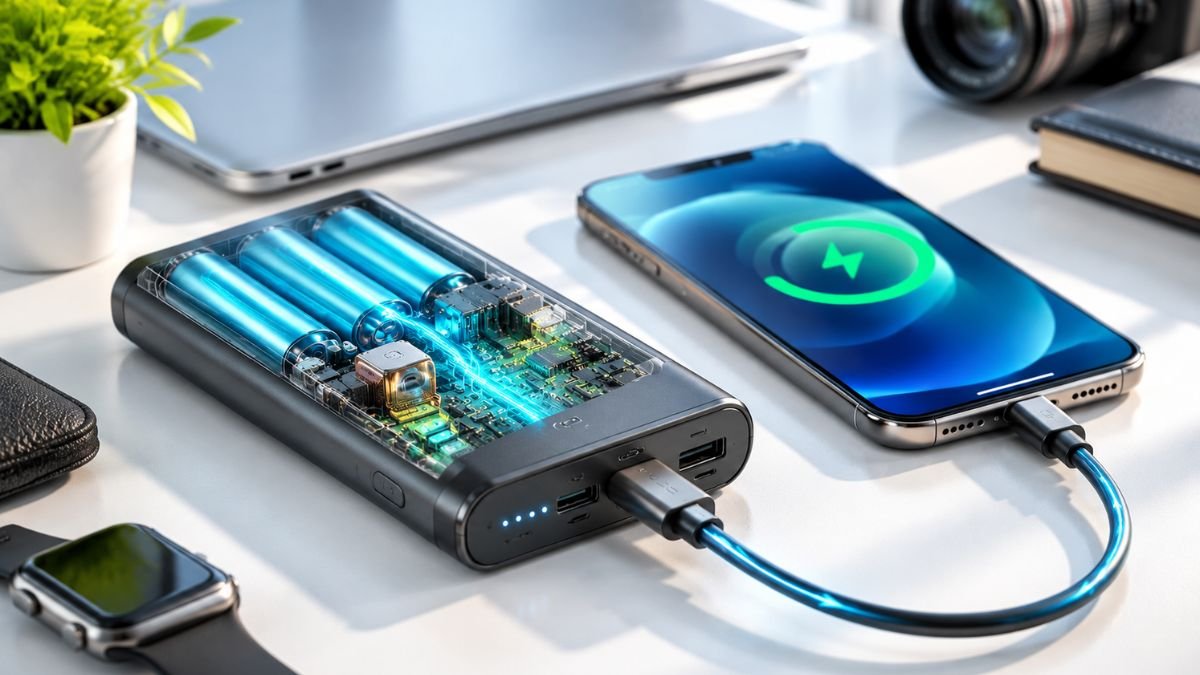
Although it looks like a simple battery pack, a modern power bank combines rechargeable battery cells, charging controllers, voltage regulation systems, and safety components to deliver controlled power to connected devices.
The basic idea is simple: a power bank stores electricity when it is connected to a wall charger and releases that stored energy later when another device needs power.
However, the process involves several stages. Electricity must first be converted, stored safely inside battery cells, managed by electronic circuits, and then delivered at the correct voltage and current level required by the connected device.
How Power Banks Store and Transfer Energy
Inside every power bank are rechargeable battery cells that act as the energy storage system. Most modern models use lithium-based batteries because they offer a high energy density, allowing manufacturers to store more power in a smaller and lighter design.
When a power bank is connected to a charger, electrical energy flows through the input port and reaches the internal charging circuit. This circuit manages how much energy enters the battery, helping prevent problems such as overheating or overcharging.
During charging, the stored electrical energy is converted into chemical energy inside the battery cells. When a smartphone or another device is connected, the process reverses. The chemical energy is converted back into electrical energy and delivered through the output port.
The complete process involves three main components:
- Battery cells: Store the electrical energy for later use.
- Charging controller: Regulates how energy enters and leaves the battery.
- Power management system: Adjusts voltage and current according to the connected device.
This internal management is why modern power banks can safely charge sensitive electronics without directly sending raw battery power to the device.
The Role of Battery Cells Inside a Power Bank
The battery cells are the foundation of any portable charger. Their quality and design influence important factors such as:
- Total energy capacity
- Charging efficiency
- Physical size
- Weight
- Heat generation
- Overall lifespan
Most consumer power banks use lithium-ion battery technology because it provides a practical balance between energy storage and portability.
Lithium-ion batteries are widely used across consumer electronics, including smartphones, laptops, and portable devices.
According to information from the U.S. Department of Energy, lithium-ion batteries are among the most common rechargeable battery technologies because of their high energy density and rechargeable capabilities.
A power bank with higher-quality battery cells can usually maintain better performance over repeated charging cycles compared with lower-quality alternatives.
How the Charging Circuit Controls Energy Flow
The battery itself cannot directly power a smartphone. The stored energy must pass through electronic components that regulate the electricity before it reaches the device.
A modern power bank includes a power management system that controls:
- Input charging speed
- Output power delivery
- Voltage conversion
- Temperature monitoring
- Protection against electrical problems
For example, a smartphone may require a specific voltage and current combination to charge efficiently. The power bank detects the device requirements and adjusts the output accordingly.
This is especially important with modern fast charging technologies. Without proper regulation, supplying incorrect power levels could reduce charging efficiency or create unnecessary heat.
Power Bank Technology in Real-World Use
Understanding how a power bank works helps explain why two devices with the same capacity rating can perform differently.
For example:
A 10,000mAh power bank with efficient energy management may provide better real-world charging performance than a cheaper model with the same advertised capacity but lower conversion efficiency.
Factors such as:
- battery quality;
- internal electronics;
- charging protocol support;
- temperature control;
all influence the final charging experience.
How Does a Power Bank Work?
A power bank stores electrical energy inside rechargeable battery cells and uses electronic circuits to safely convert and deliver that energy to smartphones and other devices when charging is needed.
Understanding Power Bank Capacity: What Does mAh Mean?
One of the first specifications people notice when looking at a power bank is its capacity, usually displayed in mAh (milliamp-hours). A higher number often creates the impression that the power bank will automatically provide better performance, but capacity is only one part of the overall technology.
Understanding what mAh means helps explain how much energy a power bank can store, how many times it may recharge a device, and why real-world performance can differ from the number printed on the package.
What Does mAh Mean in a Power Bank?
The term mAh stands for milliamp-hour and represents the electrical charge capacity of a battery.
In simple terms, mAh indicates how much current a battery can provide over a specific period of time.
For example:
- A 5,000mAh power bank stores less energy than a 20,000mAh model.
- A 20,000mAh power bank can generally store enough energy for more charging cycles.
- A higher capacity usually means a larger battery and heavier design.
However, mAh alone does not tell the complete story because power banks operate with voltage conversion and energy losses during charging.
A more accurate measurement of stored energy is watt-hours (Wh), calculated using battery voltage and capacity.
The formula is:
Wh = (mAh × Voltage) ÷ 1000
For example, a 10,000mAh battery operating at 3.7V stores approximately:
37Wh of energy
This measurement helps compare batteries more accurately because it considers the actual energy stored rather than only electrical charge.

Power Bank Capacity vs Real Charging Performance
A common misunderstanding is assuming that a 20,000mAh power bank will always provide exactly two times more charging than a 10,000mAh model.
In reality, usable energy is affected by several factors:
- Voltage conversion losses
- Cable quality
- Charging efficiency
- Device power management
- Temperature conditions
Power banks store energy at the battery cell voltage, but smartphones typically require different voltage levels. The internal conversion process creates some energy loss as electricity moves between the battery and the device.
This means the usable capacity will always be lower than the advertised number.
Typical Power Bank Capacities Explained
| Power Bank Capacity | Typical Use Case | Best For |
|---|---|---|
| 5,000mAh | Lightweight emergency charging | Daily carry and short trips |
| 10,000mAh | Balanced capacity and portability | Most smartphone users |
| 20,000mAh | Multiple device charging | Travel and longer periods away from outlets |
| 25,000mAh+ | High energy storage | Extended travel and demanding devices |
Why Higher Capacity Is Not Always Better
A larger capacity power bank can provide more stored energy, but it also introduces trade-offs.
A 20,000mAh or 25,000mAh model may offer more charging cycles, but it is usually:
- heavier;
- physically larger;
- slower to fully recharge;
- less convenient for everyday carrying.
For someone commuting daily, a compact power bank may be more practical than carrying a large-capacity model.
For travelers, outdoor users, or people who regularly use multiple devices, the additional capacity may provide a significant advantage.
The best capacity depends on the user’s situation, not simply the largest number available.
How Device Size Affects Power Bank Capacity
Modern smartphones have different battery sizes, which changes how many times a power bank can recharge them.
For example:
- A smaller smartphone battery may receive multiple charges from a 20,000mAh power bank.
- A large smartphone with a high-capacity battery will consume more stored energy.
- Tablets and laptops require significantly more power compared with smartphones.
This is why capacity should always be considered together with device compatibility and charging output.
Is a Higher mAh Power Bank Always Better?
A higher mAh rating means a power bank can store more electrical charge, but it does not always mean better overall performance. Size, efficiency, charging speed, and portability also determine whether a power bank is suitable for a specific user.
Choosing Capacity Based on Real Situations
Different users have different energy needs.
Everyday Smartphone Users
A moderate capacity power bank is often enough for:
- commuting;
- workdays;
- emergency charging;
- daily smartphone use.
A smaller design is usually easier to carry and more convenient.
Travelers
People traveling internationally or spending long periods away from outlets may benefit from higher-capacity options.
Important factors include:
- capacity;
- charging speed;
- airline restrictions;
- device compatibility.
Many airlines use watt-hours rather than mAh when defining battery limits, so understanding the energy rating is useful for travelers.
Outdoor and Emergency Use
For camping, hiking, or emergency situations, capacity becomes more important because access to electricity may be limited.
However, users should also consider:
- durability;
- weather resistance;
- charging efficiency;
- additional features such as solar input.
Power Bank Charging Speed Explained
Capacity determines how much energy a power bank can store, but charging speed determines how quickly that energy can be delivered to a device.
Many users assume that a higher-capacity power bank will automatically charge a smartphone faster. However, charging speed depends mainly on power output, charging protocols, voltage, current, and device compatibility.
A 10,000mAh power bank with modern fast-charging technology can sometimes charge a device faster than a larger 20,000mAh model with slower output.
While power banks store energy for portable charging, wireless charging technology uses a different approach by transferring power through electromagnetic induction.
Understanding Watts, Voltage and Current
Charging speed is measured in watts (W), which represents the amount of electrical power being delivered.
The basic relationship is:
Power (Watts) = Voltage (Volts) × Current (Amps)
For example:
- 5V × 2A = 10W
- 9V × 2A = 18W
- 20V × 5A = 100W
Higher wattage allows compatible devices to receive energy faster, reducing charging time.
However, the power output of the power bank is only one part of the equation. The connected device must also support that charging speed.
A smartphone designed for slower charging cannot automatically use the maximum output of a high-powered power bank.
How USB-C Power Delivery Improves Charging
Modern power banks increasingly use USB-C Power Delivery, a charging standard designed to provide higher power levels while allowing devices and chargers to communicate with each other.
Unlike older charging methods that provide a fixed power output, USB-C PD allows compatible devices to negotiate the appropriate voltage and current level.
This helps improve:
- charging speed;
- energy efficiency;
- device compatibility;
- safety during power transfer.
The USB Implementers Forum (USB-IF) defines USB Power Delivery as a technology that enables higher power delivery through USB-C connections while supporting intelligent power management between devices.
Fast Charging Does Not Depend Only on the Power Bank
A common misconception is:
“More watts always means faster charging.”
In reality, fast charging requires cooperation between three elements:
- Power bank output
- Charging cable capability
- Device charging support
If any one of these components has limitations, charging speed will be reduced.
For example:
- A 65W power bank connected to a smartphone supporting only 25W charging will not charge at 65W.
- A high-speed power bank connected with an unsuitable cable may not reach maximum performance.
- Older devices may not support newer charging protocols.
The fastest charging experience happens when all components are compatible.
For a broader explanation of compatible cables, chargers, hubs, and adapters, see our guide to USB-C accessories.
Common Power Bank Charging Speeds Explained
| Power Output | Typical Charging Capability | Common Usage |
|---|---|---|
| 5W–10W | Basic charging | Older devices and accessories |
| 18W–25W | Standard fast charging | Most modern smartphones |
| 30W–65W | High-speed charging | Smartphones, tablets, some laptops |
| 65W+ | Advanced portable power | Higher-power devices |
The Difference Between Input Speed and Output Speed
Power banks have two different charging speeds:
Input Speed
This refers to how quickly the power bank itself can recharge.
Example:
A 20,000mAh power bank with slow input charging may take many hours to refill.
Output Speed
This refers to how quickly the power bank charges another device.
Example:
A power bank may recharge slowly but still provide fast output charging.
Both specifications matter because a powerful power bank that takes an extremely long time to recharge may be inconvenient for daily use.
Why Charging Speed Changes During a Charging Session
Fast charging is not always maintained from 0% to 100%.
Most modern devices use intelligent charging systems that adjust power delivery depending on battery conditions.
Typically:
- Charging begins faster when the battery level is low.
- Power decreases as the battery approaches full capacity.
- Temperature monitoring may reduce charging speed to protect battery health.
This approach helps balance speed and long-term battery safety.
Real-World Example: Choosing Charging Speed
Consider two users:
User A — Daily Smartphone User
Needs:
- quick top-ups during work;
- lightweight equipment;
- convenient charging.
A compact power bank with around 18W–30W output may be enough.
User B — Traveler With Multiple Devices
Needs:
- smartphone charging;
- tablet support;
- longer periods away from outlets.
A higher-output power bank with USB-C PD may be more suitable.
What Determines Power Bank Charging Speed?
Power bank charging speed depends on output wattage, charging protocols, cable capability, and device compatibility. A higher-capacity battery does not automatically mean faster charging because speed is controlled by the entire charging system.
Power Bank Battery Technology and Safety Features
A modern power bank is more than just a portable battery. Behind the external case are advanced battery cells and electronic protection systems designed to store energy efficiently and deliver power safely.
As power banks become more powerful, with higher capacities and faster charging speeds, battery technology and safety features become increasingly important.
Understanding these systems helps explain why quality power banks rely on more than just a large capacity number.
Lithium-Ion vs Lithium Polymer Batteries
Most consumer power banks use lithium-ion battery technology because it provides a strong combination of energy density, rechargeability, and portability.
The two most common battery types found in portable chargers are lithium-ion (Li-ion) and lithium polymer (Li-Po).
Although both technologies work using lithium-based chemistry, they have different characteristics.
| Battery Type | Characteristics | Common Advantages |
|---|---|---|
| Lithium-Ion (Li-ion) | Uses liquid electrolyte and rigid cell structures | High energy density, widely available, cost-effective |
| Lithium Polymer (Li-Po) | Uses polymer electrolyte and flexible packaging | Slim designs, lighter construction, flexible shapes |
Lithium-Ion Batteries in Power Banks
Lithium-ion batteries remain popular because they provide excellent energy storage in a relatively compact size.
Advantages include:
- High energy density
- Reliable performance
- Established manufacturing technology
- Lower production cost
Many traditional portable chargers use cylindrical or pouch-style lithium-ion cells because they can store significant energy while maintaining a practical size.
Lithium Polymer Batteries in Portable Chargers
Lithium polymer batteries allow manufacturers to create thinner and more flexible designs.
They are often used in:
- slim power banks;
- lightweight charging devices;
- compact electronics.
However, battery chemistry alone does not determine quality. The overall design, battery management system, and manufacturing standards are equally important.
Battery Management Systems: The Technology Behind Safety
A power bank requires more than battery cells to operate safely.
Inside the device is a Battery Management System (BMS) that monitors and controls important conditions during charging and discharging.
The BMS helps manage:
- voltage levels;
- current flow;
- temperature;
- charging cycles;
- battery protection.
Without proper management, batteries could experience unsafe conditions such as excessive heat or abnormal charging behavior.
The National Institute of Standards and Technology (NIST) highlights the importance of battery safety research and measurement standards as rechargeable battery technologies continue expanding across consumer electronics.

Protection Features Found in Modern Power Banks
Quality power banks include multiple safety mechanisms designed to protect both the battery and connected devices.
Overcharge Protection
Overcharging occurs when a battery continues receiving energy after reaching full capacity.
Modern charging controllers help prevent this by reducing or stopping current flow when the battery reaches its safe charging limit.
Overcurrent Protection
This system monitors excessive current levels.
If too much current flows through the circuit, protection mechanisms can reduce output or disconnect power to prevent damage.
Overvoltage Protection
Different devices require different voltage levels.
Overvoltage protection helps prevent situations where the connected device receives more voltage than it can safely handle.
Temperature Monitoring
Heat is one of the most important factors affecting battery performance.
Power banks with temperature sensors can adjust charging behavior when internal temperatures rise.
This helps:
- reduce thermal stress;
- protect battery lifespan;
- improve charging reliability.
Why Heat Management Matters in Power Banks
Fast charging technology creates more demand on battery systems because higher power transfer can generate additional heat.
A well-designed power bank manages heat through:
- efficient circuit design;
- temperature monitoring;
- optimized charging algorithms;
- appropriate materials.
Users may notice that a power bank becomes slightly warm during operation. This can be normal, especially during fast charging.
However, excessive heat, unusual smells, swelling, or physical damage can indicate a serious battery problem.
Safety Certifications and Quality Standards
Battery safety is also influenced by manufacturing quality and testing standards.
Reputable manufacturers usually follow established safety requirements related to:
- battery cell quality;
- electrical protection;
- thermal testing;
- transportation standards.
For example, the International Electrotechnical Commission (IEC) develops international standards used across electrical and electronic technologies, including battery-related safety considerations.
How Users Can Improve Power Bank Safety
Even a well-designed power bank should be used correctly.
Best practices include:
- Use compatible charging cables.
- Avoid exposing the device to extreme heat.
- Do not use damaged charging ports or swollen batteries.
- Store the power bank in a dry environment.
- Follow manufacturer charging recommendations.
Proper usage helps maintain battery performance and reduces unnecessary stress on internal components.
Are Power Banks Safe to Use?
Modern power banks are generally safe when they use quality battery cells, proper charging controllers, and built-in protection systems. Safety depends on both the technology inside the device and correct user handling.
How to Choose the Right Power Bank for Different Uses
Choosing a power bank is not only about selecting the highest capacity or the fastest charging speed available. The right option depends on how the device will be used, which devices need power, how often charging is required, and how important portability is.
A power bank designed for daily commuting has different priorities compared with one used for international travel, outdoor activities, or emergency situations.
Understanding these differences helps users choose a charging solution that matches their real needs.
For a broader look at portable charger types, capacity, charging compatibility, battery safety, and air travel considerations, read our complete guide to portable chargers.
Choosing a Power Bank for Everyday Smartphone Use
For most smartphone users, the ideal power bank is a balance between portability and enough energy capacity for daily situations.
Common scenarios include:
- commuting to work;
- long meetings;
- university or school days;
- spending time away from charging outlets.
In these situations, carrying a very large power bank may not be practical because additional capacity usually means increased weight and size.
A balanced everyday power bank should consider:
- comfortable size for carrying;
- reliable charging speed;
- compatibility with the smartphone;
- enough capacity for emergency charging.
For many users, a moderate-capacity power bank provides a practical combination of convenience and performance.
Choosing a Power Bank for Travel
Travel creates different charging challenges because access to power outlets may be limited for several hours or even days.
Travel-focused power banks often prioritize:
- higher energy capacity;
- faster charging;
- multiple device support;
- compact organization.
A traveler may need to charge:
- smartphone;
- wireless earbuds;
- smartwatch;
- tablet;
- other portable electronics.
In this situation, capacity becomes more important, but users should also consider practical limitations.
For example, airlines typically evaluate portable batteries based on watt-hours (Wh), not only mAh ratings. The Federal Aviation Administration (FAA) provides guidance regarding portable electronic devices and spare lithium batteries during air travel.
Understanding watt-hours helps travelers determine whether a power bank meets airline requirements.
Choosing a Power Bank for Multiple Devices
Modern users often carry several connected devices.
A single smartphone may now be accompanied by:
- wireless headphones;
- smartwatches;
- tablets;
- portable gaming devices.
For multiple-device users, important features include:
Multiple Output Ports
Power banks with multiple ports allow users to charge more than one device at the same time.
However, the total available power may be divided between connected devices, meaning charging speed can change when multiple devices are connected.
Higher Power Output
Devices such as tablets and some laptops require more power than standard smartphones.
A higher-output power bank with USB-C Power Delivery can provide better compatibility for these situations.
Choosing a Power Bank for Outdoor Activities
Outdoor users often have different priorities compared with everyday smartphone users.
For activities such as:
- hiking;
- camping;
- extended trips;
- emergency preparation;
important considerations include:
- durability;
- capacity;
- charging reliability;
- resistance to environmental conditions.
A large-capacity power bank can be useful when access to electricity is unavailable for extended periods.
However, capacity should be balanced with weight because every additional component matters when carrying equipment outdoors.
Portable Power Banks vs Larger Capacity Models
The choice between portability and capacity is one of the biggest decisions users face.

| Priority | Better Choice |
|---|---|
| Lightweight daily carry | Smaller capacity power bank |
| Longer trips | Higher capacity power bank |
| Multiple devices | Higher output and capacity |
| Emergency backup | Large capacity with reliable safety features |
| Minimal bag space | Compact charging solution |
There is no universal “best” capacity for everyone. The ideal choice depends on the user’s daily routine and charging requirements.
Important Features Beyond Capacity
While capacity is important, several other specifications influence the overall experience.
Charging Protocol Support
A power bank supporting modern charging standards can provide better compatibility with newer devices.
Features such as USB-C Power Delivery can improve charging flexibility across different electronics.
Cable Compatibility
The charging cable also affects performance.
A power bank capable of high-speed charging requires a cable that can support the required power level.
Using incompatible cables may reduce charging speed.
Physical Design
The design affects how practical the power bank is in everyday life.
Consider:
- weight;
- thickness;
- portability;
- durability;
- ease of carrying.
A technically powerful power bank that is inconvenient to carry may not provide the best user experience.
A Practical Way to Evaluate Power Bank Technology
Instead of focusing on one specification, evaluate the complete system:
Capacity + Charging Speed + Safety + Compatibility + Portability
A well-balanced power bank provides reliable energy when needed without creating unnecessary inconvenience.
What Should You Consider Before Choosing a Power Bank?
The right power bank depends on capacity, charging speed, device compatibility, portability, and safety features. A larger battery is not always better because the best choice depends on how and where the power bank will be used.
The Future of Power Bank Technology
Power bank technology continues to evolve as smartphones, tablets, and portable devices demand faster, safer, and more efficient charging solutions.
Early power banks were mainly focused on providing emergency battery backup. Modern models have become more advanced, combining higher energy density, intelligent charging systems, faster power delivery, and improved safety controls.
As mobile technology continues to expand, portable charging is becoming an important part of the connected lifestyle.
Faster Charging Through Advanced Power Delivery
One of the biggest trends in power bank technology is the move toward higher charging speeds.
Modern devices increasingly support faster charging standards, allowing users to restore battery levels in less time.
Future improvements will focus on:
- higher power efficiency;
- improved heat control;
- smarter power management;
- better compatibility across devices.
USB-C Power Delivery has already changed how portable chargers operate by allowing more flexible communication between chargers and devices.
Instead of simply sending power, modern charging systems can intelligently adjust energy delivery based on device requirements.
Higher Energy Density and Smaller Designs
One challenge in portable charging technology is balancing capacity with portability.
Users want:
- more stored energy;
- smaller devices;
- lighter designs;
- longer battery life.
Future battery developments aim to improve energy density, allowing manufacturers to store more power without significantly increasing size or weight.
This could lead to power banks that provide longer charging capability while remaining easier to carry.
Smarter Battery Management Systems
Future power banks will likely become more intelligent through advanced battery management systems.
Instead of only controlling basic charging functions, smarter systems can potentially monitor:
- battery health;
- charging patterns;
- temperature changes;
- energy efficiency.
These improvements can help extend battery lifespan and provide more reliable performance over time.
Sustainable Approaches to Portable Charging
As consumer electronics grow, sustainability is becoming an important consideration in battery technology.
Future developments may focus on:
- improved battery recycling;
- longer-lasting battery materials;
- more efficient energy usage;
- reduced electronic waste.
A power bank that lasts longer and maintains performance over more charging cycles can reduce the need for frequent replacement.
Integration With New Mobile Technologies
Power banks are also adapting to a wider ecosystem of connected devices.
Future portable charging solutions may support:
- smartphones;
- wearable devices;
- wireless accessories;
- portable computers;
- emerging consumer electronics.
As devices become more connected, users will increasingly need flexible charging solutions that work across multiple products.
The Role of Wireless Charging in Future Power Banks
Wireless charging has already changed how users interact with mobile devices.
Some modern power banks combine traditional wired charging with wireless charging features, allowing compatible devices to receive power without a physical cable.
However, wired charging still remains important because it generally provides higher efficiency and faster power transfer for many situations.
The future of portable charging will likely involve a combination of:
- wired fast charging;
- wireless convenience;
- intelligent energy management.
What Is the Future of Power Bank Technology?
The future of power bank technology focuses on faster charging, higher energy efficiency, smarter battery management, and more compact designs. New developments aim to provide more portable energy while improving safety and sustainability.
Conclusion
Power bank technology has evolved from simple backup batteries into advanced portable energy systems that combine battery science, charging protocols, and intelligent safety controls.
Understanding how power banks work helps users look beyond basic capacity numbers and recognize the factors that influence real performance, including charging speed, battery efficiency, compatibility, and protection features.
A reliable power bank is not defined by one specification alone. The best technology combines enough capacity for the situation, efficient power delivery, safe operation, and practical portability.
As mobile devices continue becoming more essential in everyday life, portable charging technology will continue improving to provide faster, smarter, and more efficient ways to stay connected.
FAQ: Power Bank Technology Explained
What are the best power banks for modern smartphones?
The best power banks for modern smartphones depend on factors such as battery capacity, charging speed, USB-C compatibility, portability, and safety features. A reliable power bank should provide enough energy for your needs while supporting efficient charging technologies and proper battery protection systems.
How do power banks work?
Power banks work by storing electrical energy inside rechargeable battery cells and converting that stored energy into usable power for smartphones and other electronic devices. Internal charging controllers regulate voltage, current, and temperature to deliver energy safely and efficiently.
Is a higher mAh power bank always better?
A higher mAh power bank can store more electrical charge, but it is not always the best choice for every user. Larger-capacity models usually provide more charging cycles but may also be heavier and less portable. The ideal capacity depends on device requirements, travel habits, and how often charging is needed.
How many times can a power bank charge a smartphone?
The number of times a power bank can charge a smartphone depends on its capacity, the smartphone battery size, and charging efficiency. A higher-capacity power bank can usually provide more charging cycles, but some energy is lost during voltage conversion and power transfer.
Are USB-C power banks better than older charging models?
USB-C power banks often provide advantages over older charging solutions because they can support faster charging speeds, improved compatibility, and technologies such as USB-C Power Delivery. However, charging performance still depends on whether the connected device and cable support the same charging standards.
Are power banks safe to use?
Modern power banks are generally safe when they use quality battery cells, proper charging controllers, and built-in protection systems. Features such as overcharge protection, temperature monitoring, and overcurrent protection help reduce risks and improve battery reliability.
How do I choose the right power bank capacity?
Choosing the right power bank capacity depends on how you plan to use it. Smaller capacities are convenient for daily carry, while larger capacities are better for travel, multiple devices, and situations where access to power outlets is limited. Capacity should always be considered together with charging speed, portability, and compatibility.

I’m a Technology Editor at SmartGadgetWave with a passion for innovation, AI, and consumer technology. I enjoy exploring the latest gadgets, smart home devices, and wearable tech. My goal is to make technology easy to understand by sharing practical insights, honest perspectives, and helpful product comparisons so readers can make smarter tech decisions.


