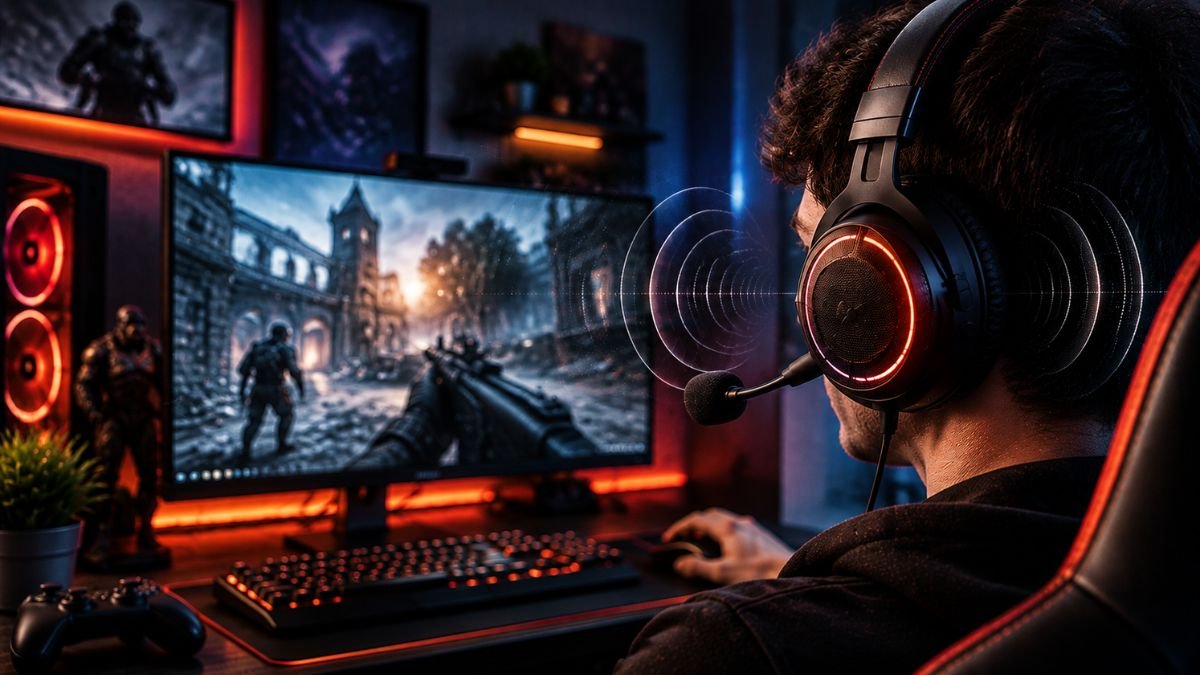
Surround sound gaming headsets can be worth it for gamers who want a more immersive audio experience and improved awareness of sound direction.
However, they are not automatically better than stereo headsets. The real value depends on audio processing quality, game support, headset tuning, and personal preference.
However, they do not automatically provide better performance than stereo headsets. The real benefit depends on the quality of audio processing, game support, headset tuning, and personal preference.
Gaming audio has become one of the most important parts of the overall gaming experience. Modern players are no longer focused only on graphics and performance; they also want accurate sound that helps them understand what is happening around them.
A surround sound gaming headset is designed to create a wider and more realistic audio environment by making sounds appear as if they are coming from different directions.
This can include hearing footsteps behind a character, identifying the location of environmental sounds, or experiencing a more immersive atmosphere during gameplay.
However, surround sound technology is also one of the most misunderstood features in gaming accessories. Many headsets advertise terms such as 7.1 surround sound, 3D audio, and spatial audio, but these labels do not always explain how the technology actually works or whether it provides a meaningful improvement.
Most gaming headsets do not contain multiple physical speakers surrounding the listener. Instead, they use software-based processing to simulate directional audio through standard headset drivers.
The effectiveness of this technology depends on several factors, including audio quality, game compatibility, processing algorithms, and the user’s ability to interpret sound cues.
Understanding how surround sound works and where it provides real benefits can help gamers decide whether this feature is valuable for their setup.
What Is a Surround Sound Gaming Headset?
A surround sound gaming headset is a headset that uses audio processing technology to create the perception of sounds coming from different locations around the player.
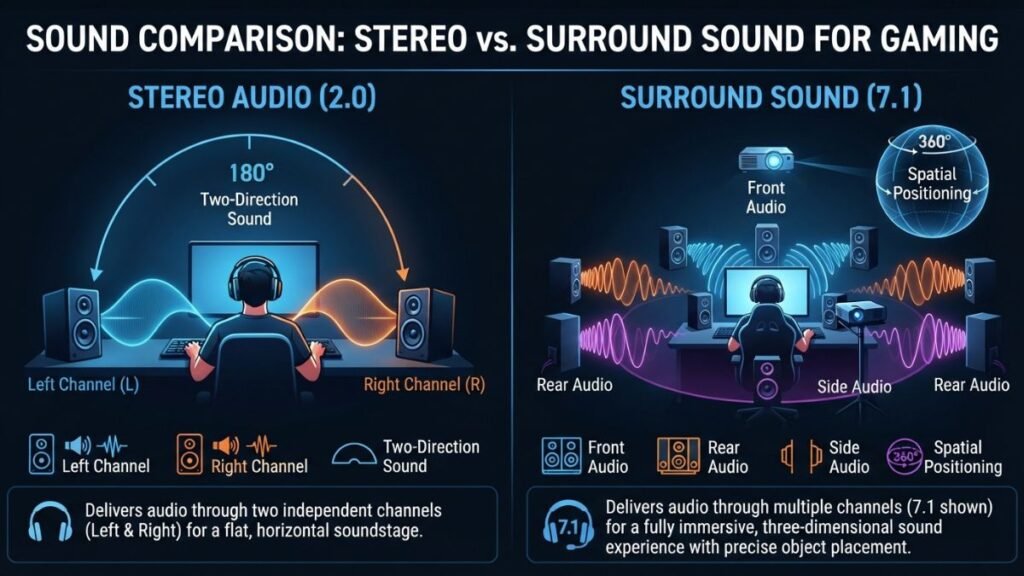
Traditional stereo headsets use two audio channels:
- Left channel
- Right channel
Surround sound technology attempts to expand this experience by adding a greater sense of:
- Direction
- Distance
- Depth
- Position
This allows players to experience audio in a more three-dimensional way.
For example, instead of only hearing footsteps on the left or right side, a surround sound system attempts to make the player perceive whether those footsteps are coming from the front, back, above, or another angle.
How Surround Sound Differs From Regular Stereo Audio
Stereo audio has been the standard format for headphones for decades.
With stereo sound:
- The left ear receives the left audio channel.
- The right ear receives the right audio channel.
- Direction is created through differences in volume and timing.
This method can already provide strong positional awareness because human hearing naturally uses two ears to locate sounds.
Surround sound adds another layer through digital processing. The software modifies audio signals to create additional spatial cues that imitate how sounds behave in real environments.
A basic example:
A stereo headset may help a player recognize that footsteps are coming from the right side.
A surround sound gaming headset attempts to create the impression that those footsteps are specifically coming from the right rear direction.
What Does 7.1 Surround Sound Mean?
The term 7.1 surround sound originally comes from traditional speaker systems.
A physical 7.1 audio setup usually includes:
- Front left speaker
- Front right speaker
- Center speaker
- Side speakers
- Rear speakers
- Subwoofer channel
However, most gaming headsets labeled as “7.1 surround sound” do not contain seven separate speakers inside the headset.
Instead, they use virtual 7.1 surround sound, where software creates the illusion of multiple audio channels.
This approach allows gaming headsets to provide directional audio without requiring a large speaker setup.
According to Dolby Atmos, modern spatial audio systems use advanced sound positioning techniques to create a more immersive listening experience across compatible devices.
Virtual Surround Sound vs True Surround Sound
There are two main approaches to surround audio:
| Type | How It Works | Common Usage |
|---|---|---|
| True Surround Sound | Uses multiple physical speakers to create separate channels | Rare in gaming headsets |
| Virtual Surround Sound | Uses software processing to simulate directional audio | Most common approach |
For gaming headsets, virtual surround sound is the dominant technology because it provides spatial effects without increasing headset size, weight, or complexity.
How Surround Sound Technology Works in Gaming Headsets
Surround sound gaming headsets combine hardware and software to create a wider audio experience.
The headset itself provides the physical audio output, while software processing changes how the sound reaches the listener.
These technologies are part of the broader gaming headset technology ecosystem, which includes audio processing, microphones, connectivity, and other features that influence the overall gaming experience.
The goal is not to create additional speakers but to influence how the brain interprets audio direction.
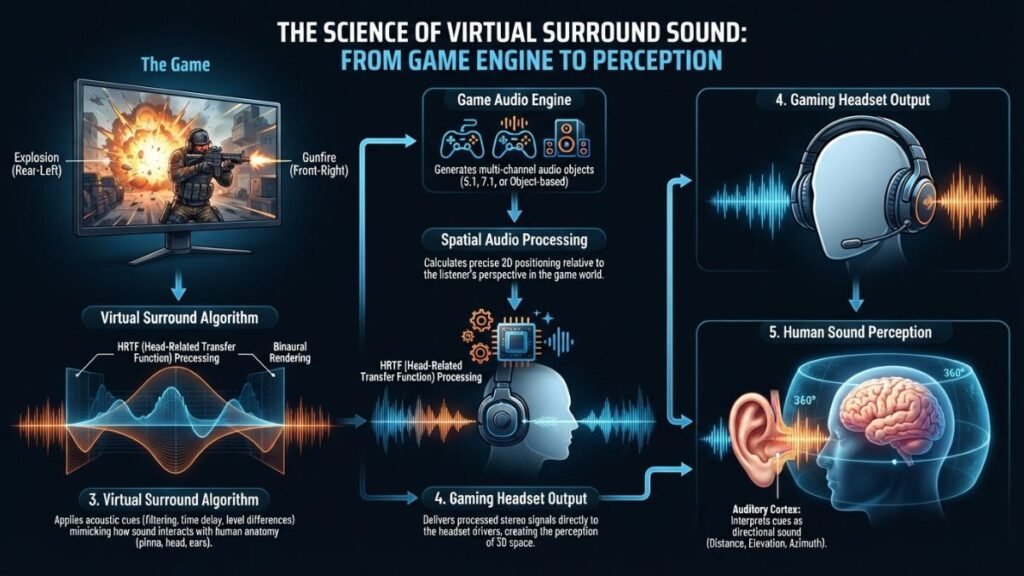
How Virtual Surround Sound Creates Directional Audio
Virtual surround sound relies on principles related to how humans naturally hear the world.
When a sound reaches a person, the brain determines its location by analyzing:
- Differences in timing between both ears
- Volume differences
- Frequency changes
- Reflections from the environment
Audio processing systems attempt to recreate these natural signals.
A game may identify that a sound source is located behind the player. The surround processing software then adjusts the audio characteristics to create cues that suggest that direction.
The result is a simulated three-dimensional sound experience.
The Role of Game Audio Engines
A surround sound gaming headset does not create directional audio by itself.
The headset can only reproduce the audio information provided by the game. The accuracy of positional sound depends heavily on how the game engine creates and processes audio.
Modern games use advanced audio systems that calculate factors such as:
- Distance between the player and sound source
- Direction of movement
- Environmental effects
- Obstacles that block or change sound
- Room size and reflections
For example, if an enemy character moves behind a wall, a well-designed game audio engine may reduce volume, change frequencies, and create environmental effects that make the sound feel more realistic.
A surround sound headset then processes these signals to help the player interpret the location of that sound.
Why Game Compatibility Matters
A common misunderstanding is that a surround sound headset automatically improves every game.
In reality, the headset depends on the game’s audio design.
A game with detailed positional audio can take advantage of spatial technologies, while a game with basic sound design may show little difference.
Factors that influence the experience include:
- Native spatial audio support
- Audio engine quality
- Game settings
- Platform compatibility
- Headset software
This is why the same headset can feel impressive in one game and less noticeable in another.
Software Processing and Spatial Audio Formats
Modern gaming audio relies heavily on software processing.
Instead of using multiple physical speakers inside a headset, software creates the perception of additional sound directions.
Popular spatial audio technologies include:
- Windows Sonic for Headphones
- Dolby Atmos for Headphones
- DTS Headphone:X
- Console-based 3D audio systems
These technologies use different processing methods, but they share a similar goal: creating a more realistic three-dimensional sound experience.
For example, Windows Sonic for Headphones provides spatial audio processing designed to enhance headphone listening experiences on compatible Windows devices.
Dolby Atmos and Headphone-Based Spatial Audio
Dolby Atmos is one example of a spatial audio technology designed to create a more immersive sound environment.
Unlike traditional stereo audio, spatial audio systems attempt to represent sounds based on their position in a three-dimensional space.
This can include:
- Horizontal direction
- Distance perception
- Height effects
- Environmental positioning
For gaming, this technology can be useful when a game supports detailed audio positioning.
However, the final experience still depends on the headset hardware, game implementation, and user preferences.
Virtual 7.1 Surround Sound vs Stereo Gaming Audio
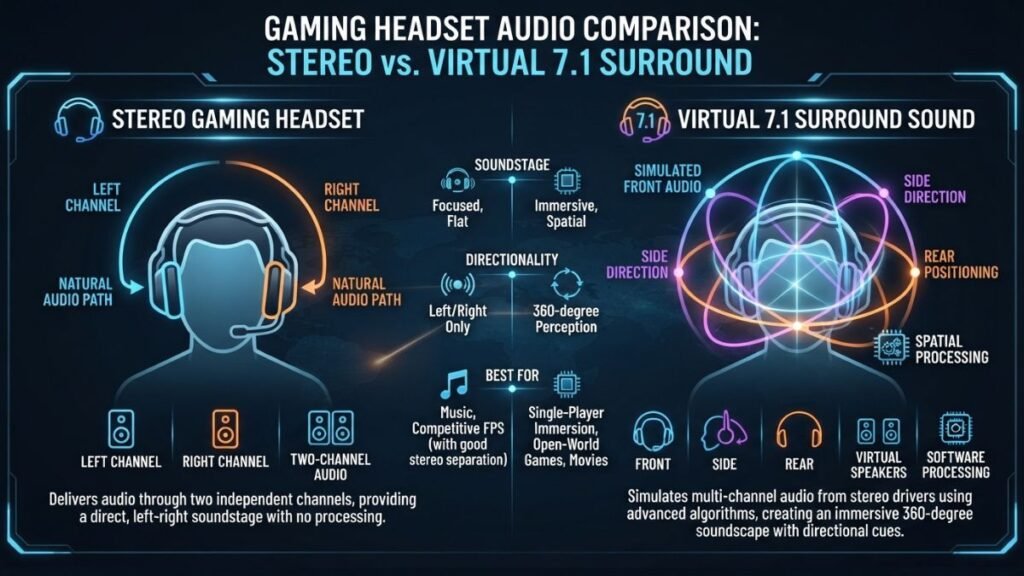
The difference between virtual 7.1 surround sound and stereo audio is one of the most important concepts for understanding gaming headsets.
Many users assume that a headset with more channels must automatically produce better sound. However, audio quality depends on much more than the number of channels.
A well-tuned stereo headset can provide excellent positional awareness, while a poorly implemented surround system may create unnecessary processing effects.
How Stereo Gaming Headsets Work
Understanding the difference between a gaming headset vs regular headphones is also important because audio hardware, microphone features, and software support can significantly affect the overall experience.
Stereo gaming headsets use two audio channels:
- Left channel
- Right channel
This simple approach remains popular because it provides natural and reliable sound reproduction.
Stereo audio allows players to identify:
- Left and right movement
- Changes in volume
- Basic direction of sound sources
The human brain already uses two ears to locate sounds, meaning stereo audio can provide strong spatial information when the headset is well designed.
Advantages of Stereo Gaming Audio
Stereo gaming headsets offer several benefits:
Natural Sound Presentation
Because stereo audio involves less processing, it often provides a cleaner and more realistic listening experience.
Better Audio Consistency
Stereo profiles are usually more predictable because they do not rely heavily on additional processing algorithms.
Broad Compatibility
Stereo headsets generally work across:
- PCs
- Consoles
- Mobile devices
- Audio systems
without requiring additional software.
How Virtual 7.1 Surround Sound Works
Virtual 7.1 surround sound uses software algorithms to simulate additional audio channels.
The system modifies elements such as:
- Timing
- Volume
- Frequency response
- Audio positioning
to create the impression of sounds coming from multiple directions.
Unlike a traditional 7.1 speaker setup, the headset does not physically surround the listener with multiple speakers.
Instead, it creates the illusion of surround positioning through digital processing.
Benefits of Virtual 7.1 Surround Sound
Virtual surround sound can provide advantages in certain gaming situations.
More Immersive Experiences
For cinematic games, surround processing can create a stronger feeling of being inside the game world.
Players may notice:
- More realistic environments
- Wider sound perception
- Stronger atmosphere
Improved Environmental Awareness
In some games, surround sound can help players notice:
- Movement around them
- Direction of sound effects
- Changes in the environment
However, the benefit depends on the quality of the implementation.
Wider Soundstage
Some users prefer virtual surround because it makes audio feel more open compared with traditional headphone listening.
Stereo vs Virtual 7.1 Surround Sound Comparison
| Feature | Stereo Gaming Headset | Virtual 7.1 Surround Sound Headset |
|---|---|---|
| Audio Processing | Minimal | Software-based processing |
| Sound Presentation | Natural and direct | Wider simulated sound field |
| Directional Awareness | Depends on tuning | Depends on processing quality |
| Immersion | Good | Often higher |
| Competitive Gaming | Can perform extremely well | Helpful for some players |
| Music Listening | Usually preferred | May sound processed |
| Setup | Simple | May require software configuration |
Which One Is Better for Gaming?
There is no universal winner between stereo and virtual surround sound.
The better choice depends on the user’s priorities.
Players who focus on competitive games may prefer:
- Clear audio separation
- Accurate positioning
- Low processing
- Consistent sound
Players who prefer immersive experiences may enjoy:
- Wider sound environments
- More cinematic effects
- Spatial audio features
A surround sound gaming headset should be viewed as an additional tool, not an automatic upgrade.
Does Surround Sound Actually Improve Gaming Performance?
One of the main reasons gamers consider a surround sound gaming headset is the possibility of gaining a competitive advantage.
The idea seems simple: if a player can hear an opponent before seeing them, they may have more time to react. However, surround sound does not directly improve gaming skill. Instead, it can provide additional audio information that helps players understand their environment.
The actual benefit depends on:
- Audio processing quality
- Game design
- Player experience
- Headset tuning
- Personal preference
A surround sound headset is a tool that can improve awareness, but it cannot replace game knowledge or mechanical skill.
How Surround Sound Can Help in Competitive Games
Competitive games often use audio as an important gameplay element.
Players rely on sound cues to understand situations they cannot immediately see.
Examples include:
- Enemy footsteps
- Weapon reload sounds
- Vehicle movement
- Doors opening
- Environmental changes
- Character movement
A well-implemented spatial audio system can make these sounds easier to locate by creating stronger directional cues.
For example:
A player may hear footsteps approaching from the left side.
A more advanced spatial audio system may help the player determine whether those footsteps are:
- Front left
- Rear left
- Above
- Below
This additional information can influence decision-making.
Surround Sound in First-Person Shooter Games
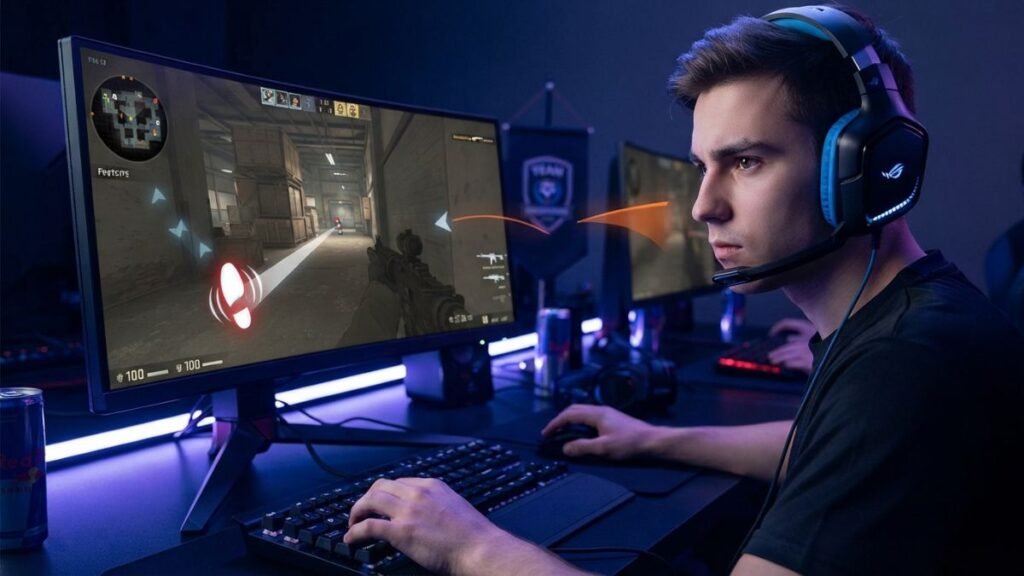
First-person shooter games are among the genres where surround sound is most discussed.
Games that depend heavily on positioning often require players to interpret audio information quickly.
Examples include:
- Competitive FPS games
- Tactical shooters
- Battle royale games
Players may use audio cues to estimate:
- Enemy location
- Movement direction
- Distance
- Timing of actions
In these situations, accurate sound positioning can be valuable.
However, accuracy is more important than simply creating a larger sound field.
A headset with excessive processing may make sounds feel wider while reducing clarity.
Does Surround Sound Improve Reaction Time?
Surround sound does not directly make a player react faster.
Instead, it may provide earlier information.
The process works like this:
- A game produces an audio cue.
- The headset reproduces that information.
- The player interprets the sound.
- The player makes a decision.
The headset only affects the second step.
Reaction speed still depends on:
- Experience
- Practice
- Decision-making
- Visual awareness
- Game knowledge
The Importance of Audio Accuracy
For competitive gaming, accurate audio reproduction is often more important than having additional effects.
Players usually benefit from:
- Clear footsteps
- Balanced frequency response
- Good sound separation
- Low latency
A headset that creates artificial surround effects but reduces clarity may actually make important sounds harder to identify.
This is why some competitive players prefer high-quality stereo headsets over virtual surround systems.
Surround Sound and Different Gaming Genres
The value of surround sound changes depending on the type of game.
| Game Genre | Surround Sound Value |
|---|---|
| Competitive FPS | Medium to High depending on implementation |
| Horror Games | High because atmosphere is important |
| Open-World Games | High for immersion |
| Racing Games | Medium for environmental realism |
| Strategy Games | Lower priority |
| Casual Games | Depends on personal preference |
How Surround Sound Improves Gaming Immersion
While competitive players focus on accuracy, many gamers value surround sound because it creates a more engaging experience.
In cinematic games, spatial audio can improve:
- Environmental realism
- Atmosphere
- Emotional impact
- Sense of scale
Examples include:
- Hearing weather effects around the player
- Experiencing explosions with greater depth
- Feeling surrounded by the game environment
For these players, surround sound is less about performance and more about immersion.
When Surround Sound Gaming Headsets Are Worth It
A surround sound gaming headset is most valuable when the technology matches the user’s gaming habits.
Surround Sound Is Worth Considering If You:
Players should also consider other factors beyond audio processing, including comfort, connectivity, and features found in modern wireless gaming headsets.
Play Immersive Single-Player Games
Players who enjoy story-driven experiences may notice the biggest improvement.
Benefits include:
- More realistic environments
- Stronger atmosphere
- Better spatial awareness
Play Games With Detailed Audio Design
Games with advanced audio systems can take better advantage of surround processing.
The headset and game work together to create a more realistic experience.
Want More Environmental Awareness
Surround sound can help some players notice:
- Movement around them
- Direction of sound effects
- Changes in the environment
When Surround Sound May Not Be Worth It
Surround sound is not always the most important feature.
Some users may prefer other improvements.
Competitive Players Who Prefer Simplicity
Some competitive gamers prefer stereo because it offers:
- Cleaner sound
- Less processing
- More predictable audio
- Better consistency
Music-Focused Users
Gaming headsets are often used for multiple purposes.
For users who frequently listen to music, a well-tuned stereo headset may provide a more natural experience.
Users With an Already Good Stereo Headset
Upgrading from a poor headset to a better-quality stereo model may provide a larger improvement than simply adding surround processing.
Limitations of Surround Sound Gaming Headsets
Although surround sound gaming headsets can improve immersion and provide additional spatial information, they are not a perfect solution for every player.
Many gamers assume that a headset with 7.1 surround sound automatically delivers better audio performance. However, surround technology has several limitations that are important to understand.
The final experience depends on:
- Quality of the audio processing
- Headset hardware
- Game compatibility
- Personal hearing preferences
- Audio configuration
Surround sound is a feature that can enhance gaming, but it should not be viewed as a replacement for overall headset quality.
Virtual Surround Sound Can Feel Artificial
Because virtual surround sound relies on digital processing, the result depends heavily on how well the technology is implemented.
A high-quality system can create a convincing sense of space, while a poorly designed system may make audio feel unnatural.
Some common issues include:
- Artificial sound effects
- Reduced clarity
- Excessive echo
- Less accurate positioning
- Distorted audio balance
For competitive gaming, these problems can become noticeable because players rely on small audio details to make decisions.
A wider soundstage does not always mean better accuracy.
Surround Sound Depends on Software Quality
The term 7.1 surround sound does not describe the complete audio experience.
Two gaming headsets with the same label can produce very different results because manufacturers may use different:
- Audio algorithms
- Equalizer settings
- Processing methods
- Software features
Technologies such as DTS Headphone:X focus on creating virtual three-dimensional audio experiences through headphones, showing how software processing plays a major role in modern gaming audio.
The quality of the processing system often matters more than the number of channels advertised.
Surround Sound Cannot Fix Poor Hardware
A common mistake is assuming that surround processing can transform any headset into a premium audio device.
It cannot.
The foundation of good gaming audio still depends on hardware components such as:
- Speaker drivers
- Sound tuning
- Frequency response
- Comfort
- Microphone quality
- Build quality
A well-designed stereo headset with excellent tuning may outperform a lower-quality headset that simply adds virtual surround effects.
Human Hearing Already Creates Spatial Awareness
Human hearing naturally allows people to locate sounds using two ears.
The brain identifies direction through:
- Timing differences between ears
- Volume differences
- Frequency changes
- Environmental reflections
Because of this, many players can already achieve strong positional awareness with a quality stereo headset.
Virtual surround sound attempts to enhance these natural cues, but the results vary between users.
Setup Problems Can Affect Performance
Surround sound features often require proper configuration.
Spatial audio should be treated as one part of a complete gaming audio setup, alongside correct device selection, connection settings, audio routing, volume levels, and other system configurations.
Common setup problems include:
- Incorrect audio settings
- Conflicting spatial audio software
- Unsupported game modes
- Incorrect console configuration
For example, enabling multiple surround processing systems at the same time can sometimes create unnecessary audio changes instead of improving clarity.
Testing different settings is usually the best way to find the most accurate experience.
Not Every Game Benefits Equally
The value of surround sound depends on the game’s audio design.
Games with detailed sound systems can provide more noticeable benefits.
| Game Type | Surround Sound Impact |
|---|---|
| Competitive FPS Games | Higher potential benefit |
| Horror Games | Strong immersion improvement |
| Open-World Games | Better environmental realism |
| Older Games | Limited improvement |
| Casual Games | Depends on preference |
| Music Playback | Usually lower priority |
The Future of Gaming Audio Technology
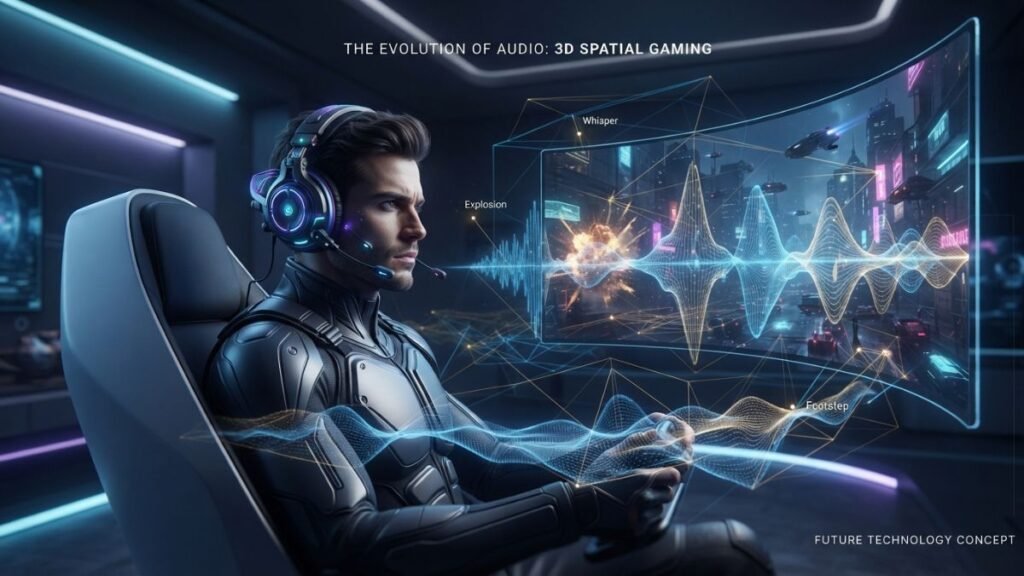
Gaming audio continues to move beyond traditional stereo and basic surround processing.
Future technologies are expected to focus on making audio experiences more realistic through:
- Advanced spatial audio
- Real-time sound environments
- Better object-based audio processing
- Improved personalization
- More accurate headphone calibration
Modern spatial audio systems are already moving toward creating sound environments where individual audio objects can be positioned naturally around the listener.
Instead of simply adding more channels, future gaming audio is likely to focus on smarter processing and more accurate simulation of real-world sound.
Will Surround Sound Become More Important in Gaming?
As games become more realistic, audio will continue to play a larger role in immersion.
Future gaming experiences may use audio systems that better understand:
- Player location
- Environment size
- Sound reflections
- Movement direction
- Virtual surroundings
However, the goal is not necessarily to create more complicated audio labels.
The focus will likely remain on creating clearer, more natural, and more realistic sound experiences.
Final Thoughts: Are Surround Sound Gaming Headsets Worth It?
So, are surround sound gaming headsets worth it?
The answer depends on what you expect from your gaming audio experience.
A surround sound gaming headset can be valuable for players who want:
- More immersive gameplay
- Better environmental awareness
- Stronger spatial audio effects
- A more cinematic experience
However, surround sound does not automatically make a headset better or make a player more skilled.
A high-quality gaming audio experience depends on the combination of:
- Accurate sound reproduction
- Comfortable design
- Reliable connectivity
- Good microphone quality
- Proper software implementation
For competitive gamers, a clean and accurate audio profile may matter more than additional surround effects. For players who enjoy immersive worlds and cinematic experiences, surround sound can add another layer of realism.
The best approach is to understand how the technology works and choose the audio experience that matches the games you actually play.
Frequently Asked Questions About Surround Sound Gaming Headsets
Are surround sound gaming headsets worth it?
Surround sound gaming headsets can be worth it for players who value immersive audio and directional awareness. However, they are not automatically better than stereo headsets. The benefit depends on audio processing quality, game support, and personal preference.
Are 7.1 surround sound gaming headsets better than traditional stereo headsets?
Not always. Virtual 7.1 surround sound uses software processing to simulate directional audio, while stereo headsets use traditional left and right channels. A high-quality stereo headset can sometimes provide clearer and more accurate sound than a poorly implemented surround system.
Can surround sound gaming headsets help hear footsteps in games?
A surround sound gaming headset may help some players recognize directional sounds such as footsteps, but the improvement depends on the game’s audio design and headset quality.
Do surround sound headsets have multiple speakers inside?
Most gaming headsets with surround sound do not contain multiple physical speakers. They usually use software processing to simulate additional audio directions through standard headset drivers.
Does surround sound improve FPS gaming performance?
Surround sound does not directly improve gaming skill. It may provide additional audio information that helps players understand their surroundings, but reaction speed and decision-making still depend on player experience.
Should I use surround sound or stereo for gaming?
The choice depends on personal preference. Stereo may provide cleaner and more predictable audio, while surround sound may create a wider and more immersive experience.
Does surround sound work on consoles?
Surround sound can work on consoles when the headset, game, and platform support compatible spatial audio technologies. Users should check compatibility before relying on specific surround features.