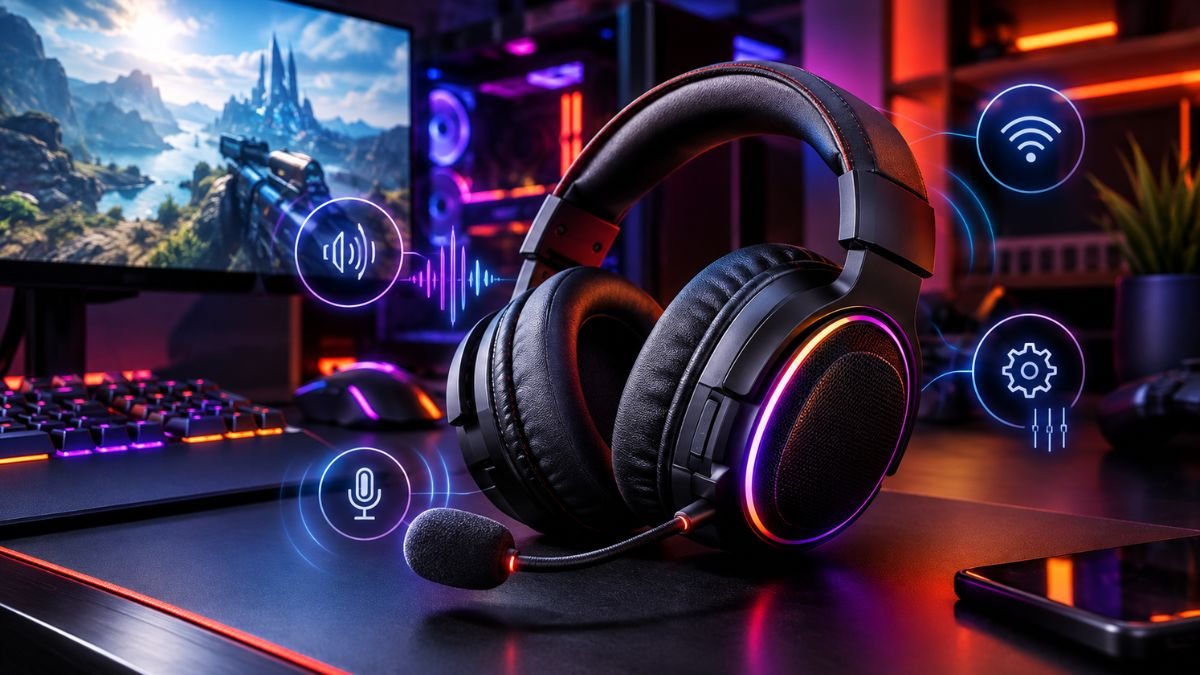
Gaming headset features are the technologies and design elements that influence audio quality, communication, comfort, and connectivity during gaming.
These features include sound drivers, microphones, surround audio, wireless connections, software controls, and ergonomic designs that affect how players experience games across different platforms.
Choosing a gaming headset is no longer just about finding a device that produces sound. Modern gaming headsets combine multiple technologies designed to improve immersion, communication, and overall comfort during long gaming sessions.
For many players, specifications such as driver size, frequency response, microphone type, wireless connection, and surround sound can feel confusing. Two headsets may look similar but offer very different experiences because of the technology used inside them.
Understanding gaming headset features helps users make better decisions by explaining what each specification actually does and when it matters. A competitive player who needs accurate positional audio may value different features compared with someone who mainly plays casual games with friends.
The gaming headset market has also expanded beyond traditional wired models. Today, players can choose between USB headsets, 3.5mm connections, Bluetooth devices, and low-latency wireless technologies designed specifically for gaming.
This guide explains the major features found in gaming headsets, including audio performance, microphone technology, connectivity options, comfort factors, and software capabilities.
The goal is not to promote specific products but to help users understand the technology behind modern gaming audio equipment.
What Makes a Gaming Headset Different From a Regular Headset?
A gaming headset and a regular headset may appear similar because both provide audio output and often include microphones. However, gaming-focused models are usually designed around specific needs that appear during interactive experiences.
Unlike traditional headphones that mainly focus on music playback, gaming headsets are built to handle real-time audio environments.
The differences between these devices become clearer when comparing gaming headset vs regular headphones.
Games require players to identify direction, distance, movement, and environmental changes while also communicating with teammates.
A player hearing footsteps behind them, detecting an approaching vehicle, or communicating during a multiplayer match depends on more than just loud volume. The headset must process different sound elements clearly and deliver them with minimal delay.
Gaming headsets usually focus on three major areas:
| Feature Area | Why It Matters During Gaming |
|---|---|
| Audio positioning | Helps players understand where sounds are coming from |
| Microphone performance | Improves team communication and voice clarity |
| Comfort design | Allows longer gaming sessions without discomfort |
Another difference is compatibility. Gaming headsets are often designed to work across multiple platforms, including PCs, consoles, and mobile devices.
Understanding how these devices connect and work within a complete gaming environment is also important when building a proper gaming headset setup.
Features such as USB connections, wireless adapters, and software customization are commonly included because gamers often use different setups.
Gaming-Focused Audio Design
Audio design is one of the biggest differences between gaming headsets and standard headphones.
In games, sound is not only about entertainment. Audio provides information. A player may rely on subtle sounds such as footsteps, reload animations, environmental effects, or directional movement to understand what is happening around them.
Gaming headsets often prioritize:
- Clear positional audio
- Balanced sound separation
- Detailed environmental effects
- Strong communication between audio channels
A headset with good audio separation allows different sounds to remain understandable instead of blending together. This can be especially useful in fast-paced games where multiple effects happen at the same time.
However, more features do not always mean better performance. A headset with advanced audio processing still needs proper tuning and compatibility with the gaming platform to provide a useful experience.
Communication Features for Multiplayer Gaming
Multiplayer gaming has made microphone quality an essential part of headset design.
A gaming headset microphone needs to capture the user’s voice clearly while reducing unwanted background sounds such as keyboard noise, room sounds, or nearby conversations.
Players who want to understand microphone technology in more detail can explore how gaming headset microphones are designed for clearer communication.
Important microphone characteristics include:
- Voice clarity
- Noise filtering
- Microphone positioning
- Pickup consistency
A poorly positioned microphone can affect communication even if the headset has strong audio performance. This is why many gaming headsets use adjustable boom microphones that can be placed closer to the user’s mouth.
Microphone technology continues to improve as manufacturers add software-based processing, noise reduction, and voice customization features. Understanding these technologies helps users evaluate what actually improves communication rather than focusing only on marketing terms.
Gaming Headset Audio Features Explained
Audio performance is one of the most important parts of a gaming headset because sound provides information, not just entertainment. In competitive and immersive games, players often depend on audio cues to understand their surroundings, identify movement, and react quickly.
Modern gaming headset features related to audio include driver technology, frequency response, stereo imaging, surround sound, and spatial audio processing. Each feature affects the way players experience sound, but the impact depends on the game type, platform, and personal preference.
A headset designed for competitive shooters may prioritize accurate directional audio, while a headset used for story-driven games may focus more on immersion and balanced sound quality.
Driver Size and Sound Quality
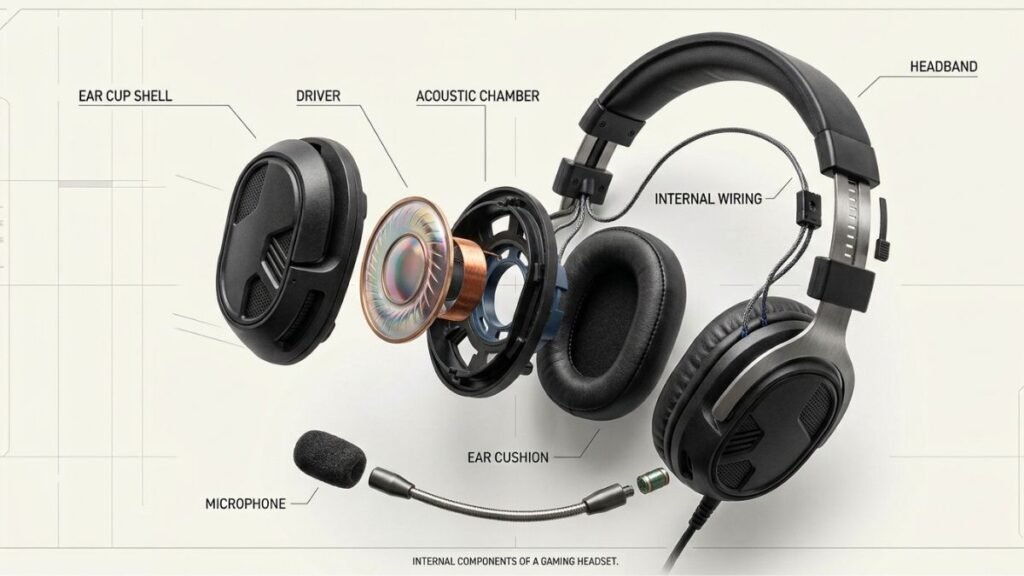
The driver is the component inside a headset that converts electrical signals into sound waves. It is one of the most discussed specifications because it directly influences how audio is produced.
Gaming headsets commonly use dynamic drivers because they provide a balance between cost, durability, and sound performance.
A larger driver does not automatically guarantee better audio quality. While larger drivers can potentially move more air and create stronger bass response, overall sound depends on multiple factors:
- Driver tuning
- Material quality
- Headset design
- Software processing
- Acoustic chamber construction
For gaming, sound separation is often more important than simply producing louder audio. Players need to distinguish between different sounds happening at the same time.
For example, during a multiplayer match, a player may need to hear:
- Footsteps approaching from a specific direction
- Teammate communication
- Environmental sounds
- Weapon effects
A well-designed headset separates these elements so they remain understandable instead of becoming a single layer of noise.
Frequency Response Explained
Frequency response describes the range of sounds a headset can reproduce, usually measured in Hertz (Hz).
The human hearing range is commonly considered to be around 20 Hz to 20 kHz, although individual hearing ability varies.
A headset’s frequency response covers three main areas:
| Frequency Range | Sound Characteristics | Gaming Impact |
|---|---|---|
| Low frequencies | Bass, explosions, deep effects | Adds impact and immersion |
| Mid frequencies | Voices and important details | Improves dialogue and communication |
| High frequencies | Detail, movement sounds, effects | Helps identify subtle audio cues |
However, a wider frequency range does not automatically mean better performance.
Manufacturers may highlight large frequency numbers, but real-world gaming performance depends more on how those frequencies are balanced.
A headset with excessive bass may make explosions feel powerful but can reduce clarity for important sounds like footsteps or voice communication.
Stereo vs Surround Sound
One of the most common discussions around gaming headsets is whether surround sound improves gaming performance.
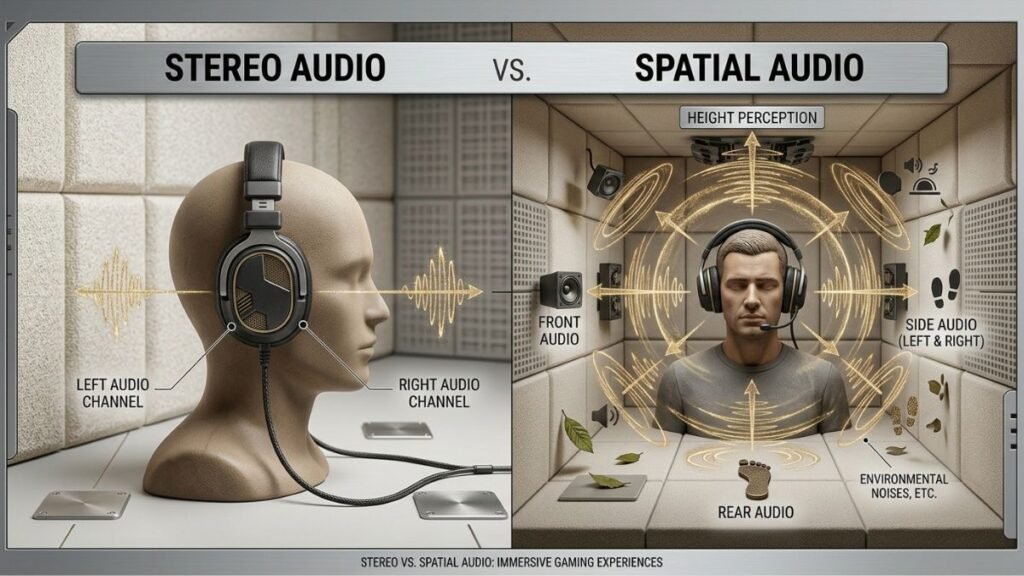
Traditional stereo headsets use two audio channels:
- Left
- Right
This creates a natural sense of direction by changing volume and timing between channels.
Surround sound technologies attempt to create a wider audio environment by processing sound digitally. These systems can simulate multiple audio positions around the listener.
For example, virtual surround processing may help create the feeling that sound is coming from:
- Behind the player
- Above the player
- From different sides
However, results depend heavily on the implementation and the game itself.
Some players prefer traditional stereo because it provides a cleaner and more natural sound, while others enjoy virtual surround because it creates a stronger sense of immersion.
Players interested in understanding this technology in more detail can explore how surround sound gaming headsets use audio processing to create positional awareness.
Spatial Audio Technology
Spatial audio has become increasingly common across gaming platforms because it focuses on creating a more realistic three-dimensional sound environment.
Unlike basic stereo audio, spatial audio attempts to simulate how humans naturally perceive sound direction and distance.
According to Microsoft spatial sound overview, spatial audio technologies use audio processing techniques to create a more immersive and realistic listening experience.
In gaming, spatial audio can be useful for:
- Open-world games with detailed environments
- Competitive games requiring positional awareness
- Immersive single-player experiences
However, spatial audio is not a replacement for good headset hardware. Processing technology works together with the headset’s drivers, tuning, and game support.
Microphone Features That Matter for Gaming
A gaming headset is not only an audio device. For multiplayer gaming, the microphone is equally important because communication can directly affect teamwork and coordination.
A good gaming microphone should capture speech clearly while reducing unwanted background sounds.
Important microphone-related features include:
- Voice clarity
- Noise reduction
- Microphone placement
- Pickup pattern
- Software processing
A headset with excellent audio but poor microphone performance can create frustrating communication problems during multiplayer sessions.
Microphone Clarity and Voice Capture
Microphone clarity depends on how accurately the device captures the user’s voice.
Several factors influence microphone performance:
- Microphone quality
- Distance from the user’s mouth
- Signal processing
- Environmental noise
Boom microphones are popular in gaming headsets because they can be positioned closer to the user’s mouth. This helps capture voice more consistently compared with microphones placed inside the headset body.
A properly positioned microphone reduces the need for excessive volume processing, which can sometimes create unnatural voice quality.
According to Shure microphone technology resources, microphone design, placement, and engineering principles play important roles in achieving clear voice capture.
Noise Reduction and Background Filtering
Noise reduction has become a common feature in modern gaming headsets because many players use their equipment in environments that are not completely silent.
Background sounds such as keyboard clicks, fans, conversations, and room noise can interfere with voice communication. Noise reduction technologies attempt to separate the user’s voice from unwanted sounds and improve clarity for teammates.
There are two common approaches:
| Technology | How It Works | Main Benefit |
|---|---|---|
| Hardware-based noise reduction | Uses microphone design and physical placement | Reduces unwanted sounds before processing |
| Software-based noise filtering | Uses algorithms to analyze and modify audio signals | Improves voice clarity through digital processing |
While these technologies can improve communication, they are not perfect. Strong filtering may sometimes affect natural voice quality by removing parts of the original sound.
The best results usually come from combining:
- A well-positioned microphone
- Good room conditions
- Proper software settings
- Quality audio processing
Understanding these limitations helps users recognize that microphone features are tools, not automatic solutions for every environment.
Boom Microphones vs Built-In Microphones
The microphone design also influences the overall communication experience.
Boom microphones are commonly found on gaming headsets because they can be positioned close to the user’s mouth. This placement usually provides more consistent voice capture.
Built-in microphones, on the other hand, are integrated into the headset body. They can create a cleaner appearance and are common in compact designs, but their distance from the user’s mouth can affect voice pickup.
| Microphone Type | Advantages | Limitations |
|---|---|---|
| Boom microphone | Better voice positioning and control | Larger physical design |
| Built-in microphone | Cleaner appearance and portability | May capture more environmental sound |
For players who frequently use voice chat, microphone placement can be just as important as the microphone technology itself.
Wireless, Wired and Connection Features
Connection technology is another important part of gaming headset features because it affects latency, compatibility, battery life, and convenience.
Different connection methods are designed for different situations. A competitive PC player, a console user, and someone who switches between gaming and mobile devices may have different priorities.
The main connection types include:
- Wired 3.5mm connections
- USB connections
- 2.4GHz wireless connections
- Bluetooth connectivity
Each option has advantages and limitations.
Wired Gaming Headset Connections
Wired headsets remain popular because they provide a direct connection between the device and the headset.
The most common wired options include:
3.5mm audio connection
This traditional connection is widely supported across:
- PCs
- Gaming consoles
- Controllers
- Mobile devices with compatible ports
Its main advantage is simplicity. Users can connect the headset without worrying about battery levels or wireless pairing.
USB connection
USB headsets often include built-in digital audio processing. This allows manufacturers to add features such as:
- Custom audio profiles
- Virtual surround processing
- Software controls
However, compatibility can vary depending on the device being used.
2.4GHz Wireless Technology
Many modern gaming headsets use 2.4GHz wireless connections because they are designed specifically for low-latency communication between gaming devices and headsets.
Unlike standard Bluetooth connections, dedicated wireless adapters can maintain a more direct connection optimized for gaming scenarios.
Players interested in understanding wireless headset technology in more detail can explore how wireless gaming headsets use different connection methods to balance freedom, stability, and performance.
Key advantages of 2.4GHz wireless technology include:
- Lower latency compared with many Bluetooth connections
- Stable connection during gameplay
- Freedom from cables
However, wireless headsets also introduce additional considerations:
- Battery management
- Charging time
- Wireless range
- Device compatibility
Bluetooth Connectivity
Bluetooth is one of the most widely used wireless technologies across consumer electronics.
According to Bluetooth wireless technology information, Bluetooth provides a standardized method for short-range wireless communication between compatible devices.
Bluetooth gaming headset features are useful because they allow users to connect with:
- Smartphones
- Tablets
- Laptops
- Other Bluetooth-enabled devices
However, Bluetooth may not always be the preferred choice for competitive gaming because latency can vary depending on the implementation, codec support, and device compatibility.
For casual gaming, mobile gaming, or everyday listening, Bluetooth can provide convenient flexibility.
Comfort and Design Features for Long Gaming Sessions
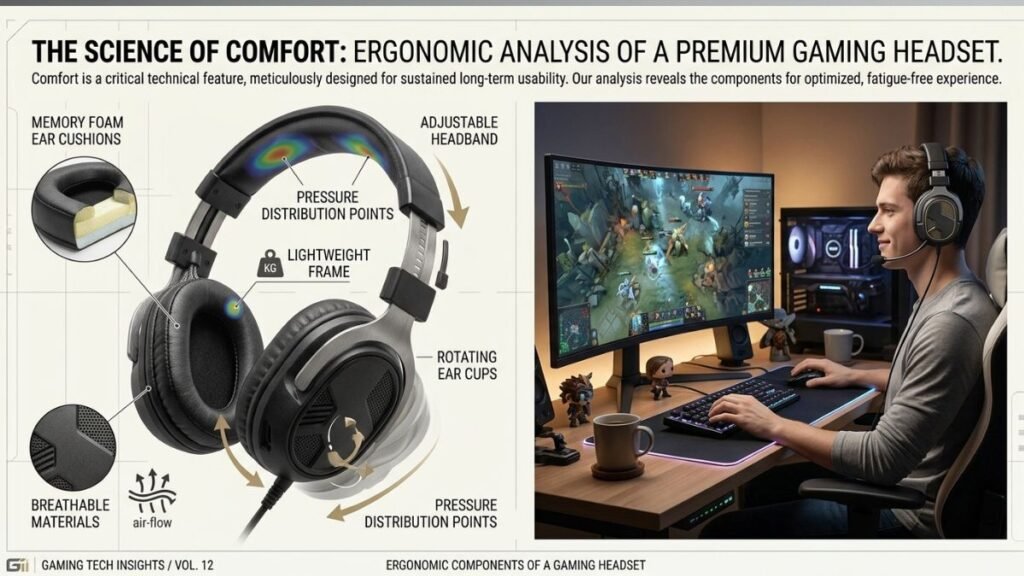
Audio performance is important, but comfort determines whether a gaming headset remains enjoyable after several hours of use.
Many gamers spend extended periods wearing headsets, especially during multiplayer sessions, tournaments, or long single-player campaigns. Because of this, physical design is an important part of overall headset quality.
Important comfort-related features include:
- Ear cup design
- Weight distribution
- Headband adjustment
- Material selection
- Clamp pressure
A headset with excellent audio technology may still create a poor experience if it causes discomfort during longer sessions.
Ear Cup Design and Materials
Ear cups influence both comfort and sound isolation.
Common designs include:
Over-ear ear cups
These surround the ears and are popular among gaming headsets because they can provide:
- Better passive noise isolation
- More comfortable long-term use
- More space for larger drivers
Materials also affect comfort.
Common ear cup materials include:
- Memory foam
- Fabric cushions
- Synthetic leather
Each material creates different experiences. Fabric materials may offer better breathability, while synthetic materials can create stronger isolation.
Weight, Headband and Adjustability
Weight distribution is another factor that affects long gaming sessions.
A lightweight headset can reduce pressure on the head and neck, but extremely lightweight designs may require compromises in materials or features.
A well-designed headband should:
- Distribute weight evenly
- Adjust easily
- Maintain a comfortable fit
Adjustability is especially important because users have different head sizes and wearing preferences.
Gaming Headset Software and Extra Features
Modern gaming headsets are no longer limited to physical hardware. Many models now include software ecosystems that allow users to customize audio settings, adjust microphone performance, and control additional features.
Software does not replace good hardware, but it can change how users interact with their headset. Features such as equalizers, audio profiles, microphone adjustments, and firmware updates allow users to personalize their experience.
A headset with flexible software options can adapt to different situations, such as:
- Competitive gaming
- Casual entertainment
- Streaming
- Voice communication
- Music listening
Equalizer and Audio Customization
An equalizer (EQ) allows users to adjust different frequency ranges within audio output.
Instead of using one fixed sound profile, users can modify settings to emphasize certain parts of the audio spectrum.
For example:
| EQ Adjustment | Possible Effect |
|---|---|
| Increased bass | Stronger impact from explosions and effects |
| Balanced mids | Clearer dialogue and communication |
| Enhanced highs | More detail in certain sound effects |
Many gaming headsets include companion applications where users can create different profiles for different games, adjust equalizer settings, and customize audio experiences depending on the device ecosystem and available software features.
A player who enjoys immersive single-player games may prefer a different sound profile compared with someone playing competitive multiplayer titles.
However, software customization should be viewed as an adjustment tool rather than a replacement for quality hardware. Poor audio design cannot always be corrected through software alone.
RGB Lighting and Additional Features
RGB lighting is one of the most visible features found in gaming accessories.
While lighting does not directly improve sound quality or performance, it can contribute to the visual identity of a gaming setup.
Additional features may include:
- Custom lighting effects
- Touch controls
- Detachable microphones
- Physical mute buttons
- Battery indicators
- Mobile application support
The value of these features depends on the user.
For some gamers, customization and aesthetics are part of the overall experience. For others, audio quality, comfort, and reliability are much more important.
Understanding the difference between functional features and decorative features helps users evaluate technology more realistically.
Compatibility Across Gaming Platforms
Compatibility is an important consideration because gamers often use multiple devices.
A headset may work differently depending on whether it is connected to:
- PC
- PlayStation
- Xbox
- Nintendo Switch
- Mobile devices
Some features may also change depending on the platform.
For example:
- Software controls may only be available on PC
- Certain surround technologies may require specific systems
- Wireless adapters may support only selected devices
A complete gaming audio setup requires understanding how each component works together, including the headset, platform, connection method, and software support.
Which Gaming Headset Features Matter Most?
Not every gaming headset feature has the same impact for every player.
The most valuable features depend on how the headset will be used.
| User Type | Features That Usually Matter Most |
|---|---|
| Competitive gamers | Low latency, accurate audio positioning, clear microphone |
| Multiplayer players | Voice clarity, noise reduction, microphone quality |
| Casual gamers | Comfort, balanced sound, compatibility |
| Long-session gamers | Lightweight design, comfortable materials, battery life |
The most important lesson is that specifications should always be connected to real-world use.
A feature may look impressive on paper but provide limited value if it does not solve a specific user need.
For example:
- High-end surround processing may not matter to someone who mainly plays casual games.
- Advanced microphone filtering may be unnecessary for someone who rarely uses voice chat.
- Wireless convenience may be more valuable than maximum connection simplicity for some users.
Understanding the purpose behind each technology helps users make more informed decisions.
Final Thoughts
Gaming headset features go far beyond basic audio output. Modern headsets combine sound technology, microphone systems, connection methods, comfort design, and software customization to create a complete gaming experience.
Understanding these features helps users look beyond marketing terms and recognize what actually affects daily use.
Audio quality, microphone performance, connectivity, and comfort all contribute to how a headset performs during real gaming sessions. Features such as surround sound, wireless technology, and software controls can provide additional benefits, but their value depends on the user’s specific needs.
As gaming technology continues to evolve, learning how these features work creates a stronger foundation for evaluating future devices and understanding the rapidly changing world of gaming accessories.
Frequently Asked Questions About Gaming Headset Features
What are the most important gaming headset features?
The most important gaming headset features include audio quality, microphone clarity, comfort, and connection reliability. The priority depends on the user’s gaming style. Competitive players often focus on low-latency audio and clear communication, while casual players may prioritize comfort and compatibility.
Is surround sound a useful gaming headset feature?
Surround sound can be useful because it attempts to create a wider sense of direction and immersion. However, its effectiveness depends on the headset implementation, game support, and personal preference. Some users prefer traditional stereo audio because it can provide a cleaner and more natural sound.
Which gaming headset feature improves microphone quality?
Microphone quality depends on several factors, including microphone design, placement, noise reduction, and audio processing. A properly positioned boom microphone often provides clearer voice capture because it stays closer to the user’s mouth.
Are wireless gaming headset features different from wired models?
Yes. Wireless gaming headsets add features such as battery management, wireless adapters, and connection flexibility. Wired models usually provide a direct connection without charging requirements, while wireless models focus more on convenience and mobility.
Does frequency response matter in gaming headsets?
Frequency response matters because it influences how different sounds are reproduced. Low frequencies affect bass and impact, mid frequencies influence voices, and high frequencies contribute to detail. However, a wider frequency range alone does not guarantee better gaming performance.
Which gaming headset features improve comfort?
Comfort-related features include lightweight construction, adjustable headbands, breathable ear cushions, and balanced weight distribution. These features become especially important during long gaming sessions where small design differences can significantly affect the overall experience.